Punjab & Haryana HC: contractual Legal Assistants must get equal pay for equal work
What happened
The Punjab and Haryana High Court ruled that Haryana cannot pay contractual Legal Assistants lower wages than regular employees performing identical duties. The court held that employment status — contractual versus permanent — cannot justify wage discrimination when work performed is the same. The ruling invokes the constitutional principle of equal pay for equal work, treating it as an enforceable right rather than a mere directive principle, and directs parity in remuneration for the affected Legal Assistants.
Why it matters
The principle of 'equal pay for equal work' originates in Articles 14 and 16 of the Constitution (equality before law and equality of opportunity in public employment) and Article 39(d) under the Directive Principles of State Policy. For decades, courts treated Article 39(d) as non-justiciable. The Supreme Court changed this in State of Punjab v. Jagjit Singh (2017), holding that equal pay for equal work is a constitutional right enforceable in courts, not merely a policy aspiration. The Punjab and Haryana HC's ruling applies this principle to contractual Legal Assistants in Haryana — reaffirming that the mode of appointment (contractual, ad hoc, daily wage) cannot justify differential pay when the nature, quantum, and quality of work are identical to that of regular employees.
The critical legal test: courts examine whether the duties, responsibilities, and work performed are substantively the same. If yes, the employment label — 'contractual' or 'regular' — cannot create a pay disparity. This distinction matters for CLAT PG because examiners often present a hypothetical where two employees do identical work but are paid differently due to their appointment mode, then ask which constitutional provision is violated or which precedent applies. The examiner tests whether the aspirant understands that Article 14 (not just Article 39(d)) is the operative right, and that Jagjit Singh settled the enforceability question.
SC upholds denial of default bail in CBI cyber fraud case under PMLA
What happened
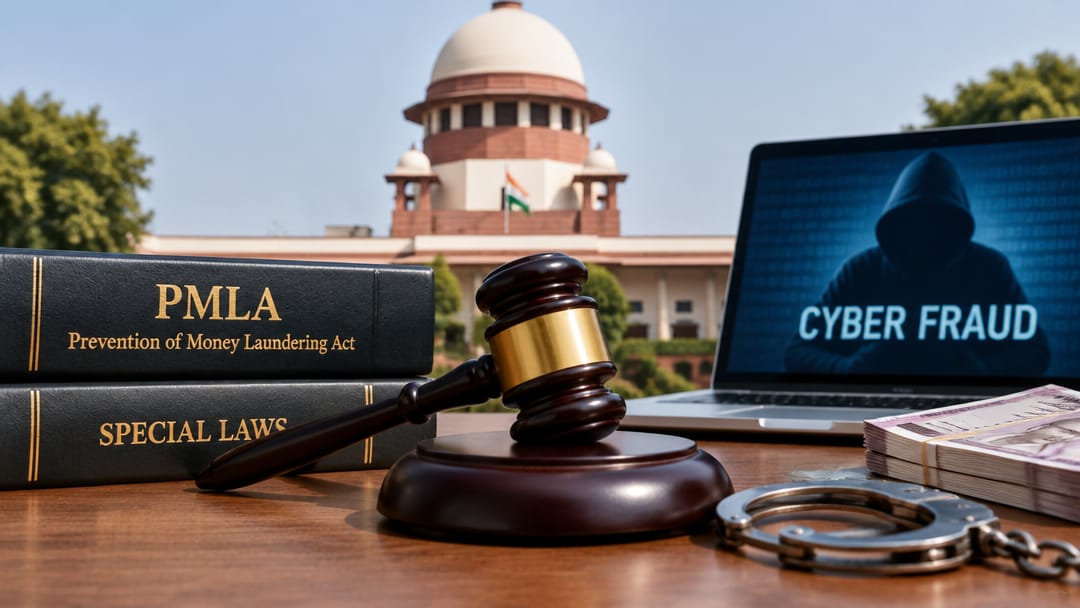
The Supreme Court upheld a High Court ruling rejecting an accused's plea for default bail in a CBI case involving large-scale cyber fraud. The Court affirmed that strict bail conditions under special statutes like the Prevention of Money Laundering Act apply, and that the twin conditions for bail must be satisfied even when investigating agencies miss statutory deadlines. The ruling clarifies that default bail rights are not automatic when PMLA or allied special laws govern the offence.
Why it matters
Default bail, also called statutory bail, arises under Section 167(2) CrPC (now Section 187 BNSS) when an investigating agency fails to file a chargesheet within the prescribed period: 60 days for most offences, 90 days for offences punishable with death, life imprisonment, or imprisonment of not less than 10 years. The accused's right to default bail is an indefeasible right that accrues the moment the deadline passes without a chargesheet being filed — unless the special law overrides it.
The complication in PMLA cases is that Section 167(2) CrPC must be read alongside Section 45 PMLA, which imposes the 'twin conditions' for bail: (1) the public prosecutor must be given an opportunity to oppose bail, and (2) the court must be satisfied that there are reasonable grounds to believe the accused is not guilty and is unlikely to commit any offence while on bail. The Supreme Court has consistently held in cases like Vijay Madanlal Choudhary v. Union of India (2022) that these twin conditions survive even in default bail scenarios under PMLA.
This ruling reinforces that default bail under PMLA is not purely mechanical. The accused cannot simply point to the calendar and walk free — the twin conditions act as a filtering layer. The examiner will test whether aspirants can distinguish the general CrPC default bail rule from the PMLA-modified version, and identify which section triggers which right.
Bail granted but still in jail: SC orders UP to audit undertrials across 55 districts
What happened
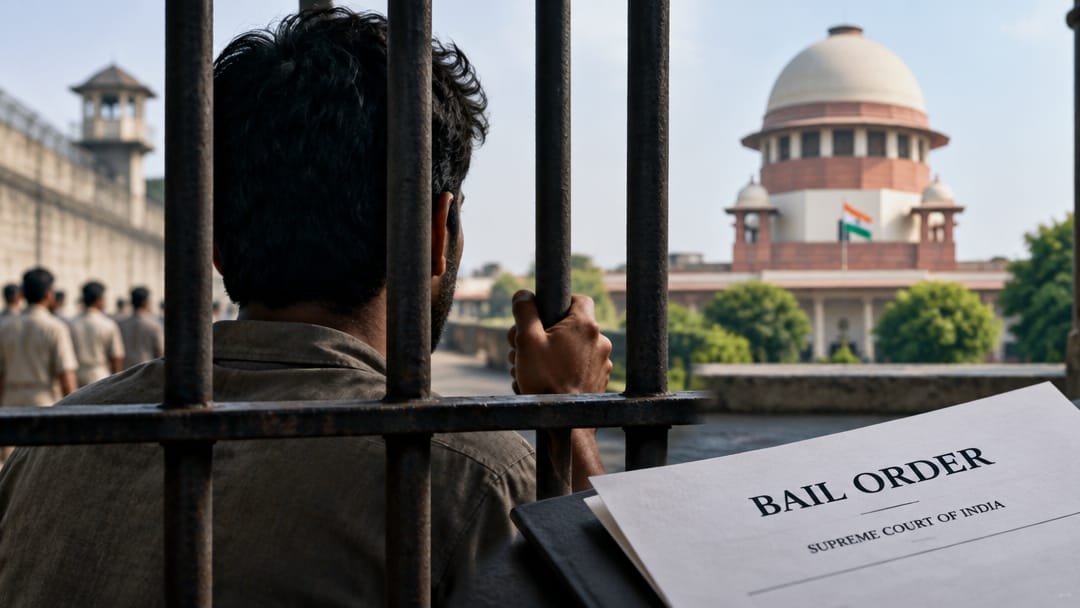
The Supreme Court has directed the Uttar Pradesh government to identify all undertrial prisoners across 55 districts who have been granted bail but remain in custody — typically because they cannot meet surety or other bail conditions. The order highlights a systemic failure where legal release has been ordered but physical release has not followed. The Court's intervention reflects its ongoing concern about personal liberty being denied despite judicial orders in UP's overcrowded prison system.
Why it matters
This Supreme Court direction addresses one of the most troubling gaps in India's criminal justice system: the difference between being legally entitled to bail and actually walking free. An undertrial is a person in custody awaiting trial — not yet convicted. Indian prisons hold a disproportionately large undertrial population; NCRB data consistently shows undertrials constitute over 75% of India's prison population.
Bail, under the Code of Criminal Procedure (CrPC) or the Bharatiya Nagarik Suraksha Sanhita (BNSS) 2023, is a right for bailable offences and a discretionary remedy for non-bailable ones. However, even after bail is granted, release is conditional on furnishing sureties and bail bonds. Poor undertrials — unable to arrange sureties — remain imprisoned despite court orders. This is precisely what the Supreme Court targeted in Hussainara Khatoon v. State of Bihar (1979), where it held that the right to speedy trial is a fundamental right under Article 21, and that prolonged undertrial detention without trial violates personal liberty.
Section 436A CrPC (Section 479 BNSS) provides that an undertrial who has served half the maximum sentence for the offence can be released on personal bond. The Supreme Court has repeatedly directed its enforcement. This UP direction continues that line — it is supervisory jurisdiction to ensure executive compliance with judicial orders, rooted in Article 32 and Article 142 of the Constitution.
For CLAT PG, the examiner will test whether you can distinguish bail granted (court order) from bail executed (actual release), and identify the constitutional and statutory anchors — Article 21, Section 436A CrPC / Section 479 BNSS.
SC: compulsory retirement carries no stigma, even for a poor service record
What happened
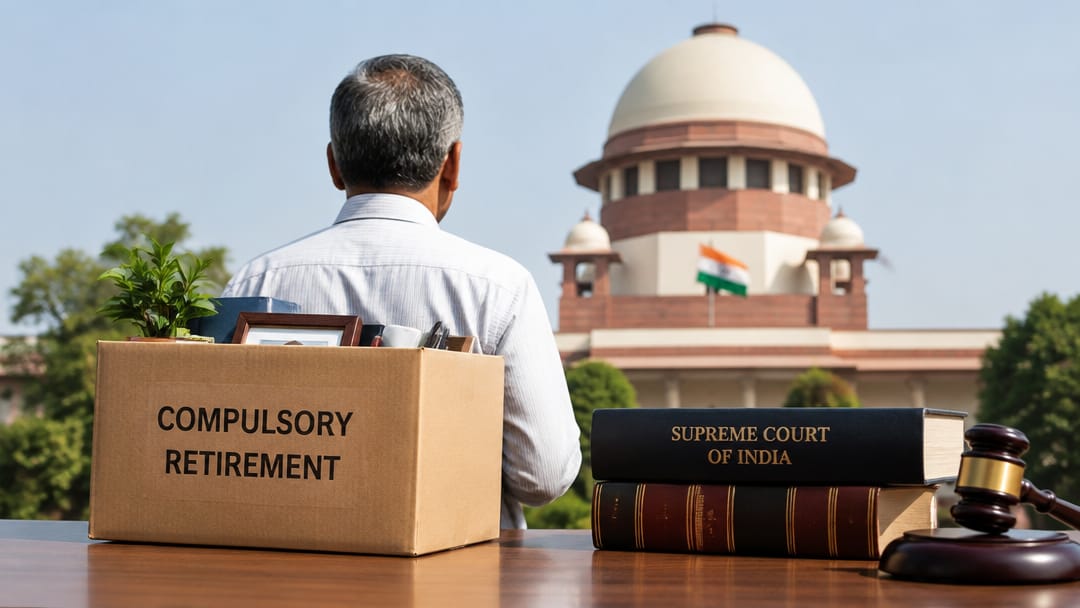
The Supreme Court upheld the compulsory retirement of two government clerks whose service records showed consistently poor performance. The Court reaffirmed that compulsory retirement is not a punitive measure and carries no stigma, distinguishing it from dismissal or removal. Because it is an administrative action taken in public interest, the government enjoys wide amplitude in exercising this power. The order does not attract the procedural safeguards of Article 311 that protect against dismissal and removal from service.
Why it matters
Compulsory retirement sits at the intersection of service law and constitutional rights, particularly Articles 14, 16, and 311. The Supreme Court has consistently held — from Union of India v. J.N. Sinha (1970) onward — that compulsory retirement is neither dismissal nor removal and therefore does not attract the protection of Article 311(2), which mandates an inquiry before punishment. The rationale is that the action is taken in public interest to weed out inefficient officers, not to penalise them. The retiring employee retains full pensionary and retirement benefits, which is the key marker distinguishing it from punitive action.
The doctrine of 'wide amplitude' means courts will not ordinarily interfere with the subjective satisfaction of the competent authority unless there is mala fides, non-application of mind, or the order is a colourable exercise of power — i.e., using compulsory retirement as a disguised punishment when the real intent is punitive. Courts look at whether a stigma is explicitly cast in the order itself. If the language of the order merely says the government is not satisfied with continued service and no misconduct is found or recorded, it passes constitutional muster.
The Fundamental Service Rule (FR 56(j)) and analogous state rules empower the government to retire an employee after they complete 50 years of age or 25 years of qualifying service. The review must be bona fide, based on the entire service record, and not on a solitary incident. This ruling reinforces that judicial review in such cases is of a limited, supervisory nature.