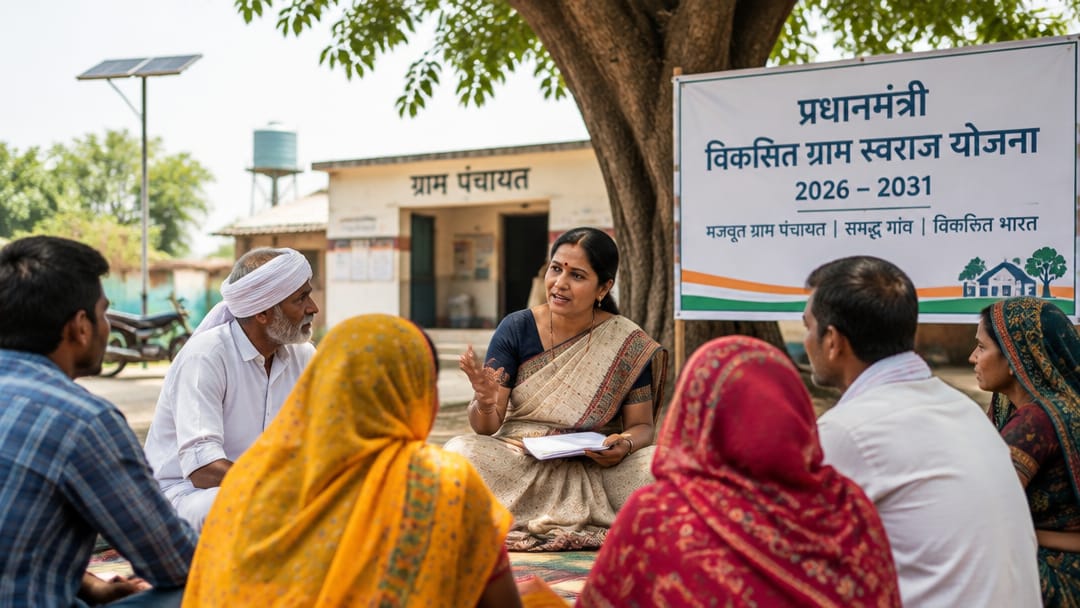
Cabinet approves PM Viksit Gram Swaraj Yojana as a Centrally Sponsored Scheme for 2026–31
What happened
The Union Cabinet approved Pradhan Mantri Viksit Gram Swaraj Yojana as a Centrally Sponsored Scheme covering the period 2026-27 to 2030-31. Announced on 28 October 2026, the scheme targets strengthening rural governance and village-level development aligned with the Viksit Bharat vision. It represents a structured five-year commitment to gram panchayat empowerment, extending the Centre's focus on decentralised rural planning, infrastructure, and service delivery across India's villages.
Why it matters
Pradhan Mantri Viksit Gram Swaraj Yojana (PM-VGSY) is a Centrally Sponsored Scheme (CSS), meaning costs are shared between the Centre and states in a defined ratio, unlike Central Sector Schemes funded entirely by the Centre. This distinction is a frequent examiner test point.
The scheme fits within India's broader Viksit Bharat 2047 framework, which aims at transforming India into a developed nation by its centenary of independence. At the village level, this connects to Constitutional provisions under Part IX (Panchayati Raj, Articles 243–243O), particularly the 73rd Amendment's mandate for gram panchayats to plan and implement schemes for economic development.
For NABARD and RBI aspirants, the rural finance angle is critical: strengthened gram panchayats improve last-mile credit delivery, priority sector lending outcomes, and self-help group linkages. NABARD's Rural Infrastructure Development Fund (RIDF) and its gram panchayat credit linkage programmes operate more effectively when local governance is robust.
For UPSC aspirants, the scheme tests understanding of Centre-state fiscal federalism, the role of the Finance Commission in devolution, and the difference between tied and untied grants to panchayats. The five-year tenure (2026-27 to 2030-31) aligns with post-16th Finance Commission planning horizons, making it a live governance case study in decentralisation.
The scheme fits within India's broader Viksit Bharat 2047 framework, which aims at transforming India into a developed nation by its centenary of independence. At the village level, this connects to Constitutional provisions under Part IX (Panchayati Raj, Articles 243–243O), particularly the 73rd Amendment's mandate for gram panchayats to plan and implement schemes for economic development.
For NABARD and RBI aspirants, the rural finance angle is critical: strengthened gram panchayats improve last-mile credit delivery, priority sector lending outcomes, and self-help group linkages. NABARD's Rural Infrastructure Development Fund (RIDF) and its gram panchayat credit linkage programmes operate more effectively when local governance is robust.
For UPSC aspirants, the scheme tests understanding of Centre-state fiscal federalism, the role of the Finance Commission in devolution, and the difference between tied and untied grants to panchayats. The five-year tenure (2026-27 to 2030-31) aligns with post-16th Finance Commission planning horizons, making it a live governance case study in decentralisation.
🔒
Key figure and date from this topic
Specific number or threshold to remember
Policy or regulatory implication