SEBI clears MakeMyTrip India IPO: a Nasdaq-listed parent seeks a domestic listing
What happened
SEBI has approved the draft red herring prospectus for MakeMyTrip India, the domestic arm of the Nasdaq-listed MakeMyTrip group, clearing the way for its Indian stock market debut. The proposed IPO involves listing the India-incorporated entity separately from its Mauritius-based parent, which trades on Nasdaq. The structure allows Indian retail investors to participate in the travel platform's growth, while the parent retains its US listing. SEBI's observation letter grants regulatory clearance for the offer to proceed.
Why it matters
This event sits at the intersection of two important capital market concepts: the IPO approval process and the structural complexity of dual-listed corporate groups.
SEBI's Role in IPO Approval: Under the SEBI (Issue of Capital and Disclosure Requirements) Regulations, 2018 (ICDR Regulations), any company seeking a public issue of securities in India must file a Draft Red Herring Prospectus (DRHP) with SEBI. SEBI reviews the document for disclosures, pricing justification, use of proceeds, and related-party risks. SEBI issues an 'observation letter' — not an 'approval' in the strict sense — meaning it has no objections to the offer proceeding. This distinction is exam-relevant: SEBI does not guarantee the financial soundness of the issue.
The Structural Angle: MakeMyTrip Ltd (the parent) is incorporated in Mauritius and listed on Nasdaq. MakeMyTrip India Pvt. Ltd is the operational subsidiary domiciled in India. By listing the India arm separately via an IPO, the group creates a domestically listed entity that complies with Indian disclosure norms and allows FPIs, domestic institutions, and retail investors to hold Indian-domiciled shares. This is a common structure for tech companies that originally listed abroad to access global capital but now seek Indian capital market depth.
For SEBI aspirants, the key regulatory framework is the ICDR Regulations, 2018. For RBI Grade B aspirants, the significance lies in capital market regulation, investor protection norms, and the role of SEBI as the primary market regulator. UPSC aspirants should note SEBI's quasi-judicial, quasi-legislative, and executive functions.
Cabinet approves PM Viksit Gram Swaraj Yojana as a Centrally Sponsored Scheme for 2026–31
What happened
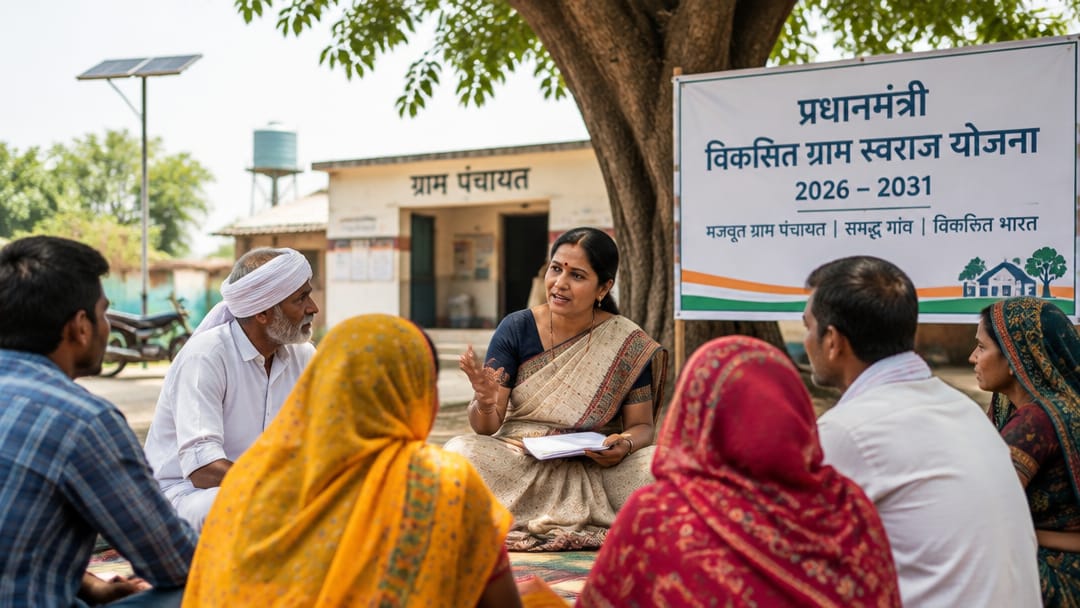
The Union Cabinet approved Pradhan Mantri Viksit Gram Swaraj Yojana as a Centrally Sponsored Scheme covering the period 2026-27 to 2030-31. Announced on 28 October 2026, the scheme targets strengthening rural governance and village-level development aligned with the Viksit Bharat vision. It represents a structured five-year commitment to gram panchayat empowerment, extending the Centre's focus on decentralised rural planning, infrastructure, and service delivery across India's villages.
Why it matters
Pradhan Mantri Viksit Gram Swaraj Yojana (PM-VGSY) is a Centrally Sponsored Scheme (CSS), meaning costs are shared between the Centre and states in a defined ratio, unlike Central Sector Schemes funded entirely by the Centre. This distinction is a frequent examiner test point.
The scheme fits within India's broader Viksit Bharat 2047 framework, which aims at transforming India into a developed nation by its centenary of independence. At the village level, this connects to Constitutional provisions under Part IX (Panchayati Raj, Articles 243–243O), particularly the 73rd Amendment's mandate for gram panchayats to plan and implement schemes for economic development.
For NABARD and RBI aspirants, the rural finance angle is critical: strengthened gram panchayats improve last-mile credit delivery, priority sector lending outcomes, and self-help group linkages. NABARD's Rural Infrastructure Development Fund (RIDF) and its gram panchayat credit linkage programmes operate more effectively when local governance is robust.
For UPSC aspirants, the scheme tests understanding of Centre-state fiscal federalism, the role of the Finance Commission in devolution, and the difference between tied and untied grants to panchayats. The five-year tenure (2026-27 to 2030-31) aligns with post-16th Finance Commission planning horizons, making it a live governance case study in decentralisation.
Green, social, and sustainability-linked bonds: the GSSS market explained
What happened
Environmental Finance's Sustainable Bonds Insight 2026 report maps global trends in green, social, sustainability, and sustainability-linked (GSSS) bonds. The free report uses infographics and data to track issuance patterns, sectoral shifts, and regulatory developments across the GSSS market. For Indian aspirants, it anchors concepts directly tested in exams: how labelled bonds are classified, who issues them, and how frameworks like SEBI's green bond guidelines and RBI's green finance circulars interact with international standards set by ICMA.
Why it matters
GSSS bonds are debt instruments whose proceeds or structural features are tied to environmental or social objectives. Each category has a distinct definition under the International Capital Market Association (ICMA) framework:
• Green bonds: proceeds exclusively for climate or environmental projects (renewable energy, clean transport, water management). • Social bonds: proceeds for projects with positive social outcomes (affordable housing, healthcare, food security). • Sustainability bonds: proceeds split between green and social projects. • Sustainability-linked bonds (SLBs): structurally linked to the issuer's ESG performance targets (KPIs); proceeds are general-purpose but the coupon adjusts if targets are missed.
The critical distinction examiners exploit: green/social/sustainability bonds are use-of-proceeds instruments, while SLBs are KPI-linked instruments — a frequent statement-based trap.
In India, SEBI issued a framework for green bonds in 2023, aligning with ICMA principles and requiring listing on recognised exchanges. RBI has encouraged banks to issue green bonds and integrate climate risk into their supervisory frameworks. NABARD operates the National Adaptation Fund for Climate Change (NAFCC) and issues green bonds to fund rural climate-resilient infrastructure.
The global GSSS market has grown to exceed $5 trillion in cumulative issuance. Sovereign green bonds have become a key instrument — India issued its first Sovereign Green Bond in January 2023, raising ₹8,000 crore, with proceeds earmarked for the Green Finance Framework sectors.
For exam purposes: know the ICMA taxonomy, the difference between use-of-proceeds vs KPI-linked structures, India's sovereign green bond timeline, and SEBI/RBI roles.
Bail granted but still in jail: SC orders UP to audit undertrials across 55 districts
What happened
The Supreme Court has directed the Uttar Pradesh government to identify all undertrial prisoners across 55 districts who have been granted bail but remain in custody — typically because they cannot meet surety or other bail conditions. The order highlights a systemic failure where legal release has been ordered but physical release has not followed. The Court's intervention reflects its ongoing concern about personal liberty being denied despite judicial orders in UP's overcrowded prison system.
Why it matters
This Supreme Court direction addresses one of the most troubling gaps in India's criminal justice system: the difference between being legally entitled to bail and actually walking free. An undertrial is a person in custody awaiting trial — not yet convicted. Indian prisons hold a disproportionately large undertrial population; NCRB data consistently shows undertrials constitute over 75% of India's prison population.
Bail, under the Code of Criminal Procedure (CrPC) or the Bharatiya Nagarik Suraksha Sanhita (BNSS) 2023, is a right for bailable offences and a discretionary remedy for non-bailable ones. However, even after bail is granted, release is conditional on furnishing sureties and bail bonds. Poor undertrials — unable to arrange sureties — remain imprisoned despite court orders. This is precisely what the Supreme Court targeted in Hussainara Khatoon v. State of Bihar (1979), where it held that the right to speedy trial is a fundamental right under Article 21, and that prolonged undertrial detention without trial violates personal liberty.
Section 436A CrPC (Section 479 BNSS) provides that an undertrial who has served half the maximum sentence for the offence can be released on personal bond. The Supreme Court has repeatedly directed its enforcement. This UP direction continues that line — it is supervisory jurisdiction to ensure executive compliance with judicial orders, rooted in Article 32 and Article 142 of the Constitution.
For CLAT PG, the examiner will test whether you can distinguish bail granted (court order) from bail executed (actual release), and identify the constitutional and statutory anchors — Article 21, Section 436A CrPC / Section 479 BNSS.