Parliament amends MSMED Act in 2026, revising MSME classification thresholds
What happened
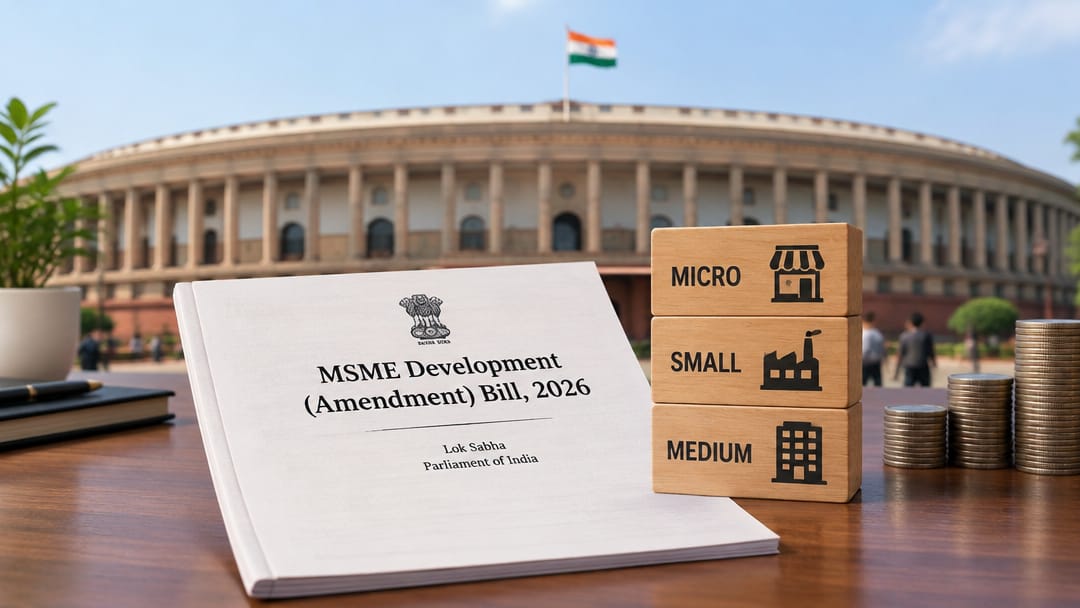
Parliament passed the MSME Development (Amendment) Bill, 2026 in August 2026, updating the MSMED Act of 2006. The amendment revises investment and turnover thresholds used to classify micro, small, and medium enterprises, reflecting inflation and business growth since the last major revision in 2020. The changes are intended to widen formal credit access, improve priority sector lending coverage, and bring more enterprises within the ambit of legal protections under the MSMED Act.
Why it matters
The MSMED Act, 2006 is the foundational legislation governing India's MSME sector, which contributes roughly 30% of GDP, over 45% of exports, and employs more than 11 crore people. The Act defines MSMEs by two criteria — investment in plant and machinery/equipment and annual turnover — and these definitions determine eligibility for priority sector lending, government procurement quotas, credit guarantee schemes, and delayed payment protections under Section 15–23 of the Act.
The last major revision of thresholds came via the Aatmanirbhar Bharat package in May 2020, which introduced turnover as a second criterion alongside investment and significantly raised limits (e.g., medium enterprises: investment up to ₹50 crore, turnover up to ₹250 crore). The 2026 amendment builds on this by further revising these ceilings upward to prevent 'threshold-linked graduation' — where growing businesses lose MSME status and associated benefits abruptly.
For RBI aspirants, the amendment directly affects Priority Sector Lending (PSL) targets: banks must lend 7.5% of ATNCR to micro enterprises and 40% overall to PSL. Wider MSME classification means more borrowers qualify, affecting how banks meet PSL targets and how the Credit Guarantee Fund Trust for Micro and Small Enterprises (CGTMSE) operates. For NABARD aspirants, rural MSMEs and agro-processing units gaining upgraded status can access better credit lines. The amendment also strengthens the Micro and Small Enterprises Facilitation Councils (MSEFCs) for faster dispute resolution on delayed payments.
RBI repo rate cut to 6% in 2025: how the LAF corridor and reserve ratios work
What happened
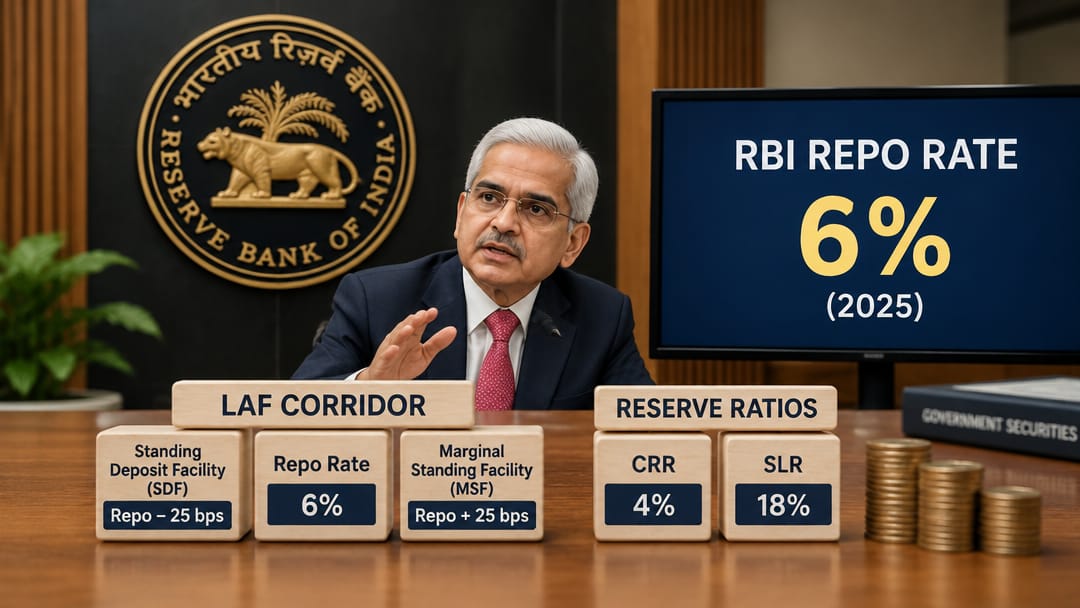
The RBI's Monetary Policy Committee cut the repo rate to 6% in 2025, continuing an accommodative shift. The repo rate — at which RBI lends overnight to commercial banks against government securities — anchors the LAF corridor. The Standing Deposit Facility sits 25 basis points below repo; the Marginal Standing Facility sits 25 basis points above. CRR remains at 4% and SLR at 18%, together shaping how much credit banks can extend into the economy.
Why it matters
India's monetary policy operates through a layered transmission mechanism. At its centre is the repo rate — the RBI's primary policy signal. When the MPC changes this rate, it cascades through the financial system: banks adjust their cost of funds, which flows into lending rates (EBLR/MCLR), which influences credit demand, investment, consumption, and ultimately inflation and GDP growth.
The Liquidity Adjustment Facility (LAF) corridor is the operational architecture around the repo rate. The Standing Deposit Facility (SDF) rate forms the floor — banks park surplus funds with RBI at this rate. The Marginal Standing Facility (MSF) rate forms the ceiling — banks borrow emergency overnight funds from RBI at this rate. The repo rate sits in the middle. This corridor prevents overnight rates from drifting far from the policy signal.
Reserve ratios work differently. The Cash Reserve Ratio (CRR) requires banks to hold a percentage of their Net Demand and Time Liabilities (NDTL) as cash with RBI — earning no interest. The Statutory Liquidity Ratio (SLR) requires them to hold an additional percentage in approved liquid assets (government securities, cash, gold). CRR directly controls money supply; SLR ensures banks hold safe assets and also finances government borrowing.
For NABARD, the repo rate affects refinancing costs: when repo falls, NABARD's borrowing cost from RBI falls, allowing cheaper agricultural credit to cooperative banks and RRBs. This is the exam-relevant transmission chain aspirants must map end-to-end.
India's 18 UNESCO-recognised biosphere reserves span ecosystems from Himalayan snow leopard habitat to Lakshadweep coral reefs. In the Nilgiri Biosphere Reserve, an invasive shrub is being converted into elephant sculptures, furniture, and handicrafts, linking conservation with local livelihoods. This model illustrates the core biosphere reserve concept: a zonation system — core, buffer, and transition — where human activity is calibrated to ecological sensitivity, with communities in transition zones benefiting economically from sustainable resource use.
Why it matters
Biosphere reserves are UNESCO designations under the Man and Biosphere (MAB) Programme, not legally protected areas under Indian wildlife law. This distinction is exam-critical: a biosphere reserve can overlap with a national park or wildlife sanctuary, but the designation itself comes from UNESCO, not the Wildlife Protection Act. India currently has 18 UNESCO-recognised biosphere reserves (out of 759 globally as of 2024).
The three-zone model is the structural heart of a biosphere reserve. The core zone has the strictest protection — no human habitation or extraction. The buffer zone allows limited research and education. The transition (cooperation) zone, also called the zone of cooperation, permits sustainable human activity including settlements, tourism, and resource use. The Nilgiri example — converting an invasive shrub into handicrafts — is precisely the kind of activity the transition zone is designed to enable.
The Nilgiri Biosphere Reserve (Tamil Nadu, Kerala, Karnataka) was India's first biosphere reserve, established in 1986, and was recognised by UNESCO in 2000. It hosts the Nilgiri tahr, Asian elephant, Bengal tiger, and several tribal communities including the Todas and Irulas.
For NABARD aspirants, the livelihood angle is key: biosphere reserves underpin rural ecological economies, and green financing instruments (like NABARD's Climate Change Fund) can support community-based conservation enterprises. For UPSC, the examiner typically tests the number of UNESCO-recognised reserves, the first reserve, and the three-zone structure.
Monsoon-dependent kharif crops: how rainfall variance drives India's food policy
What happened
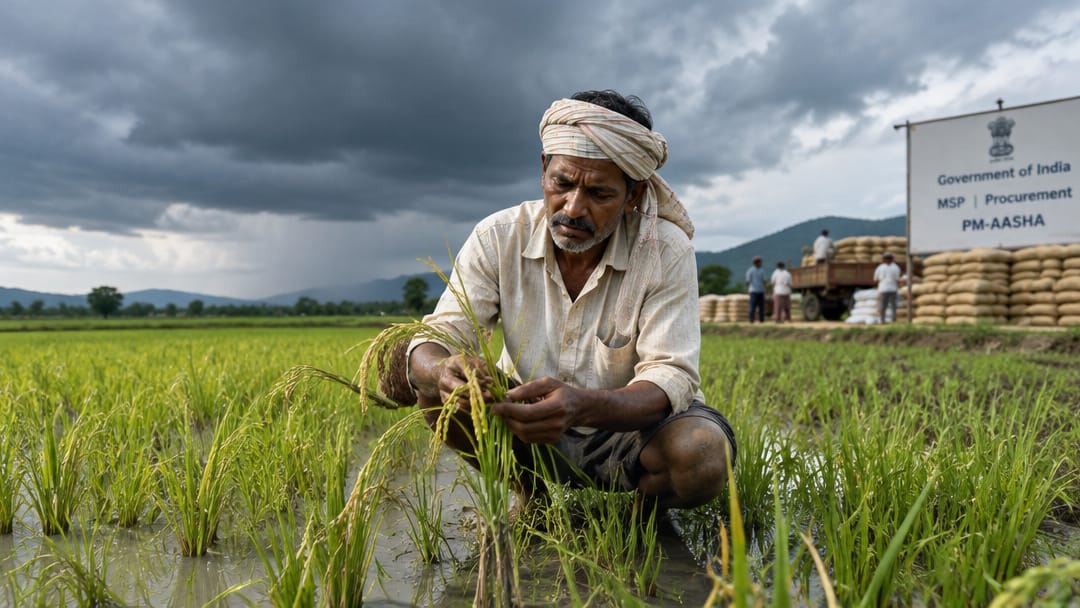
India's kharif season, anchored by rice and coarse cereals, is overwhelmingly dependent on the southwest monsoon. Erratic rainfall directly compresses yields, triggering government responses ranging from MSP revisions to procurement adjustments under schemes like PM-AASHA. UPSC PYQs from 1979 to 2025 show persistent testing of this monsoon-agriculture-policy linkage, making it a durable static foundation that connects crop science, food security architecture, and rural credit mechanisms in a single analytical thread.
Why it matters
India receives roughly 70–90% of its annual rainfall during the southwest monsoon (June–September), making kharif crops — rice, maize, jowar, bajra, cotton, and soybean — structurally vulnerable to monsoon variability. A deficient monsoon reduces sown area and yield simultaneously, pushing food inflation and stressing rural incomes.
The policy response operates on multiple levels. At the price level, the Commission for Agricultural Costs and Prices (CACP) recommends Minimum Support Prices (MSPs) for 23 crops annually, with the government committing since 2018 to fix MSP at 1.5× the cost of production (A2+FL cost basis). At the procurement level, Food Corporation of India (FCI) and state agencies undertake procurement to maintain buffer stocks — the buffer stock norms are set by the government and are distinct from actual stock levels.
For credit, NABARD refinances short-term crop loans through Regional Rural Banks and cooperative banks. Kisan Credit Card (KCC) scheme provides revolving credit for crop cultivation, post-harvest expenses, and allied activities. Interest subvention of 1.5% is provided to lending institutions, making effective interest 7% per annum for prompt repayers (further subvention brings it to 4%).
The Pradhan Mantri Fasal Bima Yojana (PMFBY), launched in 2016, is the flagship crop insurance scheme — premium is capped at 2% for kharif crops, 1.5% for rabi crops, and 5% for annual commercial/horticultural crops, with the government bearing the actuarial premium balance. Understanding this layered architecture — from rainfall to MSP to credit to insurance — is exactly what examiners test across UPSC and NABARD papers.
ZSI Andaman centre holds training on coastal and marine biodiversity
What happened
The Zoological Survey of India's Andaman and Nicobar Regional Centre concluded a three-day training workshop on coastal and marine biodiversity of island ecosystems at Sri Vijaya Puram in November 2026. The workshop focused on the unique ecological character of the Andaman and Nicobar Islands, covering coral reefs, seagrass beds, mangroves, and endemic fauna. ZSI is the nodal body under the Ministry of Environment, Forest and Climate Change responsible for surveying and documenting India's faunal biodiversity.
Why it matters
The Zoological Survey of India (ZSI), established in 1916, functions under the Ministry of Environment, Forest and Climate Change (MoEFCC) and is India's premier institution for faunal survey and documentation. Its Andaman and Nicobar Regional Centre (ANRC) at Sri Vijaya Puram (formerly Port Blair) covers one of the world's most ecologically sensitive island ecosystems.
The Andaman and Nicobar Islands sit within the Indo-Burma Biodiversity Hotspot — one of 36 globally recognised biodiversity hotspots defined by Conservation International. These islands host extraordinary endemism: species found nowhere else on Earth, including the Andaman wild pig, Nicobar megapode, and numerous endemic reptiles and marine invertebrates.
The marine dimension is equally critical. The islands contain some of India's healthiest coral reef systems, seagrass meadows (critical dugong habitat), and mangrove forests — all of which are classified as threatened ecosystems under various international frameworks including IUCN and the Convention on Biological Diversity (CBD). India's coral reefs are protected under the Wildlife Protection Act, 1972, and the islands' waters fall under the jurisdiction of the Andaman and Nicobar Islands Forest and Plantation Development Corporation.
For exam purposes, the key static facts are: ZSI's parent ministry, its founding year, the biodiversity hotspot classification of these islands, and the ecological services provided by the marine habitats covered in the workshop — coral reefs, mangroves, and seagrass beds.