CrPC replaced: how BNSS 2023 rewrites arrest, bail, and trial rules
What happened
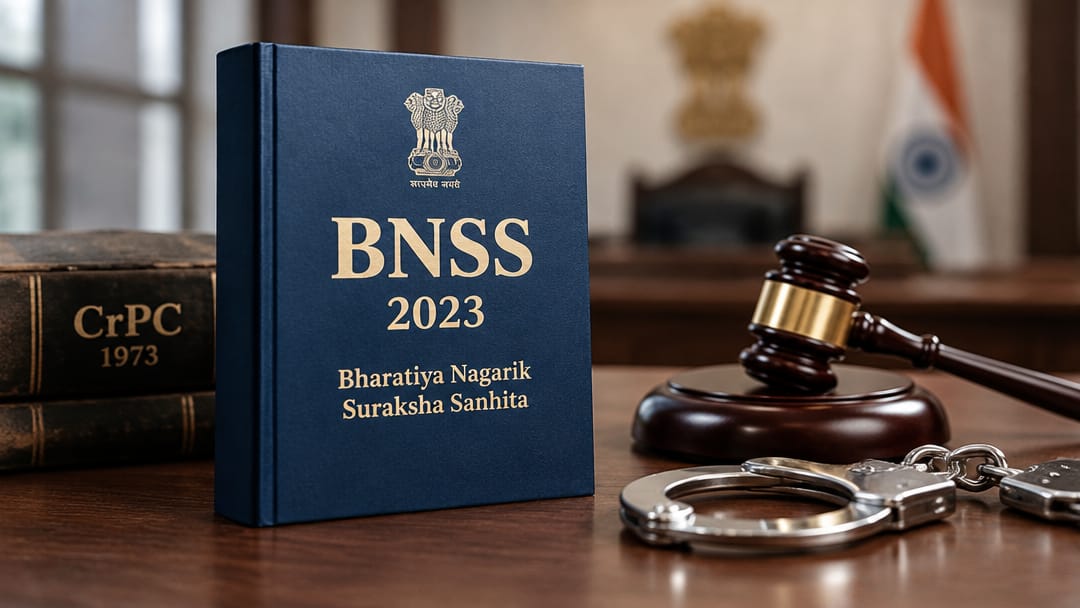
The Bharatiya Nagarik Suraksha Sanhita, 2023 replaced the Code of Criminal Procedure, 1973 with effect from 1 July 2024. It retains the structural framework of the CrPC but renumbers sections, introduces mandatory timelines for trials, expands electronic processes, and modifies bail provisions including for undertrial prisoners. The BNSS applies across India and governs arrest, remand, bail, charge, trial, judgment, and appeal — the full procedural lifecycle of a criminal case.
Why it matters
The BNSS 2023 is not merely a recodification — it is a substantive procedural reform that every criminal law practitioner and CLAT PG aspirant must map carefully against the old CrPC.
Key structural changes:
1. Section renumbering: Nearly every CrPC section has a new BNSS equivalent. For example, CrPC Section 41 (arrest without warrant) corresponds to BNSS Section 35; CrPC Section 167 (remand) maps to BNSS Section 187; CrPC Section 437 (bail in bailable offences) maps to BNSS Section 479.
2. Undertrial bail reform (BNSS Section 479): An undertrial who has served half the maximum sentence for the offence is entitled to bail — a relaxation from the CrPC regime. First-time offenders get this right after serving one-third.
3. Handcuffing permitted: BNSS Section 43(3) explicitly permits handcuffing in specified circumstances, reversing the judicial reluctance under the CrPC.
4. Electronic processes: FIRs, summons, and warrants can now be served electronically.
5. Zero FIR: Codified under BNSS — a complaint can be filed at any police station regardless of jurisdiction.
6. Trial timelines: Judgments must be delivered within 45 days of completion of arguments; charges must be framed within 60 days of first hearing.
For CLAT PG, the examiner will present a passage from a Supreme Court ruling decided under the CrPC and ask the aspirant to apply the principle — which survives unchanged — to a fact pattern. Knowing which BNSS section now governs the same subject is the satellite fact the passage will not supply.
SC approved Witness Protection Scheme in 2018, now codified under BNSS
What happened
The Supreme Court approved India's first Witness Protection Scheme on December 5, 2018, in Mahender Chawla v. Union of India, treating it as law until Parliament legislated. The Bharatiya Nagarik Suraksha Sanhita (BNSS) 2023 later codified witness protection provisions, replacing the CrPC framework. The scheme creates three threat categories and mandates a Witness Protection Fund, with the State Legal Services Authority overseeing applications. This marks the shift from judicial direction to statutory protection.
Why it matters
Before 2018, India had no statutory witness protection framework despite chronic problems of witness tampering, intimidation, and hostile witnesses derailing prosecutions. The Supreme Court in Mahender Chawla v. Union of India (2018) filled this gap by approving a model Witness Protection Scheme and declaring it binding under Articles 21 and 141 of the Constitution, holding that the right to a fair trial necessarily includes protection of witnesses.
The scheme classifies witnesses into three threat categories: Category A (threat to life), Category B (threat to safety or property), and Category C (threat to reputation or livelihood). Based on this, a Threat Analysis Report is prepared by the police, and the competent authority — the District and Sessions Judge — decides the protection measure.
Protection measures range from identity concealment and in-camera proceedings to relocation, voice and face distortion during testimony, and use of special courts. Applications are made to the State Witness Protection Fund Authority.
When the BNSS replaced the CrPC in 2023, it incorporated witness-related protections more formally into the statutory scheme. BNSS Section 398 deals with the power to tender a pardon to witnesses, while provisions on hostile witnesses and in-camera proceedings are carried forward with modifications.
For CLAT PG, the critical exam angle is: the constitutional basis (Articles 21 and 141), the case name (Mahender Chawla), the three threat categories, and the competent authority structure. Examiners test whether aspirants can apply the scheme's principles to hypothetical fact patterns involving witness intimidation.
SC upholds arrest without prior notice in AP liquor scam probe
What happened
The Supreme Court validated the arrest procedure used by Andhra Pradesh investigators in a liquor scam case, holding that prior notice before arrest is not constitutionally mandatory when the arresting authority has reasonable grounds to believe the person may abscond or obstruct the investigation. The ruling reaffirms that personal liberty under Article 21 must be balanced against legitimate state interest in effective criminal investigation, provided procedural safeguards under the CrPC are observed.
Why it matters
This ruling engages the central tension in Indian constitutional law between Article 21 (right to life and personal liberty) and the state's power to arrest. The Supreme Court has consistently held since Maneka Gandhi v. Union of India (1978) that any procedure depriving a person of liberty must be fair, just, and reasonable — not merely formally prescribed by law. However, the Court has never held that advance notice is a constitutional precondition to arrest.
The governing framework draws from D.K. Basu v. State of West Bengal (1997), which laid down eleven binding guidelines for arrest and detention (identification memo, arrest memo, right to inform a relative, medical examination, etc.) without requiring pre-arrest notice. Joginder Kumar v. State of UP (1994) added that arrest must be justified by necessity, not mere power.
In the liquor investigation context, the Court applied the proportionality test: the limitation on liberty is valid if (i) it is backed by law, (ii) it pursues a legitimate state aim, and (iii) the means are proportionate to that aim. The absence of prior notice does not violate Article 21 when the investigation involves economic offences where flight risk and evidence destruction are real concerns. This is consistent with Arnesh Kumar v. State of Bihar (2014), which restricted mechanical arrests but did not require prior notice. The ruling reconfirms that procedural validity, not advance notice, is the constitutional benchmark.
Bombay HC: arrest under NDPS Act void if only a seizure panchanama was served
What happened
The Bombay High Court has held that serving a seizure panchanama on an accused at the time of arrest does not satisfy the mandatory requirement under the Narcotic Drugs and Psychotropic Substances Act to inform the accused of the grounds of arrest. The court ruled the arrest invalid because the panchanama documents the seizure of contraband, not the reasons for detention, and cannot substitute the distinct statutory obligation to communicate grounds of arrest personally to the accused.
Why it matters
This ruling turns on Section 52A and the broader arrest framework under the NDPS Act, read alongside Article 22(1) of the Constitution, which guarantees every arrested person the right to be informed of the grounds of arrest 'as soon as may be.' The Bombay High Court drew a critical distinction between two documents that officers often treat as interchangeable in narcotics cases: the seizure panchanama and the grounds of arrest memo.
A seizure panchanama is a contemporaneous record of what was found, where, and in whose possession — it establishes the evidentiary chain of custody for the contraband. It is not addressed to the accused as an explanation of why they are being taken into custody. Grounds of arrest, by contrast, must tell the accused the specific reasons the law authorises their detention — which offence, which section, what conduct is alleged.
The Supreme Court in Pankaj Bansal v. Union of India (2023) had already raised the bar nationally by requiring written grounds of arrest to be furnished to the accused, a standard reinforced under Section 47 BNSS 2023. The Bombay HC's ruling extends that logic specifically to NDPS cases: handing over a panchanama is a seizure formality, not an arrest communication. An arrest made without communicating proper grounds is constitutionally void under Article 22(1) and renders subsequent custody illegal.
For CLAT PG, the core principle is: each step in the arrest-custody chain has its own mandatory requirement, and satisfying one does not excuse non-compliance with another.
Bombay HC: victim's rights cannot be sacrificed for beneficial remission of woman convict
What happened
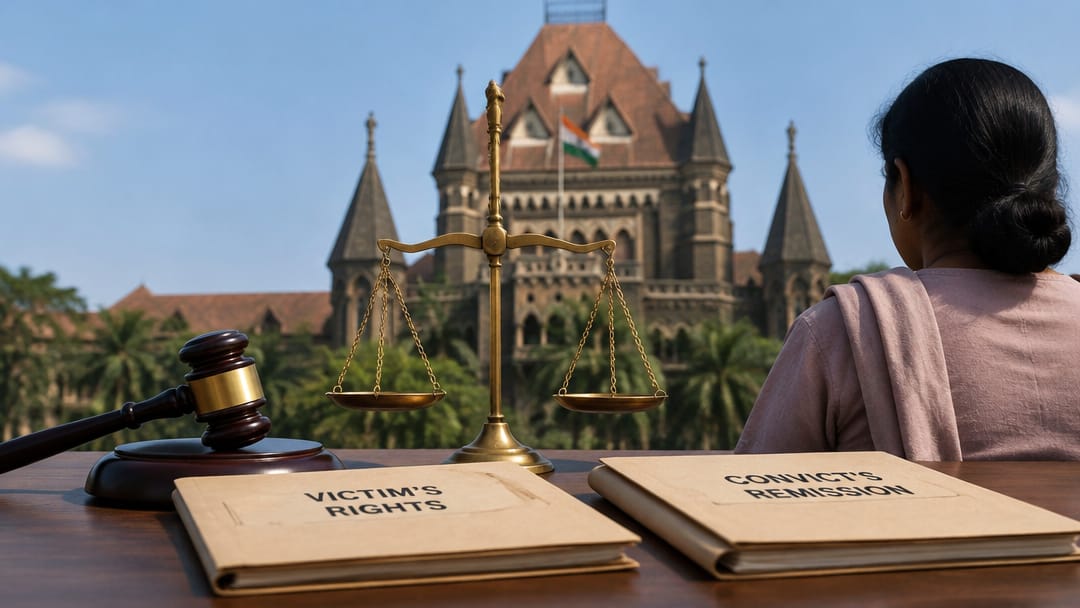
The Bombay High Court ruled that a woman convict cannot escape placement in a stricter remission category simply because a beneficial interpretation is possible. The Court held that the victim's case cannot be totally neglected, and beneficial interpretation must not become a route to erroneous interpretation. The ruling arose from a challenge to the categorisation of a woman convict under a stricter remission policy, balancing the convict's rights against the victim's legitimate interest in the criminal justice process.
Why it matters
Remission of sentence is the reduction of a prison term without changing its character, granted under Articles 72 and 161 of the Constitution (presidential and gubernatorial powers) and Sections 432–433A of the CrPC (now Sections 473–474 BNSS). Courts have consistently held that remission is not a right but a privilege, and that the state must follow a policy that is non-arbitrary and non-discriminatory under Article 14.
The Bombay HC ruling introduces a critical doctrinal nuance: beneficial interpretation, a canon of construction that favours the accused or convict, cannot override the victim's legitimate stake in the criminal justice outcome. This aligns with the Supreme Court's evolving jurisprudence recognising victims as stakeholders — seen in Nipun Saxena v. Union of India (2019) on victim privacy, and the broader movement under Section 357A CrPC for victim compensation.
The specific issue here — categorisation of a woman convict under a stricter remission category — raises the intersection of Articles 14 (equality), 21 (personal liberty of the convict), and the state's remission policy. The court essentially held that gender-neutral or gender-specific remission categories must still pass the rationality test, and cannot be relaxed in a manner that ignores victims' interests. For CLAT PG, this tests the triangle of remission power, beneficial interpretation limits, and victim rights — all live doctrinal flashpoints.