MPC hikes repo rate to 5.50% in October 2026, reversing the December 2025 cut
What happened
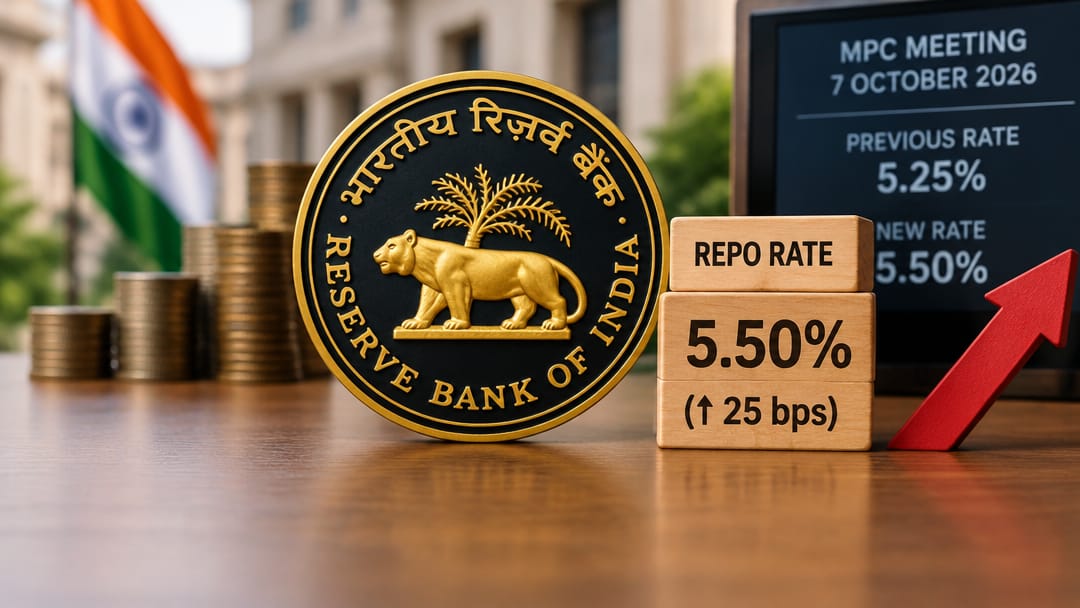
On 7 October 2026, the RBI's Monetary Policy Committee raised the repo rate by 25 basis points to 5.50%, reversing the December 2025 cut to 5.25%. The hike signals a shift from growth support back to inflation control. The Standing Deposit Facility and Marginal Standing Facility rates were adjusted accordingly. Floating-rate borrowers face higher EMIs or longer tenures, while fixed deposit holders benefit from improved returns as banks reprice both lending and deposit rates upward.
Why it matters
The repo rate is the rate at which the RBI lends overnight funds to commercial banks under the Liquidity Adjustment Facility. It anchors the entire interest-rate structure in the economy. When the MPC raises it, the LAF corridor shifts: the Standing Deposit Facility rate (floor) and the Marginal Standing Facility rate (ceiling) move in lockstep, typically maintaining a symmetric 25-basis-point spread on each side of the repo rate.
Transmission to credit markets happens through two channels. External Benchmark Lending Rate-linked loans reprice almost immediately — banks are mandated to reset EBLR at least once every three months — meaning home and auto loan EMIs rise quickly. MCLR-linked loans reprice more slowly, as MCLR depends on the bank's own cost of funds.
On the macroeconomic side, rate hikes work by raising the cost of credit, which dampens consumption and investment demand, reducing inflationary pressure. This is the standard demand-side channel of monetary transmission. The RBI operates under a flexible inflation targeting framework, with a legislated target of 4% CPI inflation (tolerance band: 2%–6%). When inflation persistently trends toward or above the upper band, the MPC is mandated to act.
For UPSC aspirants, the key concept is the transmission mechanism and the inflation-targeting mandate under the RBI Act, 1934 (amended 2016). For RBI Grade B aspirants, the exact rate levels, LAF corridor structure, and vote-count conventions are exam-critical. For NABARD aspirants, repo rate changes affect NABARD's refinancing costs and therefore the interest rates on agricultural credit extended through RRBs and cooperative banks.
Parliament amends MSMED Act in 2026, revising MSME classification thresholds
What happened
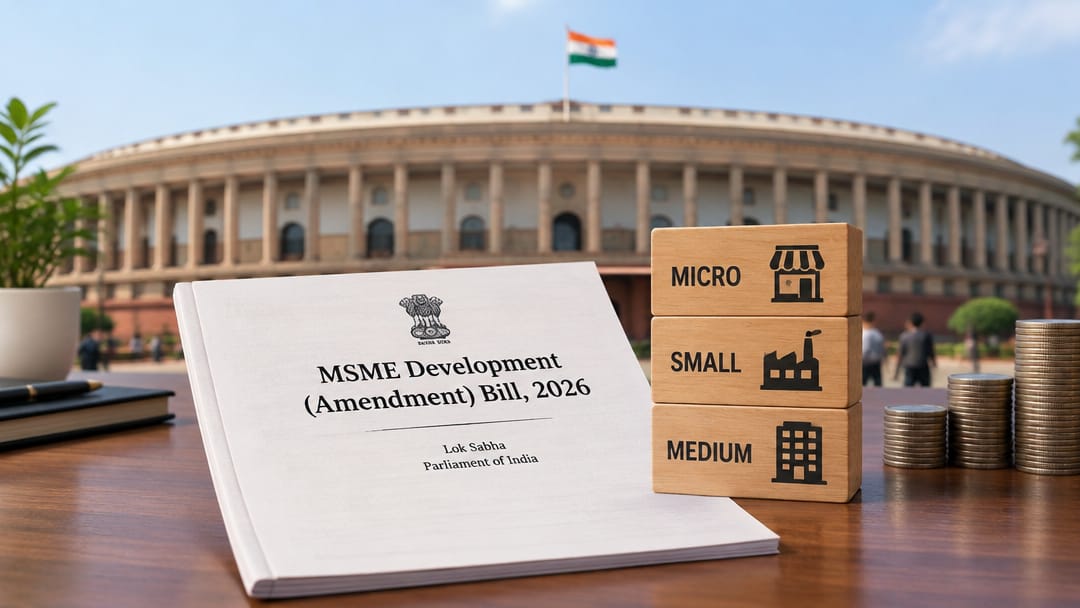
Parliament passed the MSME Development (Amendment) Bill, 2026 in August 2026, updating the MSMED Act of 2006. The amendment revises investment and turnover thresholds used to classify micro, small, and medium enterprises, reflecting inflation and business growth since the last major revision in 2020. The changes are intended to widen formal credit access, improve priority sector lending coverage, and bring more enterprises within the ambit of legal protections under the MSMED Act.
Why it matters
The MSMED Act, 2006 is the foundational legislation governing India's MSME sector, which contributes roughly 30% of GDP, over 45% of exports, and employs more than 11 crore people. The Act defines MSMEs by two criteria — investment in plant and machinery/equipment and annual turnover — and these definitions determine eligibility for priority sector lending, government procurement quotas, credit guarantee schemes, and delayed payment protections under Section 15–23 of the Act.
The last major revision of thresholds came via the Aatmanirbhar Bharat package in May 2020, which introduced turnover as a second criterion alongside investment and significantly raised limits (e.g., medium enterprises: investment up to ₹50 crore, turnover up to ₹250 crore). The 2026 amendment builds on this by further revising these ceilings upward to prevent 'threshold-linked graduation' — where growing businesses lose MSME status and associated benefits abruptly.
For RBI aspirants, the amendment directly affects Priority Sector Lending (PSL) targets: banks must lend 7.5% of ATNCR to micro enterprises and 40% overall to PSL. Wider MSME classification means more borrowers qualify, affecting how banks meet PSL targets and how the Credit Guarantee Fund Trust for Micro and Small Enterprises (CGTMSE) operates. For NABARD aspirants, rural MSMEs and agro-processing units gaining upgraded status can access better credit lines. The amendment also strengthens the Micro and Small Enterprises Facilitation Councils (MSEFCs) for faster dispute resolution on delayed payments.
RBI repo rate cut to 6% in 2025: how the LAF corridor and reserve ratios work
What happened
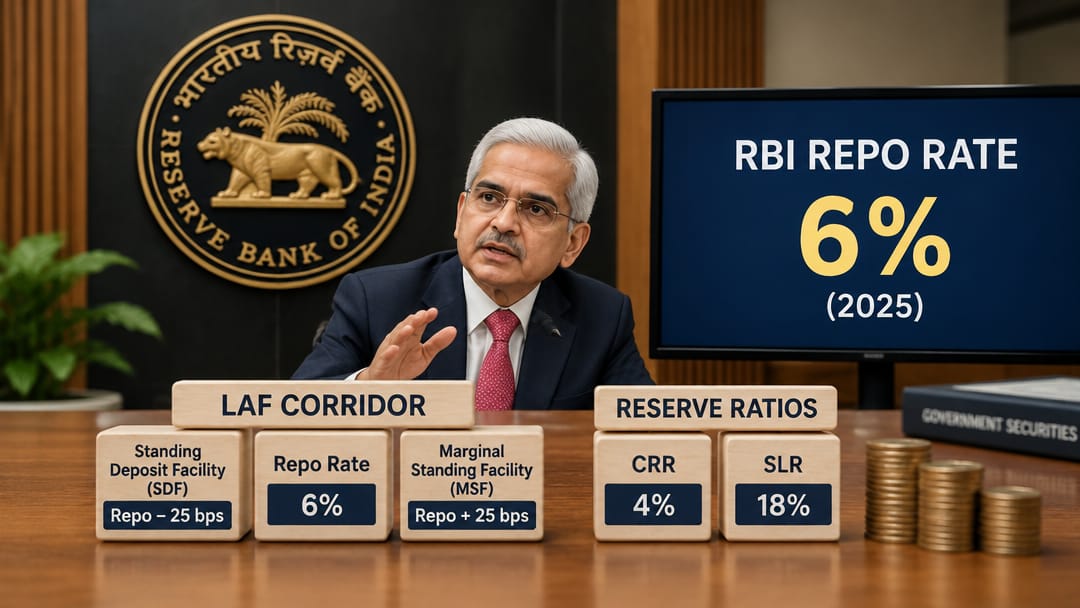
The RBI's Monetary Policy Committee cut the repo rate to 6% in 2025, continuing an accommodative shift. The repo rate — at which RBI lends overnight to commercial banks against government securities — anchors the LAF corridor. The Standing Deposit Facility sits 25 basis points below repo; the Marginal Standing Facility sits 25 basis points above. CRR remains at 4% and SLR at 18%, together shaping how much credit banks can extend into the economy.
Why it matters
India's monetary policy operates through a layered transmission mechanism. At its centre is the repo rate — the RBI's primary policy signal. When the MPC changes this rate, it cascades through the financial system: banks adjust their cost of funds, which flows into lending rates (EBLR/MCLR), which influences credit demand, investment, consumption, and ultimately inflation and GDP growth.
The Liquidity Adjustment Facility (LAF) corridor is the operational architecture around the repo rate. The Standing Deposit Facility (SDF) rate forms the floor — banks park surplus funds with RBI at this rate. The Marginal Standing Facility (MSF) rate forms the ceiling — banks borrow emergency overnight funds from RBI at this rate. The repo rate sits in the middle. This corridor prevents overnight rates from drifting far from the policy signal.
Reserve ratios work differently. The Cash Reserve Ratio (CRR) requires banks to hold a percentage of their Net Demand and Time Liabilities (NDTL) as cash with RBI — earning no interest. The Statutory Liquidity Ratio (SLR) requires them to hold an additional percentage in approved liquid assets (government securities, cash, gold). CRR directly controls money supply; SLR ensures banks hold safe assets and also finances government borrowing.
For NABARD, the repo rate affects refinancing costs: when repo falls, NABARD's borrowing cost from RBI falls, allowing cheaper agricultural credit to cooperative banks and RRBs. This is the exam-relevant transmission chain aspirants must map end-to-end.
Delhi AQI hits 382, triggering GRAP Stage-III construction ban across NCR
What happened
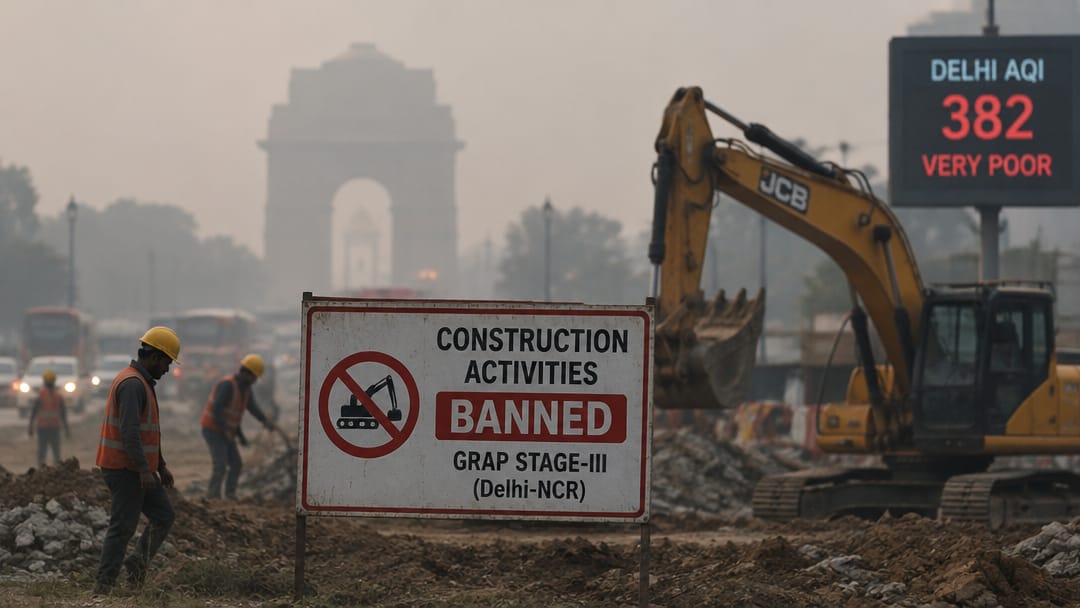
The Commission for Air Quality Management (CAQM) activated GRAP Stage-III across Delhi-NCR on November 6 after Delhi's Air Quality Index reached 382, placing it in the 'Very Poor' category. Stage-III restrictions ban most construction and demolition activities, limit entry of polluting vehicles, and intensify traffic management. The CAQM, a statutory body under a 2021 Act, holds authority to issue binding directions on air quality across Delhi and adjoining states.
Why it matters
GRAP — the Graded Response Action Plan — is a tiered emergency framework for managing air pollution in Delhi-NCR. It was notified by the Ministry of Environment, Forest and Climate Change (MoEFCC) and is now operationalised by CAQM. The four stages are triggered by AQI thresholds: Stage-I (Poor: 201–300), Stage-II (Very Poor: 301–400), Stage-III (Severe: 401–450), and Stage-IV (Severe+: above 450). Note: AQI 382 falls in the 'Very Poor' band, but CAQM can invoke higher stages pre-emptively based on forecast trajectory.
CACM was established under the Commission for Air Quality Management in National Capital Region and Adjoining Areas Act, 2021, replacing the earlier Environment Pollution (Prevention and Control) Authority (EPCA). It has statutory powers to direct state governments, local bodies, and industries — making its orders legally binding, unlike advisory committees.
Stage-III restrictions typically include: banning construction and demolition work (except essential services), stopping entry of BS-III petrol and BS-IV diesel vehicles, closing brick kilns and hot-mix plants, and deploying additional public transport. Stage-IV adds school closures and potential odd-even vehicle schemes.
For exam purposes, the key concept is the institutional shift from EPCA to CAQM, the legal basis of GRAP, the AQI classification scale (set by CPCB), and the specific triggers for each stage.