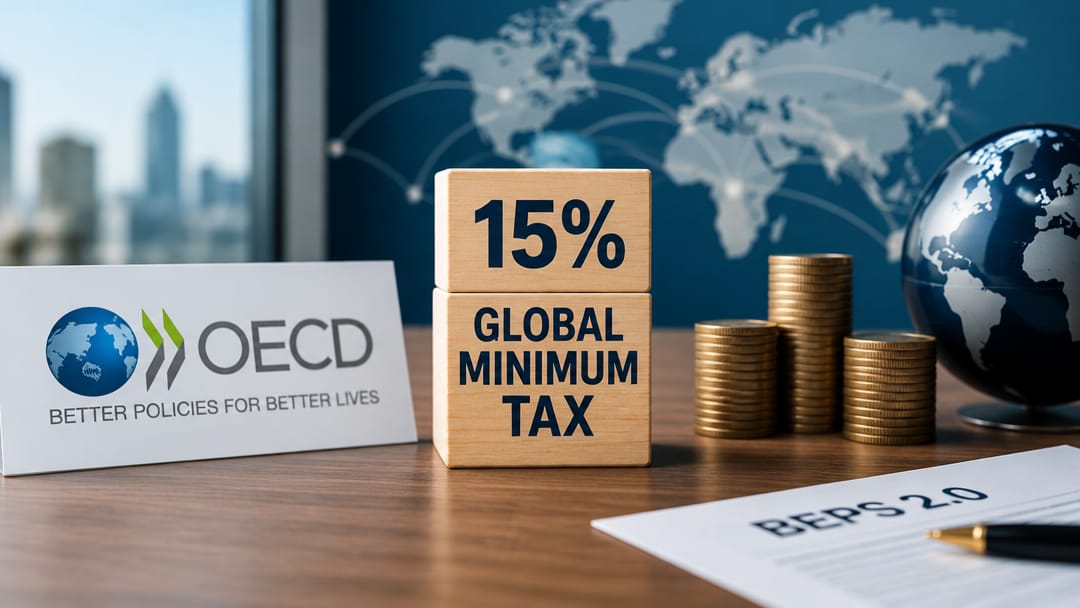
OECD sets a 15% global minimum tax floor for large multinationals
What happened
On 20 December 2021, the OECD/G20 Inclusive Framework released Model Global Anti-Base Erosion (GloBE) Rules under Pillar Two of BEPS 2.0. These rules establish a 15% global minimum corporate tax rate for multinational enterprises with annual revenues exceeding €750 million. Pillar One reallocates taxing rights to market jurisdictions. Together, the two pillars aim to curb profit-shifting to low-tax havens and ensure large corporations pay a minimum level of tax wherever they operate.
Why it matters
BEPS 2.0 is the OECD/G20 response to base erosion and profit shifting — the practice by which multinationals legally move profits to low-tax jurisdictions, reducing tax revenue for countries where actual economic activity occurs.
Pillar One addresses where tax is paid. It reallocates a portion of profits (Amount A) of the largest and most profitable multinationals (revenue >€20 billion, profitability >10%) to market jurisdictions — countries where consumers are located — regardless of physical presence. This is especially significant for digital economy companies like Google and Meta that generate revenue from a country without having a taxable presence there.
Pillar Two addresses how much tax is paid. The GloBE rules introduce an effective minimum tax rate of 15% via two interlocking domestic rules: the Income Inclusion Rule (IIR), where a parent company pays a top-up tax if a subsidiary is taxed below 15%, and the Undertaxed Profits Rule (UTPR), a backstop mechanism. A third rule — the Subject to Tax Rule (STTR) — applies to certain payments between related parties.
For India, BEPS 2.0 is significant on multiple fronts. India is a member of the Inclusive Framework, stands to gain from Pillar One's reallocation of digital profits, and has already enacted a Qualified Domestic Minimum Top-Up Tax (QDMTT) to retain revenue domestically. India's Equalisation Levy (digital tax) is expected to be withdrawn as part of the Pillar One deal. These dynamics sit at the intersection of international taxation, fiscal sovereignty, and G20 economic diplomacy — all high-frequency UPSC themes.
Pillar One addresses where tax is paid. It reallocates a portion of profits (Amount A) of the largest and most profitable multinationals (revenue >€20 billion, profitability >10%) to market jurisdictions — countries where consumers are located — regardless of physical presence. This is especially significant for digital economy companies like Google and Meta that generate revenue from a country without having a taxable presence there.
Pillar Two addresses how much tax is paid. The GloBE rules introduce an effective minimum tax rate of 15% via two interlocking domestic rules: the Income Inclusion Rule (IIR), where a parent company pays a top-up tax if a subsidiary is taxed below 15%, and the Undertaxed Profits Rule (UTPR), a backstop mechanism. A third rule — the Subject to Tax Rule (STTR) — applies to certain payments between related parties.
For India, BEPS 2.0 is significant on multiple fronts. India is a member of the Inclusive Framework, stands to gain from Pillar One's reallocation of digital profits, and has already enacted a Qualified Domestic Minimum Top-Up Tax (QDMTT) to retain revenue domestically. India's Equalisation Levy (digital tax) is expected to be withdrawn as part of the Pillar One deal. These dynamics sit at the intersection of international taxation, fiscal sovereignty, and G20 economic diplomacy — all high-frequency UPSC themes.
🔒
Key figure and date from this topic
Specific number or threshold to remember
Policy or regulatory implication