Article 19 freedoms are for citizens only — restrictions decide most cases
What happened
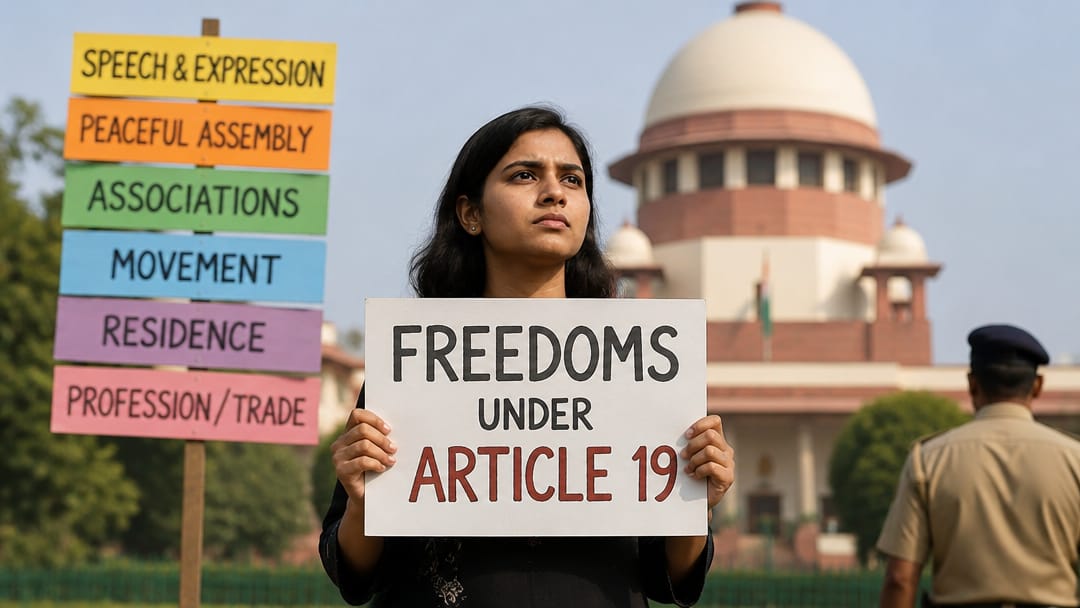
Article 19 of the Indian Constitution grants six fundamental freedoms to citizens: speech and expression, peaceful assembly, forming associations, free movement, residence, and profession or trade. Each freedom is immediately paired with a State power to impose reasonable restrictions under Articles 19(2) to 19(6). The right to property, once Article 19(1)(f), was removed by the 44th Amendment in 1978 and relocated to Article 300A as a statutory right. Article 19 is unavailable to foreign nationals and corporate entities.
Why it matters
Article 19 operates on a paired architecture: every freedom in Article 19(1) has a corresponding restriction clause in Articles 19(2) through 19(6). This design means virtually all litigation under Article 19 is not about whether the freedom exists but whether the State's restriction was reasonable and fell within constitutionally permitted grounds.
The doctrine of reasonable restriction has three essential elements that courts examine: (1) the restriction must be authorised by law — an executive order alone is insufficient; (2) the restriction must fall strictly within the grounds specified for that particular sub-clause — grounds permissible for speech cannot justify a restriction on movement; and (3) the restriction must satisfy the proportionality test — it must not be excessive relative to the legitimate aim pursued.
A critical citizenship boundary separates Article 19 from Article 21. Article 21 protects 'any person' — it is universal. Article 19 protects only 'citizens.' This means foreign nationals in India have no Article 19 claim. Corporations are not citizens, but their individual shareholders retain personal Article 19 rights.
The 44th Constitutional Amendment (1978) removed the right to property from Part III entirely, shifting it from Article 19(1)(f) to Article 300A. This downgrade from fundamental right to legal right is a recurring examination point because it changed both the standard of judicial review and the available remedies.
In the exam context, the examiner typically presents a passage from a Supreme Court ruling and tests whether the aspirant can identify: the specific freedom engaged, the specific restriction clause applicable, and whether the court's proportionality reasoning validates or invalidates the State action on novel facts.
Moral policing has no standalone offence in Indian law, but BNS and POCSO still bite
What happened
Moral policing — vigilante enforcement of social or cultural norms — is not defined as a separate crime under Indian law. However, acts that constitute moral policing, such as assault, wrongful confinement, criminal intimidation, or harassment of couples, attract provisions of the Bharatiya Nyaya Sanhita and POCSO where minors are involved. Constitutional rights under Articles 19 and 21 also provide remedies. The analysis maps specific BNS sections to common moral-policing acts, clarifying liability for perpetrators.
Why it matters
The legal concept here turns on a critical distinction: the absence of a named offence versus the presence of applicable offences. 'Moral policing' describes a category of conduct — groups or individuals coercively enforcing their version of morality on others, targeting couples in public, inter-faith relationships, or dress choices. No Indian statute creates a standalone offence called 'moral policing.'
However, the acts involved are typically covered by existing penal provisions:
• BNS Section 115 (voluntarily causing hurt), Section 126 (wrongful confinement), Section 351 (criminal intimidation), and Section 74-75 (assault and criminal force) can apply depending on the act. • POCSO applies where the victim is a minor, even if the perpetrator frames the act as protective moral intervention. • Article 21 of the Constitution guarantees the right to life and personal liberty, which the Supreme Court has interpreted to include the right to choose one's partner (see Shakti Vahini v. Union of India, 2018). Article 19(1)(a) covers expressive freedoms.
For CLAT PG, the examinable principle is the gap between moral justification and legal liability: a person cannot escape criminal liability for assault or wrongful confinement by claiming moral purpose. The examiner will test whether aspirants can identify the correct provision for a described fact pattern — not whether they know the phrase 'moral policing.'
Chhattisgarh HC rules fatwa cannot override an individual's legal rights
What happened
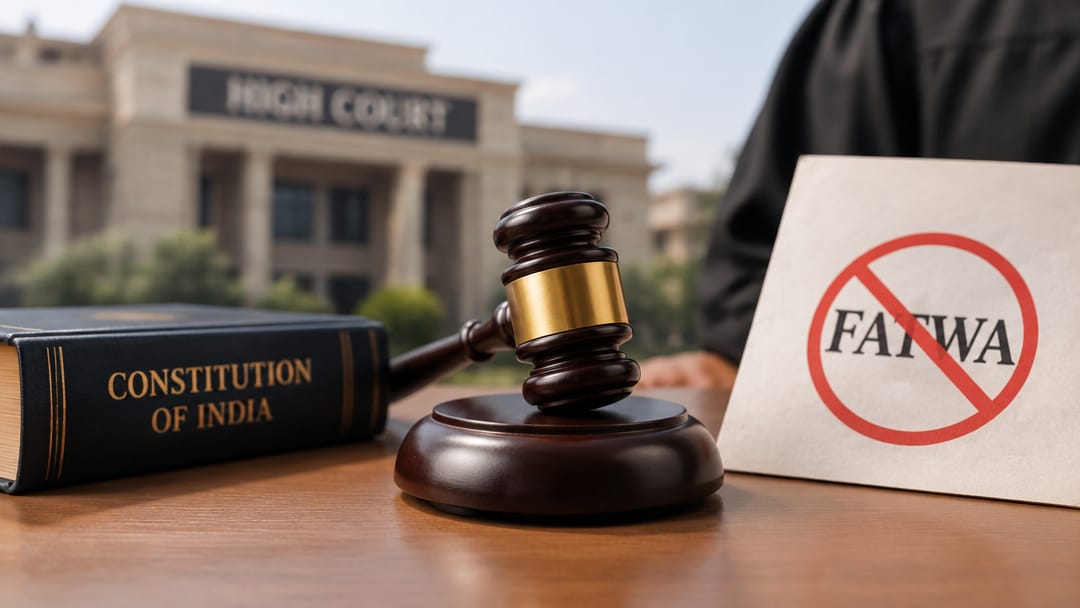
The Chhattisgarh High Court has ruled that a fatwa — a religious opinion issued by an Islamic authority — carries no binding legal force and cannot be enforced in a manner that prejudices an individual's legal rights. The court's ruling reaffirms that religious edicts issued by unofficial bodies have no standing in Indian civil or criminal law, and that constitutional rights of individuals cannot be overridden by such pronouncements under any circumstances.
Why it matters
A fatwa is a non-binding religious opinion issued by a qualified Islamic scholar (mufti) on a question of Islamic law. In India, fatwas are frequently issued by bodies such as Darul Uloom Deoband or local Sharia courts (Dar-ul-Qazas), but they have no statutory backing and cannot be enforced by state machinery.
The Chhattisgarh HC's ruling is consistent with the Supreme Court's landmark position in Vishwa Lochan Madan v. Union of India (2014), where the Supreme Court unanimously held that fatwas have no legal sanction, cannot be enforced by any authority, and any attempt to do so would be unconstitutional. The Court held that Dar-ul-Qazas and Sharia courts are neither courts nor tribunals under Indian law — they derive no authority from any statute.
Constitutionally, this ruling engages several fundamental rights: Article 14 (equality before law), Article 19(1)(a) (freedom of speech and expression), Article 21 (right to life and personal liberty), and Article 25 (freedom of conscience and religion). The key principle is that while Article 25 protects the right to practise religion, it does not permit religious directives to override statutory rights or constitutional guarantees of other individuals.
The distinction the courts consistently draw is between a fatwa as personal religious guidance — which is protected speech — and a fatwa as an enforceable directive that curtails another person's freedom, which is constitutionally impermissible. This is the classic rights-versus-rights balancing the examiner tests under constitutional law passages.
AP High Court: disputed facts cannot end a suit at the Order VII Rule 11 stage
What happened
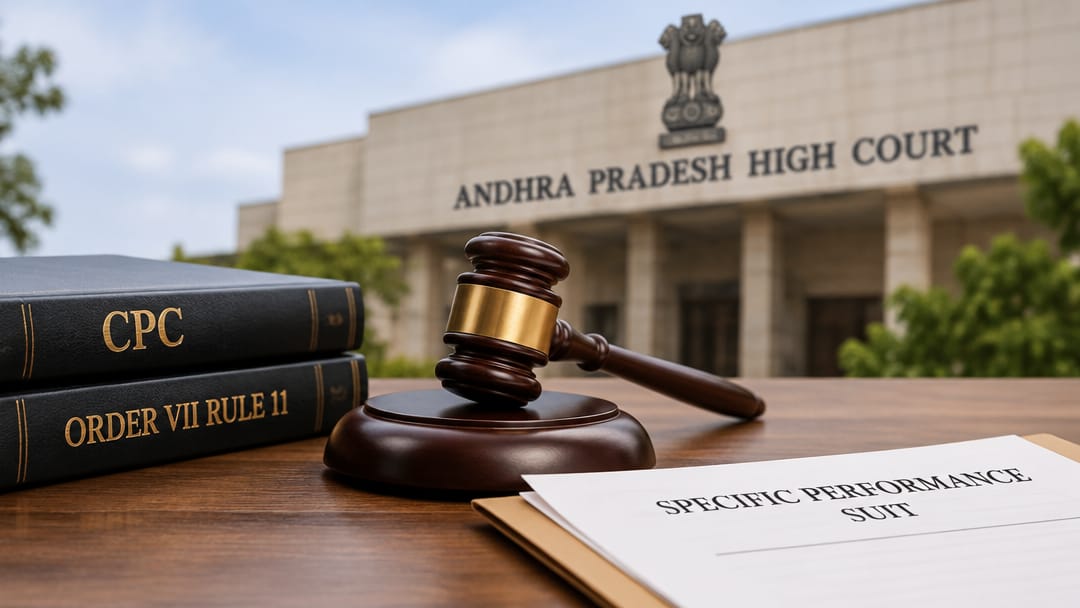
The Andhra Pradesh High Court restored a 16-year-old specific performance suit after setting aside a trial court order that had rejected the plaint under Order VII Rule 11 of the CPC. The trial court had dismissed the suit at the threshold stage, deciding disputed factual questions without a full trial. The High Court held that such contested questions of fact cannot be resolved at the rejection stage and must proceed to trial.
Why it matters
This case sits at the intersection of civil procedure and contract law — specifically the remedy of specific performance under the Specific Relief Act, 1963, and the threshold bar of Order VII Rule 11 CPC.
Order VII Rule 11 CPC allows a court to reject a plaint at the admission stage itself, without a full trial, on narrow grounds: the plaint does not disclose a cause of action, the relief claimed is undervalued, the suit is barred by law, etc. The critical rule here is that at this stage, the court must read the plaint as a whole and take the averments therein as correct. It cannot look beyond the plaint to disputed facts, oral evidence, or the defendant's version.
The AP High Court's ruling reaffirms a settled principle: if the question of whether the suit should proceed requires the court to decide disputed facts, rejection under Order VII Rule 11 is impermissible. The matter must go to trial.
For specific performance suits specifically, this matters because defendants routinely argue at the threshold that the agreement was forged, time-barred, or not specifically enforceable — all disputed questions. Under the 2018 amendment to the Specific Relief Act, specific performance is now a rule rather than a discretionary remedy, making the enforceability of sale agreements even more significant.
The intersection being tested: can a court reject a specific performance suit under Order VII Rule 11 when the enforceability of the underlying agreement itself is disputed? The answer, as this case reinforces, is no.
Bombay HC narrows SC's deemed-practice exemption to pre-2023 graduates only
What happened
The Bombay High Court restricted the Supreme Court's deemed one-year practice exemption for bar exam eligibility to law graduates who had completed their degree before the transitional period began. The Supreme Court's earlier ruling had extended the benefit to all law graduates during the transitional period without any graduation-date restriction. The Bombay HC's narrower reading effectively excludes recent graduates from claiming the exemption, creating a direct conflict with the broader SC interpretation.
Why it matters
At the heart of this dispute is eligibility for the All India Bar Examination (AIBE), administered by the Bar Council of India (BCI). Under the Advocates Act, 1961, an enrolled advocate must complete one year of practice before appearing for AIBE. The Supreme Court, during a transitional phase, ruled that this one-year practice requirement would be 'deemed' to be satisfied — meaning graduates could appear without actually completing the year — and crucially, it did not restrict this benefit to any particular batch of graduates.
The Bombay High Court's reading departs from this. It interpreted the SC ruling narrowly, confining the deemed-exemption only to those who graduated before a specific cut-off, effectively re-introducing a temporal restriction the Supreme Court had not imposed.
The legal tension here is classic statutory interpretation: when a superior court lays down a rule during a transitional period, does that rule apply universally (as the SC intended) or only to those who were within the system at the time the rule was framed (as the Bombay HC held)? This implicates the principle of beneficial construction — that provisions enabling access to a profession should be read broadly — and also the doctrine of prospective versus retrospective application of judicial pronouncements. CLAT PG examiners test whether aspirants can identify the precise ratio of a ruling versus its obiter, and whether a High Court can legitimately narrow a Supreme Court ruling's scope without expressly overruling it.