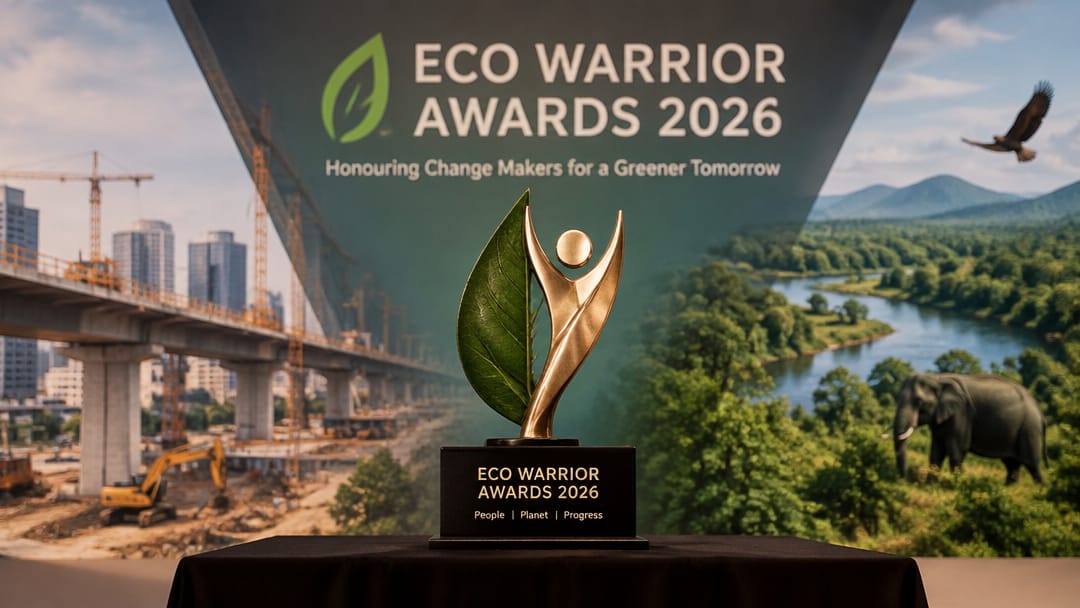
India's growth-vs-nature tension put under the spotlight at Eco Warrior Awards 2026
What happened
The Eco Warrior Awards 2026 raised a central question in India's development debate: can the country sustain rapid economic growth while preserving its forests, rivers, wildlife, and ecosystems? The event recognised individuals and organisations working at the intersection of environment and development. It highlighted the structural tension between infrastructure expansion and ecological protection — a conflict that sits at the core of India's environmental policy, NDC commitments, and biodiversity obligations under international conventions.
Why it matters
India faces a classic development-environment paradox: its growth imperatives demand land, water, energy, and infrastructure, yet its forest cover, river systems, and biodiversity hotspots are legally and ecologically constrained. This tension is not merely rhetorical — it is embedded in real policy instruments.
India's Nationally Determined Contribution (NDC) under the Paris Agreement commits to creating an additional carbon sink of 2.5 to 3 billion tonnes of CO₂ equivalent through forest and tree cover by 2030. Simultaneously, the Forest Conservation Act (now the Van Sanrakshan Evam Samvardhan Adhiniyam, 2023) governs diversion of forest land for non-forest use, with the compensatory afforestation mechanism as a mitigation tool.
Biodiversity protection falls under the Biological Diversity Act, 2002, which operationalises India's obligations under the Convention on Biological Diversity (CBD) and its Nagoya Protocol. The Kunming-Montreal Global Biodiversity Framework (2022) further commits nations to protect 30% of land and oceans by 2030 — the '30x30' target — which India endorsed.
River conservation intersects with the National Mission for Clean Ganga (Namami Gange) and the broader National Water Policy. Environmental Impact Assessments (EIA), governed by the Environment Protection Act, 1986, are the procedural checkpoint for balancing growth projects against ecological costs.
Awards like Eco Warrior serve as civil-society signals of which conservation approaches are working on the ground — the kind of grassroots implementation that UPSC tests through biodiversity management committees, biosphere reserves, and community-led conservation models.
🔒
Key figure and date from this topic
Specific number or threshold to remember
Policy or regulatory implication