SEBI and RBI join hands to simplify the foreign portfolio investor framework
What happened
SEBI, working with RBI, plans to release a consultation paper to overhaul the Foreign Portfolio Investor framework, aligning it with global norms. SEBI chairperson Tuhin Kanta Pandey announced the move aims to reduce compliance burdens and streamline entry for foreign investors. The regulator intends to simplify KYC requirements, rationalise investment limits, and harmonise rules across both equity and debt markets to make India more attractive to international capital.
Why it matters
The FPI framework governs how foreign institutional money enters Indian capital markets. Currently, FPIs must register with SEBI and comply with both SEBI regulations and RBI's Foreign Exchange Management Act rules simultaneously, creating a dual-compliance burden. The proposed revamp addresses this overlap.
Key structural elements of the existing FPI regime: FPIs are categorised into three groups based on risk profile. Category I includes government entities and central banks; Category II covers regulated funds and broad-based funds; Category III is a residual category with the highest compliance requirements. The 2019 SEBI (FPI) Regulations replaced the earlier FII/QFI/sub-account structure.
The proposed changes seek to: (1) align KYC documentation with FATF standards; (2) rationalise the aggregate FPI investment limits in individual companies (currently, FPI aggregate holding triggering the 'on-demand' repatriation scrutiny is 10% of paid-up equity); (3) simplify the 'material change' reporting timelines; and (4) harmonise rules so the same investor does not face contradictory RBI and SEBI requirements on the same instrument.
For exam purposes, understand that FPI regulation sits at the intersection of capital market regulation (SEBI) and forex regulation (RBI/FEMA). Any consultation paper is a precursor to a formal circular — the examiner loves testing which regulator issued which rule and what threshold changed.
SEBI curbs fresh investments in Gold ETF fund-of-funds, calls the ban temporary
What happened
SEBI Chairman Tuhin Kanta Pandey stated that restrictions on fresh investments in Gold ETF fund-of-funds schemes are temporary, not permanent policy. The curbs were imposed because underlying Gold ETFs hit prescribed investment limits under mutual fund regulations. SEBI is working with the government and RBI to resolve the constraint, which stems from overall portfolio limits on gold-linked instruments. The pause affects retail investors who access gold indirectly through fund-of-funds routes rather than buying Gold ETF units directly on exchanges.
Why it matters
A Gold ETF Fund-of-Funds (FoF) is a mutual fund that invests its corpus entirely into units of Gold ETFs rather than buying physical gold or equity directly. This structure allows investors without demat accounts to gain gold exposure through a regular mutual fund SIP or lump-sum route.
The regulatory constraint here arises from SEBI's investment limits on how much a mutual fund scheme can hold in a single underlying ETF or asset class. When Gold ETF schemes collectively approach or breach these concentration thresholds, SEBI mandates a halt on fresh inflows into the FoF that feeds into them. This is a prudential safeguard against over-concentration risk.
The broader context is that gold demand has surged sharply in 2024–25, driven by global uncertainty and rupee depreciation, pushing Gold ETF AUMs to record levels. The FoF channel, being the preferred route for SIP investors, bore the brunt of the restriction.
SEBI's assurance that the curb is temporary signals that a regulatory fix — possibly a revision of concentration limits, a new RBI dispensation for gold holdings, or an increase in permissible portfolio limits — is under consideration. The episode illustrates how product-level restrictions in capital markets can be triggered not by fraud or misconduct, but purely by structural portfolio ceiling limits hitting their bounds.
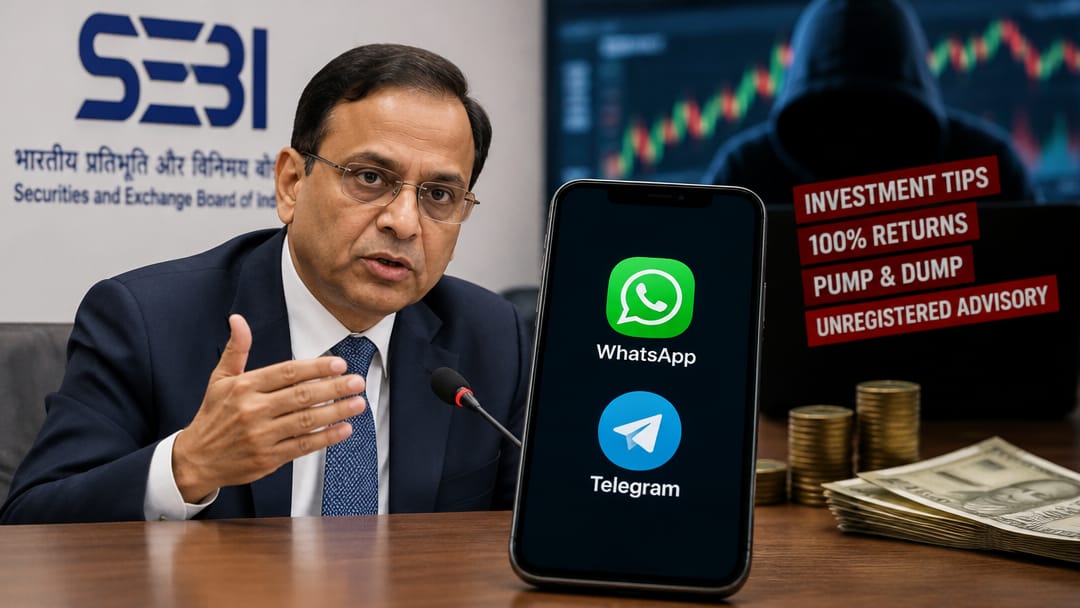
SEBI chair calls for crackdown on WhatsApp and Telegram investment fraud groups
What happened
SEBI Chairperson Tuhin Kanta Pandey has signalled a strict enforcement stance against fraudulent investment advisory groups operating on WhatsApp and Telegram. These platforms are routinely used to run unregistered tip-sharing schemes, pump-and-dump operations, and fake advisory services targeting retail investors. SEBI's concern centres on entities providing investment advice without registration under the Investment Advisers Regulations, 2013, and Securities Law, bypassing regulatory oversight and causing significant financial harm to retail participants.
Why it matters
SEBI regulates investment advisers under the SEBI (Investment Advisers) Regulations, 2013, which require anyone providing personalised investment advice for a fee to register with SEBI. Operating without such registration is a violation of the Securities and Exchange Board of India Act, 1992, specifically Section 12, which mandates registration for market intermediaries.
Social media platforms like WhatsApp and Telegram have become vectors for two distinct frauds: first, 'finfluencer' schemes where unregistered individuals charge subscriptions for stock tips; second, 'pump-and-dump' operations where operators accumulate a stock, hype it in closed groups, and exit once retail buyers inflate the price.
SEBI has progressively tightened this space. In August 2023, SEBI issued a consultation paper on regulating finfluencers. In 2024, SEBI amended the Investment Advisers Regulations to restrict unregistered persons from using associations with SEBI-registered entities as implicit endorsements. SEBI can take action under Section 11(4) of the SEBI Act — imposing penalties, issuing cease-and-desist orders, and referring cases to SFIO or law enforcement.
The distinction between 'research analysts' (regulated under RA Regulations, 2014) and 'investment advisers' (regulated under IA Regulations, 2013) is a recurring exam trap: research analysts publish impersonal reports; investment advisers give personalised advice. Both require SEBI registration. Unregistered activity on social media platforms violates both frameworks simultaneously.