Article 142 used to quash criminal cases en masse: a rule-of-law challenge
What happened
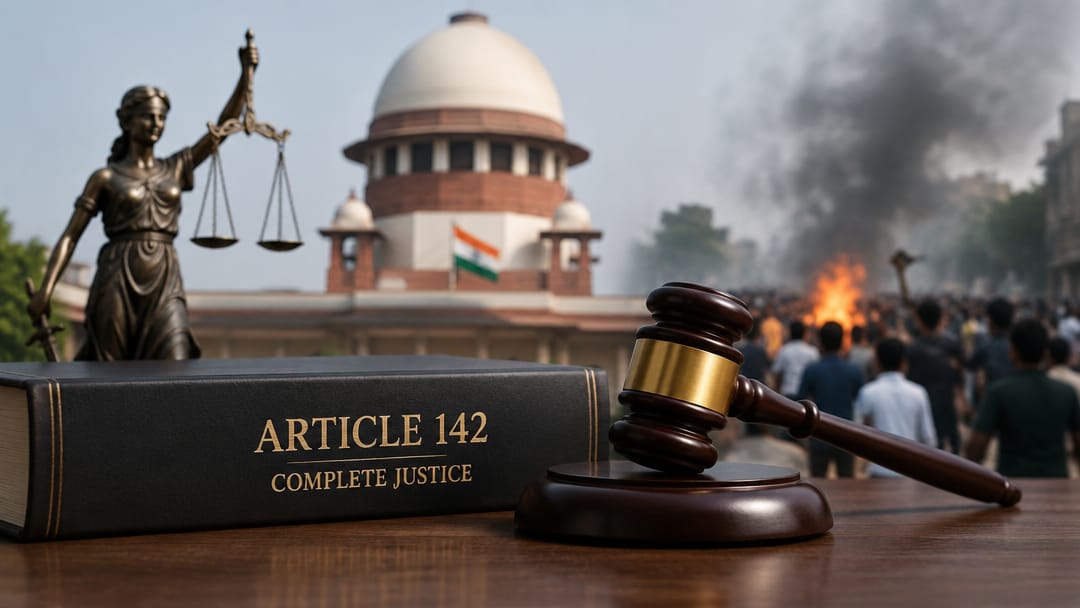
A constitutional law critique argues that the Supreme Court's use of Article 142 — its plenary power to do 'complete justice' — to grant blanket quashing of criminal proceedings, particularly in riot and communal violence cases, substitutes individual adjudication with informal collective settlements. The piece contends this conflates substantive rights protection with procedural convenience, effectively decriminalising serious offences through judicial amnesty rather than legislative pardon, undermining the distinction between civil compounding and public-law prosecution.
Why it matters
Article 142 of the Constitution grants the Supreme Court power to pass any order necessary to do 'complete justice' in pending matters. Originally conceived as a curative, gap-filling tool — used in landmark cases like Union Carbide (Bhopal gas tragedy settlement) and in contempt enforcement — it has no textual limit except that it cannot override substantive law. The Supreme Court in Supreme Court Bar Association v. Union of India (1998) clarified that Article 142 cannot be used to supplant or ignore substantive legal provisions, only to supplement procedural gaps.
The current constitutional debate focuses on a pattern where the Court invokes Article 142 to quash First Information Reports (FIRs) or criminal trials in bulk — especially post-communal riot cases — when the parties (usually the accused and the local community or victim's family) reach a 'compromise.' Critics argue this converts the criminal justice system, which protects public interest, into a panchayat-style private settlement mechanism.
The core doctrinal distinction being violated, critics argue, is between: (1) compoundable offences under Section 320 CrPC (now BNSS), where private settlement is legislatively permitted; and (2) non-compoundable offences like murder, rape, and riot, where the State is the prosecutor and individual compromise cannot extinguish public liability. Using Article 142 to quash non-compoundable offences sidesteps this statutory architecture.
This also intersects with Article 21 (victim's right to fair investigation and justice), Article 14 (equal treatment of similarly situated accused), and the separation of powers — since the power to grant amnesty in criminal law traditionally belongs to the executive under Articles 72 and 161, not the judiciary.
Karnataka HC: false mental illness claims against a spouse violate Article 21 dignity
What happened
The Karnataka High Court ruled that levelling baseless allegations of mental illness against a spouse constitutes matrimonial cruelty and violates the right to dignity guaranteed under Article 21 of the Constitution. The court held that such unfounded claims attack a person's mental health reputation without any medical basis, causing profound psychological harm. The ruling reinforces that constitutional protection of life and personal liberty extends into the marital domain, granting divorce on grounds of cruelty.
Why it matters
Article 21 guarantees that no person shall be deprived of life or personal liberty except according to procedure established by law. The Supreme Court has progressively expanded 'life' under Article 21 far beyond mere physical survival. In Francis Coralie Mullin v. Union Territory of Delhi (1981), the Court held that the right to life includes the right to live with human dignity. In Maneka Gandhi v. Union of India (1978), it established that any procedure curtailing personal liberty must be fair, just, and reasonable.
The Karnataka High Court's ruling applies this expansive reading to the matrimonial context. Dignity — recognised as the core of Article 21 — can be violated not only by the State but also, as courts have held, by sustained private conduct that courts must remedy. Falsely labelling a spouse as mentally ill attacks their social reputation, employability, and self-worth without medical evidence, causing the kind of psychological harm courts equate with mental cruelty under the Hindu Marriage Act, 1955 (Section 13(1)(ia)).
This intersection — constitutional dignity norms informing the definition of matrimonial cruelty — is the key doctrinal move. Courts read personal dignity rights into private law disputes, meaning a matrimonial wrong simultaneously becomes a constitutional violation. The principle follows the trajectory of cases like Navtej Singh Johar (2018) and Joseph Shine (2018), where dignity under Article 21 was used to strike down or limit personal-law conduct. CLAT PG examiners frequently test whether aspirants can identify which Article protects dignity and which landmark cases built that protection.
Centre consults press editors on digital data privacy law, says journalistic freedom safe
What happened
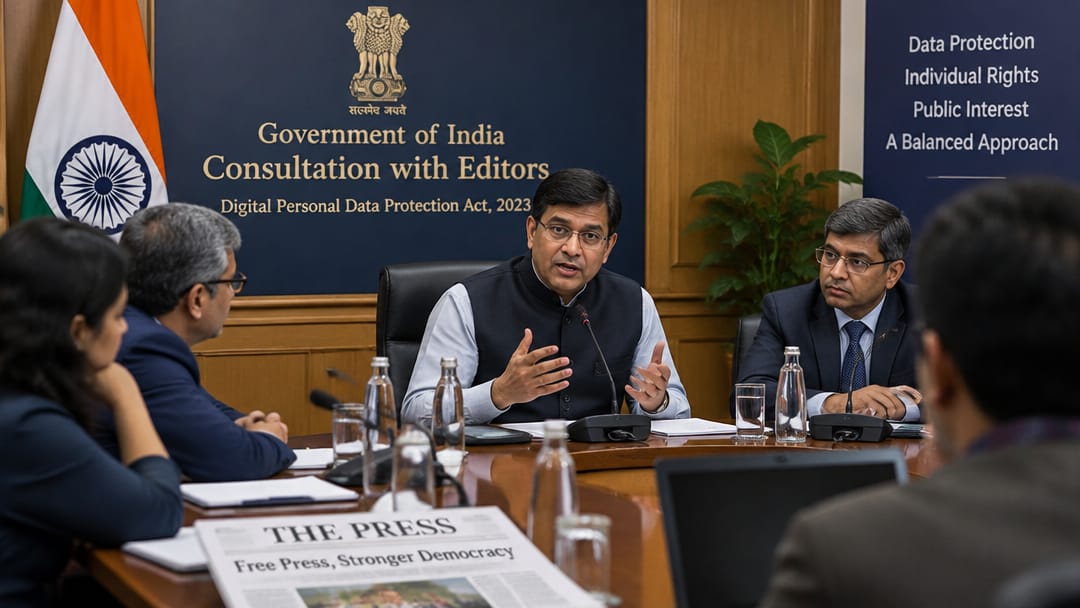
The Central Government invited newspaper editors for consultations on the Digital Personal Data Protection Act, 2023, assuring them it has no intention of restricting journalistic freedom guaranteed under the Constitution. Officials indicated openness to addressing concerns that the law's data-processing obligations and exemptions may conflict with press reporting practices. The move signals that the government is still calibrating how the Act balances individual data rights against the public interest in a free and investigative press.
Why it matters
The Digital Personal Data Protection Act, 2023 (DPDPA) is India's first comprehensive data-privacy statute, replacing the earlier framework under the Information Technology Act, 2000. It operationalises the constitutional right to privacy recognised in Justice K.S. Puttaswamy v. Union of India (2017, nine-judge bench), which held privacy to be a fundamental right under Article 21.
The tension the government is now addressing arises because the DPDPA requires 'Data Fiduciaries' — entities that collect and process personal data — to satisfy strict consent and purpose-limitation rules. News organisations routinely process personal data without explicit consent during investigative reporting. Section 17 of the Act carves out exemptions for certain legitimate state and public-interest activities, but the precise scope of a press exemption has not been finalised in the Rules, which are still being drafted.
Constitutionally, freedom of the press flows from Article 19(1)(a) as part of freedom of speech and expression. It is not absolute; Article 19(2) permits reasonable restrictions in the interests of, among other things, public order and decency. The DPDPA's consent requirements, if applied rigidly to journalism, could function as an indirect restriction on Art 19(1)(a) — a classic 'chilling effect' argument. Courts test such indirect restrictions under the proportionality standard articulated in Modern Dental College v. State of MP (2016) and Anuradha Bhasin v. Union of India (2020): the measure must be (i) backed by law, (ii) pursue a legitimate aim, (iii) be necessary, and (iv) be proportionate.
For CLAT PG aspirants, this event is the live legislative application of Puttaswamy and the Art 19(1)(a) press-freedom doctrine simultaneously.
Inter-State Council exists in the Constitution but has met only twice since 2016
What happened
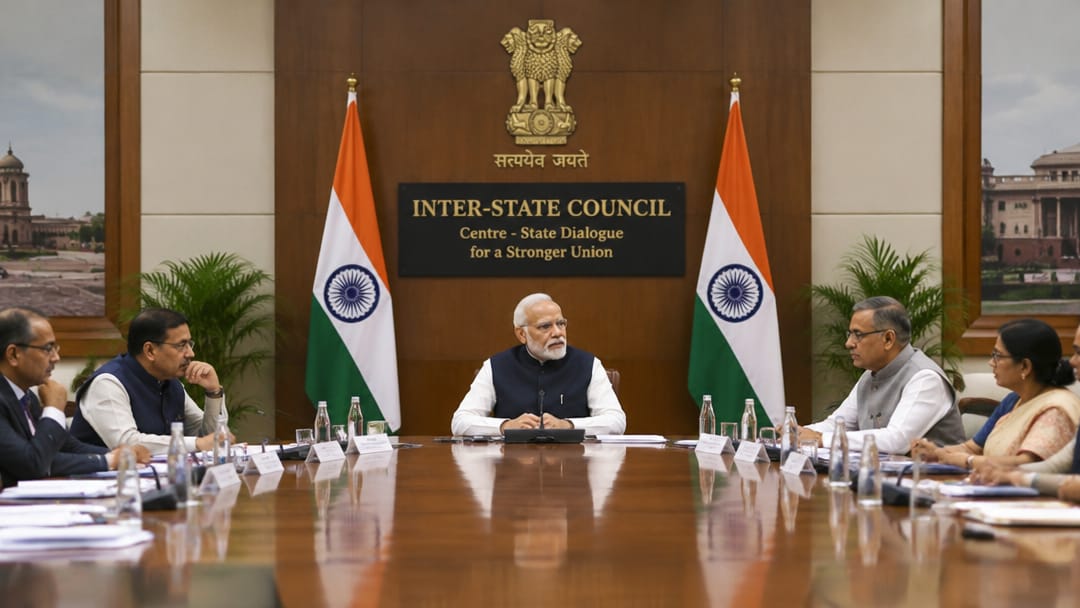
An opinion piece argues that India's cooperative federalism remains aspirational because the Inter-State Council, a constitutional body under Article 263 meant for Centre-state deliberation, has been largely dormant. The Council last met in 2016 and before that in 2006. The author calls for reviving it as a structured, regular forum for shared decision-making between the Union and states, noting the Constitution already provides this mechanism without requiring new legislation.
Why it matters
Article 263 of the Constitution empowers the President to establish an Inter-State Council if it appears to him that the public interests would be served by its creation. The Council is designed to inquire into and advise on disputes between states, investigate subjects of common interest, and make recommendations for better coordination of policy and action. It is not a permanent constitutional body like the Election Commission; it exists only when constituted by a presidential order.
The Inter-State Council was actually constituted in 1990 on the recommendation of the Sarkaria Commission. Its meetings have been infrequent: it met eleven times between 1990 and 2016, then went dormant. The Standing Committee of the Council, chaired by the Home Minister, handles inter-session matters.
The constitutional doctrine of cooperative federalism — the idea that the Union and states must work collaboratively rather than in a purely hierarchical manner — has been repeatedly invoked by the Supreme Court, notably in S.R. Bommai v. Union of India (1994) and more recently in State of West Bengal v. Union of India and the GST judgments. The court has held federalism to be a basic structure element, though Indian federalism remains asymmetric: the Constitution provides for residuary powers with the Union (Article 248), allows Central intervention through Articles 356 and 360, and gives Parliament overriding legislative authority in emergencies.
For CLAT PG, the key distinction is between Article 263 (Inter-State Council, advisory and coordinative) and Article 131 (original jurisdiction of the Supreme Court in inter-state disputes). The two are often confused. Article 263 is a political-executive mechanism; Article 131 is a judicial mechanism.
Multiple life sentences can't run back-to-back, but remission on one doesn't free the rest
What happened
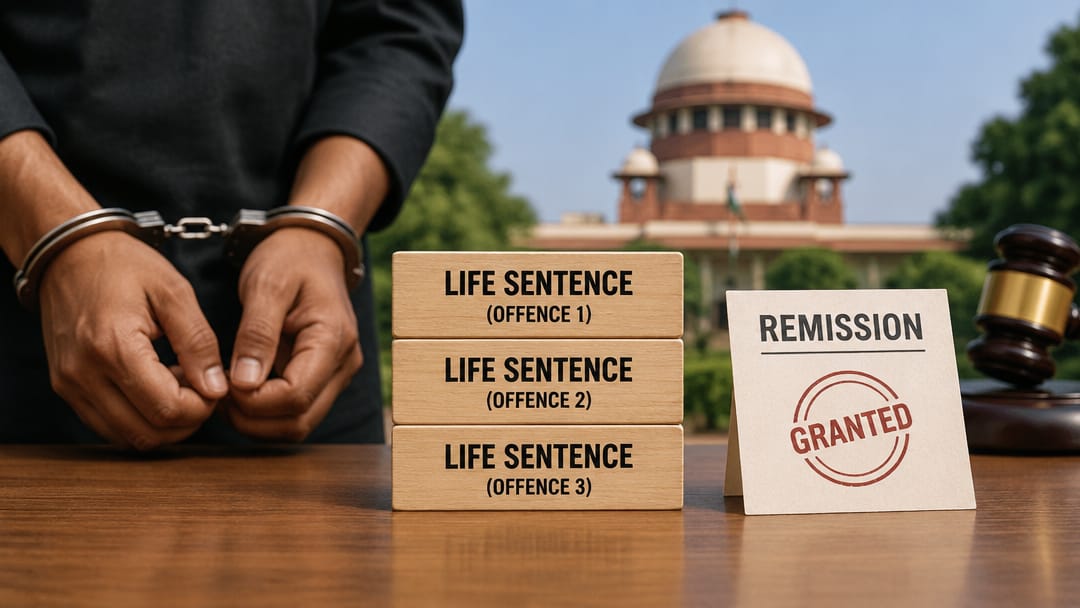
The Supreme Court has reiterated that when a convict receives life sentences for multiple offences, those sentences cannot run consecutively one after another. Instead, they run concurrently but are superimposed over each other, meaning the convict serves them simultaneously. Crucially, the Court clarified that if the government grants remission of one life sentence, that remission does not automatically affect or extinguish the remaining life sentences imposed for other offences. Each life term operates independently for remission purposes.
Why it matters
This ruling clarifies a structurally important principle in Indian sentencing law rooted in Section 31 of the Code of Criminal Procedure, 1973 (now mirrored in Section 6 of the BNSS, 2023). Section 31 CrPC gives the court discretion to direct whether sentences for multiple offences run concurrently or consecutively. However, life imprisonment occupies a special position in this framework — it cannot follow another life sentence consecutively because life imprisonment, by definition, lasts for the remainder of the convict's natural life. You cannot serve 'two lives' sequentially.
The doctrine of 'superimposition' resolves this: multiple life sentences run simultaneously but are layered upon each other. The practical consequence emerges at the remission stage. Remission under Section 432 CrPC (Section 473 BNSS) is granted by the appropriate government for a specific sentence. If Sentence A (life for murder) is remitted, the convict does not walk free if Sentence B (life for dacoity with murder) is still operative. Each life term is independently subject to the remission power of the appropriate government.
This principle also connects to Article 72 (Presidential pardon) and Article 161 (Governor's pardon) of the Constitution, which operate offence-specifically. The examiner tests whether aspirants understand that remission is sentence-specific, not person-specific — the most common distractor being that remission of one sentence automatically releases the convict from all sentences.
SC rules a public auction bid creates no contract until the authority formally accepts it
What happened
The Supreme Court has held that accepting the highest bid in a public auction does not automatically create a binding contract. The authority retains discretion to reject even the highest bid and call for fresh offers if it believes a better price is achievable. A contract crystallises only upon formal acceptance by the competent authority. The ruling reinforces that a bid is an offer, not a concluded agreement, and that public bodies owe a duty to secure the best value for public assets.
Why it matters
This ruling turns on a foundational principle of the Indian Contract Act, 1872: a contract requires a valid offer and its unconditional acceptance. In a public auction context, the bidder is the offeror and the auctioning authority is the offeree. The Supreme Court's position aligns with Section 7 of the Contract Act — acceptance must be absolute and unqualified — and with the classical rule that a bid at auction is an offer that the seller may accept or reject.
The Court distinguished between a provisional acceptance (which is merely an administrative step) and a final, formal acceptance by the competent authority (which alone concludes the contract). Until that second stage occurs, no enforceable rights vest in the highest bidder.
For public law purposes, this also engages Article 14 of the Constitution: the authority's discretion to reject bids must be exercised reasonably, not arbitrarily. The Court's reasoning prevents a bidder from claiming a vested right simply because their figure was the highest, while simultaneously preventing the State from rejecting bids capriciously.
The practical implication is significant: in land sales, mining leases, spectrum auctions, and tender processes, the highest bid triggers a duty on the authority to consider — not a duty to accept. This distinction between 'consideration' and 'acceptance' is the precise doctrinal line the examiner will test.
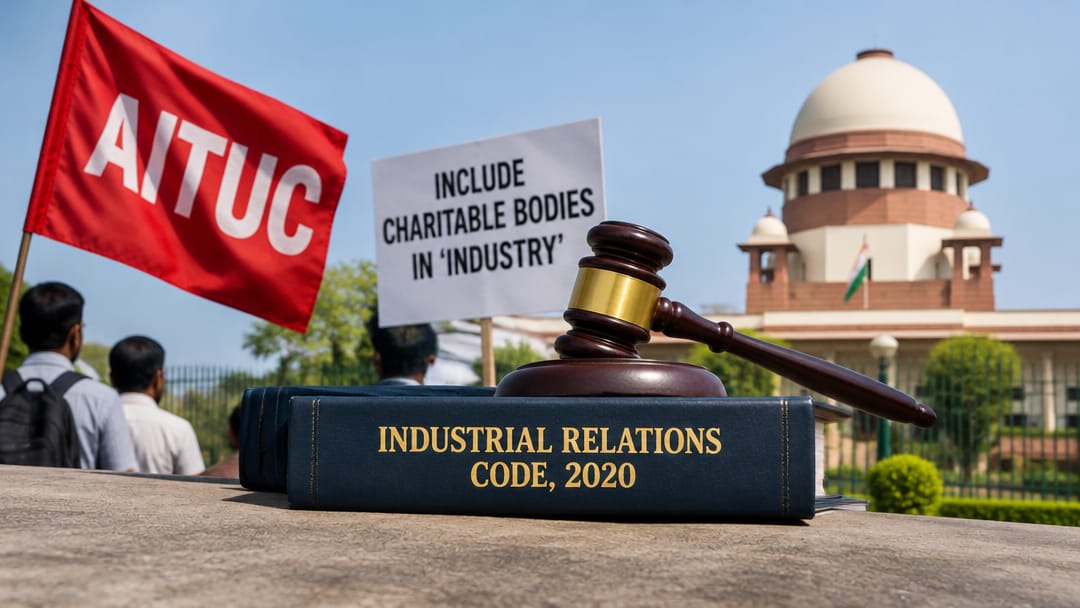
AITUC challenges exclusion of charitable bodies from 'industry' under 2020 labour code
What happened
The All India Trade Union Congress, Tamil Nadu has filed a petition in the Supreme Court challenging Section 2(p) of the Industrial Relations Code, 2020, which defines 'industry.' The petition targets specific exclusions from that definition — notably charitable and philanthropic establishments — arguing these exclusions unconstitutionally deny workers in those sectors labour protections. The Supreme Court is set to examine whether Parliament's narrowing of the 'industry' definition violates constitutional rights of workers employed in excluded establishments.
Why it matters
The definition of 'industry' is foundational to labour law because it determines which workers and employers fall within the protective framework of industrial legislation — including rights to unionise, strike, and claim reinstatement. The Industrial Relations Code, 2020 consolidates three earlier statutes: the Industrial Disputes Act 1947, the Trade Unions Act 1926, and the Industrial Employment (Standing Orders) Act 1946. Section 2(p) of the Code defines 'industry' and, crucially, excludes certain establishments such as charitable institutions, hospitals run by trusts, and philanthropic organisations.
The constitutional challenge rests on Articles 14 (equality), 19(1)(c) (right to form associations/unions), and 21 (right to livelihood). Workers in excluded sectors argue that their exclusion from the definition creates an arbitrary classification — they perform the same economic activity as workers in 'industry' but lose all statutory protection.
The landmark precedent in this space is Bangalore Water Supply & Sewerage Board v. A. Rajappa (1978), where a seven-judge Constitution Bench gave the widest possible interpretation to 'industry' under the Industrial Disputes Act, holding that even a municipality, a hospital, or a charitable institution engaged in systematic activity using capital and labour with economic output qualifies as 'industry.' Parliament's exclusions in the 2020 Code are effectively a legislative reversal of Rajappa. The Supreme Court must now decide whether that legislative reversal passes constitutional scrutiny — particularly whether the exclusions violate equality or impair the right to form trade unions under Art. 19(1)(c), which can only be restricted on grounds listed in Art. 19(4), none of which straightforwardly justify removing entire sectors from labour law coverage.