01 Read
What happened
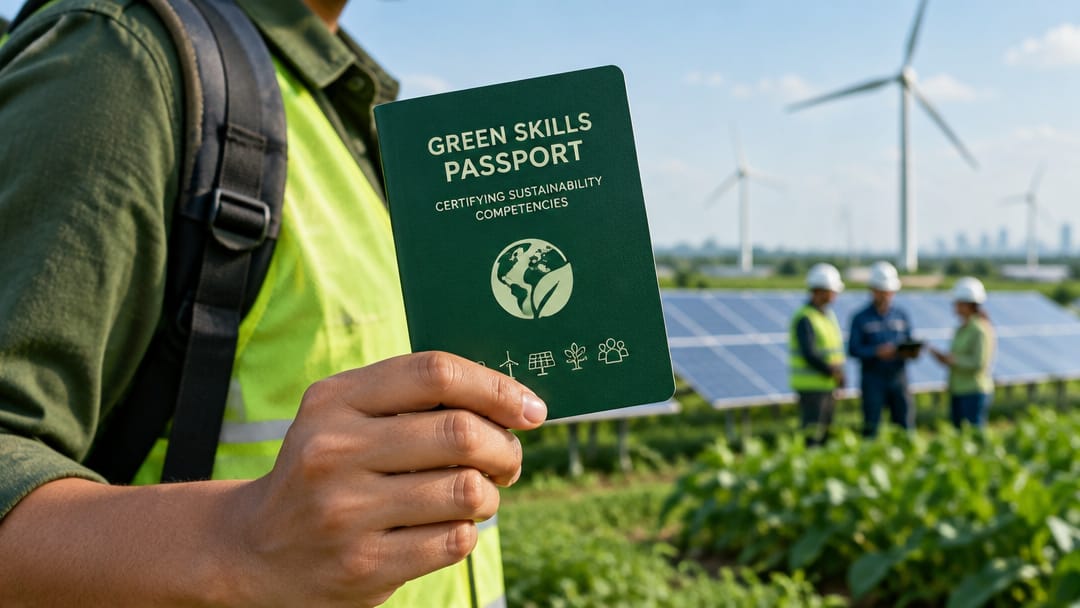
The Green Skills Passport, promoted by EY, is a global initiative designed to certify individuals in sustainability-related competencies needed for green jobs. It maps skills against emerging roles in the low-carbon economy, helping workers and employers identify gaps and pathways. India's green transition — driven by its net-zero by 2070 commitment and National Skill Development Mission — makes such frameworks increasingly relevant to workforce planning across agriculture, renewable energy, and rural development sectors.
02 Understand
Why it matters
Green jobs are defined by the International Labour Organization (ILO) as work that contributes to preserving or restoring environmental quality, reduces energy and raw material consumption, limits greenhouse gas emissions, minimises waste and pollution, and protects or restores ecosystems. The Green Skills Passport concept operationalises this definition by creating a verifiable credential framework — mapping what competencies a worker needs, at what level, to fill roles in sectors like renewable energy, sustainable agriculture, green construction, and circular economy.
For India, this connects directly to several policy layers. The National Skill Development Mission (NSDM), administered by the Ministry of Skill Development and Entrepreneurship through the National Skill Development Corporation (NSDC), is India's primary vehicle for workforce skilling. NABARD's rural credit and livelihood programmes increasingly fund green agricultural transitions — organic farming, watershed management, climate-resilient crops — all of which require certified green skills. The PM Kaushal Vikas Yojana (PMKVY) is the flagship scheme under NSDM, and its iterations have begun incorporating green skill modules.
The ILO estimates over 24 million new green jobs could be created globally by 2030 under ambitious climate policies. India's target of 500 GW of renewable energy by 2030 alone implies millions of technicians, installers, and engineers requiring certified competencies. A passport-style credential system helps bridge the recognition gap between informal green-skills training and formal employment — directly relevant to financial inclusion and rural livelihood schemes that NABARD finances.
Remember + Why it matters
The key recall facts and exact examiner angle for NABARD Grade A are in the Crux app.
01
Key figure and date from this topic
02
Specific number or threshold to remember
03
Policy or regulatory implication
Read + Understand free forever · 30-day free trial