01 Read
What happened
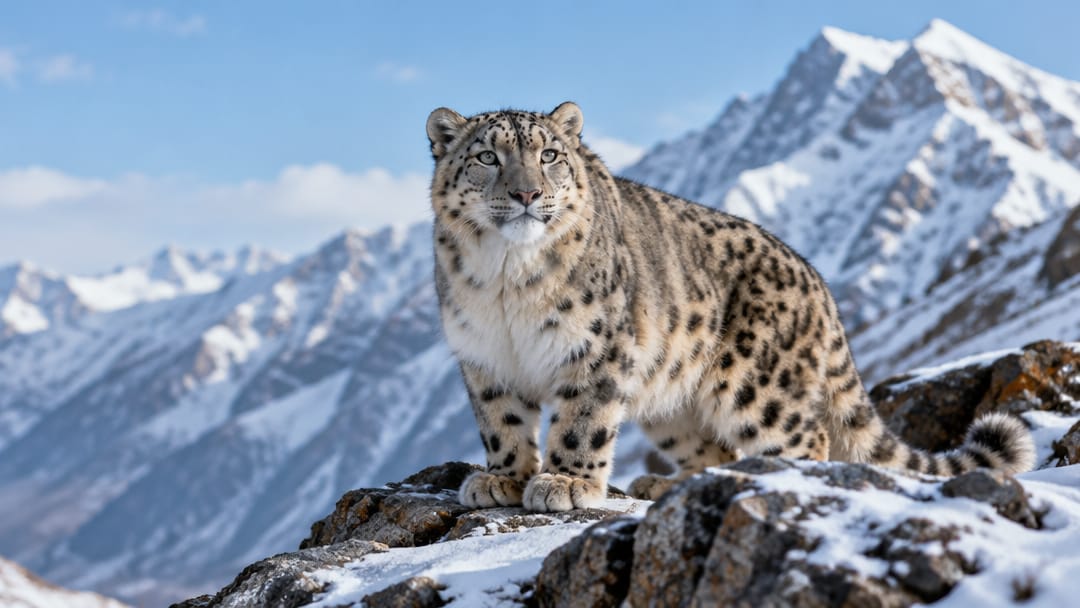
India's first-ever Snow Leopard Population Assessment recorded 718 snow leopards across the Indian Himalayas, with Ladakh alone hosting 477 — roughly two-thirds of the national count. The survey, announced by Minister of State Kirti Vardhan Singh, marks the first scientifically validated baseline for the species in India. Snow leopards are listed as Vulnerable on the IUCN Red List and receive the highest protection under Schedule I of the Wildlife (Protection) Act, 1972.
02 Understand
Why it matters
The Snow Leopard Population Assessment in India (SPAI) is significant because it provides the first statistically robust national estimate for a flagship high-altitude species that serves as an indicator of Himalayan ecosystem health. Snow leopards inhabit the alpine and sub-alpine zones above 3,000 metres across five Himalayan states — Ladakh, Himachal Pradesh, Uttarakhand, Sikkim, and Arunachal Pradesh — plus the trans-Himalayan regions.
Conservation context: India is a signatory to the Global Snow Leopard and Ecosystem Protection (GSLEP) Programme launched in 2013 in Bishkek, which unites the 12 snow leopard range countries. The IUCN downlisted the snow leopard from Endangered to Vulnerable in 2017, reflecting cautious population recovery but ongoing threats from poaching, habitat loss, and climate-driven prey base shrinkage.
Under the Wildlife (Protection) Act, 1972, the snow leopard is listed in Schedule I, Part I — the highest protection category — making hunting or trade punishable with the most severe penalties. Project Snow Leopard, launched in 2009 by the Ministry of Environment, Forest and Climate Change (MoEFCC), is India's dedicated conservation programme for the species, analogous to Project Tiger and Project Elephant.
The survey methodology used camera traps and DNA analysis from scat samples — a non-invasive technique now standard for elusive large carnivores. Ladakh's dominance (477 of 718) reflects its vast, relatively undisturbed high-altitude terrain and lower human pressure compared to other Himalayan states. This baseline number is what examiners will test.
Remember + Why it matters
The key recall facts and exact examiner angle for NABARD Grade A are in the Crux app.
01
Key figure and date from this topic
02
Specific number or threshold to remember
03
Policy or regulatory implication
Read + Understand free forever · 30-day free trial