01 Read
What happened
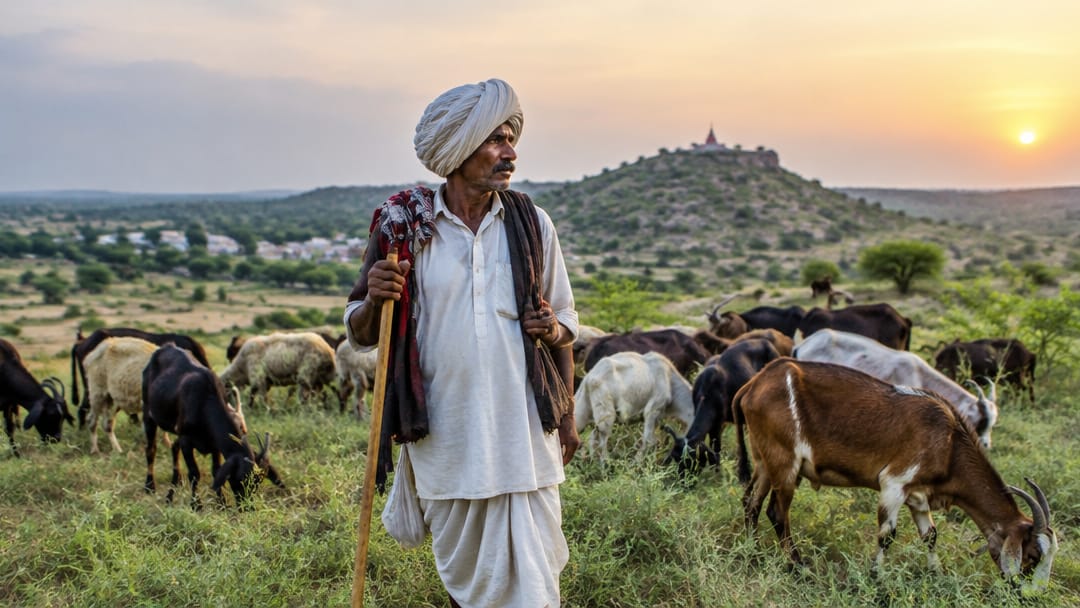
In Chotila, Gujarat, Maldhari pastoralists manage a patchwork of gauchars (village grazing commons), vidis (private pastures), and forest lands using generations of ecological knowledge. As these commons shrink under encroachment and land-use changes, Maldhari communities deploy seasonal migration patterns and species-specific grazing rotations to maintain grassland biodiversity. Their traditional knowledge system supports dryland ecosystem health while sustaining pastoral livelihoods — an intersection of indigenous knowledge, common property resources, and biodiversity conservation.
02 Understand
Why it matters
Gauchars are legally designated village grazing commons recorded under revenue land categories in Gujarat. Vidis are privately held pasture parcels. Together with forest patches, they form a mosaic that sustains both livestock and native grassland biodiversity. The Maldhari are a pastoral community whose livelihood depends entirely on this mosaic.
The exam-relevant architecture here spans several static concepts:
**Common Property Resources (CPRs):** Grazing commons are classic CPRs — rivalrous but non-excludable. Their degradation follows the 'Tragedy of the Commons' logic, but Maldhari knowledge systems represent the counter-argument: community-managed CPRs can be sustainable when governed by traditional institutions.
**Indigenous and Traditional Knowledge (ITK):** Under the Convention on Biological Diversity (CBD) and its Nagoya Protocol, traditional knowledge held by local communities has formal legal status. India's Biological Diversity Act, 2002, and the National Biodiversity Authority (NBA) govern access to such knowledge. The nodal ministry is the Ministry of Environment, Forest and Climate Change (MoEFCC).
**Grassland Ecosystems:** Indian grasslands are among the most threatened ecosystems, often misclassified as 'wastelands' in revenue records, making them vulnerable to diversion. The Wildlife Institute of India has flagged their underprotection relative to forests.
**Dryland Biodiversity:** Arid and semi-arid grasslands of Gujarat fall outside the 18 recognised biodiversity hotspots in India (which include the Western Ghats and Eastern Himalayas), yet they support critical fauna including the Great Indian Bustard — a Critically Endangered species under IUCN.
For NABARD, the livelihood dimension is central: pastoral communities' dependence on CPRs links directly to rural credit need, climate vulnerability, and natural resource governance in semi-arid regions.
Remember + Why it matters
The key recall facts and exact examiner angle for NABARD Grade A are in the Crux app.
01
Key figure and date from this topic
02
Specific number or threshold to remember
03
Policy or regulatory implication
Read + Understand free forever · 30-day free trial