01 Read
What happened
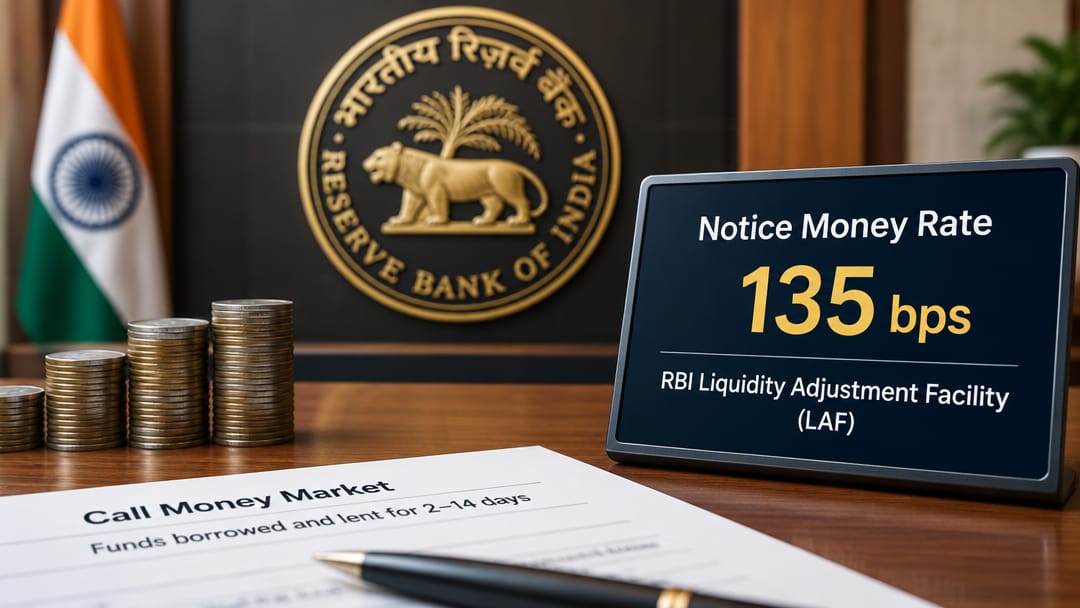
RBI's money market operations page shows the Notice Money rate at 135.00 basis points, referenced in Press Release No. 2025-2026/1201 dated September 30, 2025. Notice Money is a key segment of India's call money market where funds are borrowed and lent for 2–14 days. RBI monitors and publishes these rates as part of its Liquidity Adjustment Facility framework, which determines the operating corridor for short-term interest rates in the Indian financial system.
02 Understand
Why it matters
India's money market is segmented by tenor. Call Money covers overnight borrowing and lending between banks. Notice Money extends this to 2–14 days without requiring a fixed repayment schedule at the outset — the lender gives 'notice' before recall. Term Money covers 15 days to one year. All three segments are unsecured, meaning no collateral is pledged, which distinguishes them from repo and reverse repo operations under the LAF.
The RBI's Liquidity Adjustment Facility (LAF) corridor anchors these rates. The repo rate sets the ceiling for borrowing costs; the Standing Deposit Facility (SDF) rate acts as the floor since May 2022, replacing the reverse repo rate as the operative floor. The Marginal Standing Facility (MSF) sits 25 bps above repo as an emergency ceiling.
When the Notice Money rate prints at 135 bps (1.35%), it signals conditions in the overnight and near-overnight liquidity market. A rate significantly below the repo rate indicates surplus liquidity; a rate near or above repo signals tightness. The RBI publishes these rates daily as a transparency measure and as an input into its monetary policy transmission assessment.
For the exam, the critical chain is: MPC sets repo → LAF corridor forms → call/notice/term money rates anchor within it → bank lending rates adjust → credit growth and inflation respond. Understanding this transmission is exactly what RBI Grade B tests.
Remember + Why it matters
The key recall facts and exact examiner angle for RBI Grade B are in the Crux app.
01
Key figure and date from this topic
02
Specific number or threshold to remember
03
Policy or regulatory implication
Read + Understand free forever · 30-day free trial