01 Read
What happened
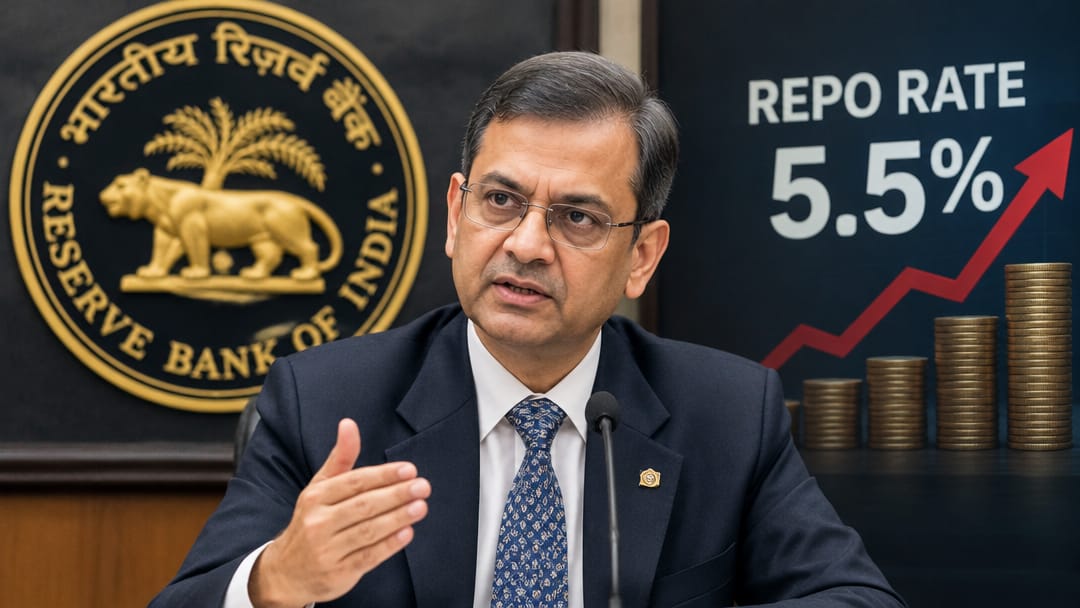
The RBI's MPC unanimously raised the repo rate by 25 basis points to 5.5 per cent at its October 5–7 meeting — the first hike in nearly four years. The stance shifted from neutral to calibrated tightening, ruling out near-term cuts. Governor Sanjay Malhotra flagged broadening inflation: 37 per cent of CPI basket commodities recorded inflation above 4 per cent in August, up from 20 per cent in March. Future hikes remain data-dependent.
02 Understand
Why it matters
This MPC decision tests several layered concepts that examiners repeatedly probe.
**The LAF Corridor and Repo Rate:** The repo rate is the rate at which RBI lends overnight funds to commercial banks under the Liquidity Adjustment Facility. A hike raises borrowing costs for banks, which transmit higher rates to consumers and firms, cooling credit demand and thereby inflation. The transmission mechanism runs: repo rate → bank lending rates → credit growth → aggregate demand → inflation.
**Stance Shift — Neutral to Calibrated Tightening:** Under the inflation targeting framework (IT framework, 2016), the MPC manages policy through both the rate and the stance. 'Neutral' means the next move could go either way. 'Calibrated tightening' explicitly rules out cuts — only a hike or a pause is possible. This is a stronger signal than a rate move alone because it shapes market expectations.
**Inflation Targeting Framework:** India adopted flexible inflation targeting in 2016. The target is 4% CPI with a tolerance band of ±2% (lower: 2%, upper: 6%). If inflation breaches the upper tolerance for three consecutive quarters, the RBI must submit a report to the government explaining the breach and remedial steps. The current data point — 37% of CPI commodities above 4% — signals broadening, not just headline, inflation.
**MPC Composition:** The six-member MPC has three RBI members (Governor as chair, Deputy Governor, one RBI officer) and three external members appointed by the Government of India. Decisions require a majority; the Governor has a casting vote in a tie. A unanimous vote, as here, is exam-notable.
**Second-Round Effects:** Supply shocks (e.g., food or fuel price spikes) can feed into wages and broader prices — these 'second-round effects' are what central banks fear most because they entrench inflation expectations.
Remember + Why it matters
The key recall facts and exact examiner angle for RBI Grade B are in the Crux app.
01
Key figure and date from this topic
02
Specific number or threshold to remember
03
Policy or regulatory implication
Read + Understand free forever · 30-day free trial