01 Read
What happened
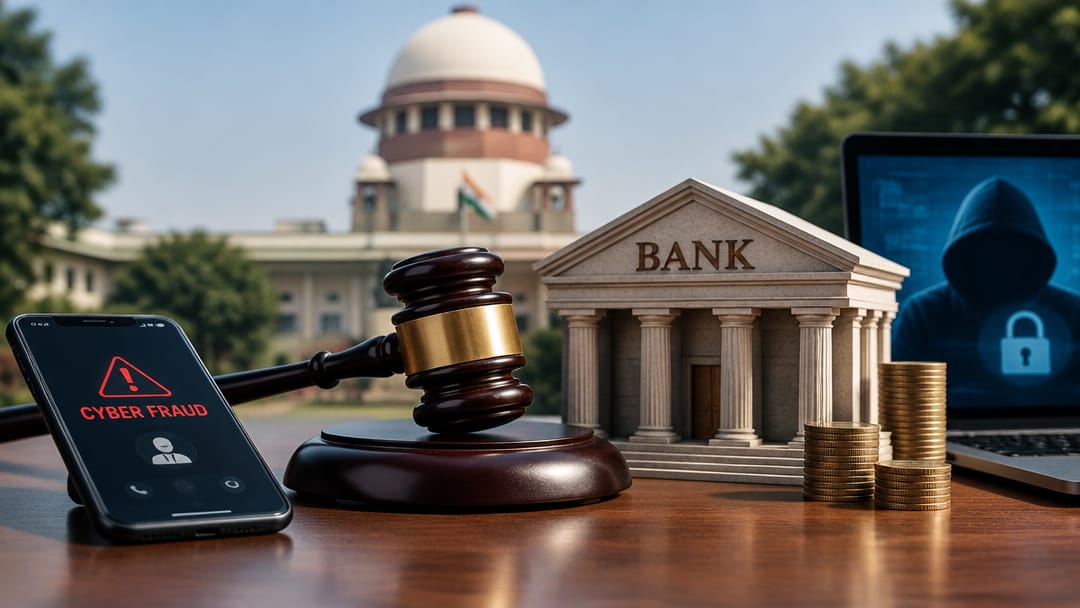
The Supreme Court, hearing a digital arrest fraud matter, held that banks must bear strict liability when customers suffer cyber fraud losses caused by the bank's failure to exercise due diligence or where collusion with fraudsters is established. The Court signalled that financial institutions cannot escape responsibility by treating such losses as purely a customer's problem, marking a significant shift in how banking negligence in cyber fraud cases will be adjudicated going forward.
02 Understand
Why it matters
This ruling sits at the intersection of constitutional rights under Article 21 (right to life and personal liberty, which includes the right to livelihood and financial security) and statutory banking law. The doctrine of strict liability, borrowed from tort law (Rylands v Fletcher, applied in Indian context through M.C. Mehta v Union of India), removes the requirement to prove intent — a bank is liable if fraud occurred due to its systemic failure, regardless of whether it intended harm.
The Court's reasoning rests on two distinct grounds: (1) negligence through failure of due diligence — banks are regulated entities under the Banking Regulation Act, 1949 and RBI guidelines, and have an affirmative duty to deploy fraud-detection systems, KYC protocols, and transaction monitoring; (2) collusion — if bank insiders assist fraudsters, liability is unambiguous.
For CLAT PG, the critical constitutional angle is that Article 21 has been read expansively since Maneka Gandhi v Union of India (1978) to protect dignified life, and loss of life savings through banker negligence arguably violates that guarantee. The Court's application of the 'just, fair, and reasonable' test (also from Maneka Gandhi) to bank conduct is the doctrinal bridge.
For RBI Grade B, the regulatory angle matters more: RBI's Master Directions on Fraud Classification and Reporting, and the obligation on banks under the Payment and Settlement Systems Act, 2007 are the statutory pillars the examiner will probe.
The Court's reasoning rests on two distinct grounds: (1) negligence through failure of due diligence — banks are regulated entities under the Banking Regulation Act, 1949 and RBI guidelines, and have an affirmative duty to deploy fraud-detection systems, KYC protocols, and transaction monitoring; (2) collusion — if bank insiders assist fraudsters, liability is unambiguous.
For CLAT PG, the critical constitutional angle is that Article 21 has been read expansively since Maneka Gandhi v Union of India (1978) to protect dignified life, and loss of life savings through banker negligence arguably violates that guarantee. The Court's application of the 'just, fair, and reasonable' test (also from Maneka Gandhi) to bank conduct is the doctrinal bridge.
For RBI Grade B, the regulatory angle matters more: RBI's Master Directions on Fraud Classification and Reporting, and the obligation on banks under the Payment and Settlement Systems Act, 2007 are the statutory pillars the examiner will probe.
Remember + Why it matters
The key recall facts and exact examiner angle for RBI Grade B are in the Crux app.
01
Key figure and date from this topic
02
Specific number or threshold to remember
03
Policy or regulatory implication
Read + Understand free forever · 30-day free trial