01 Read
What happened
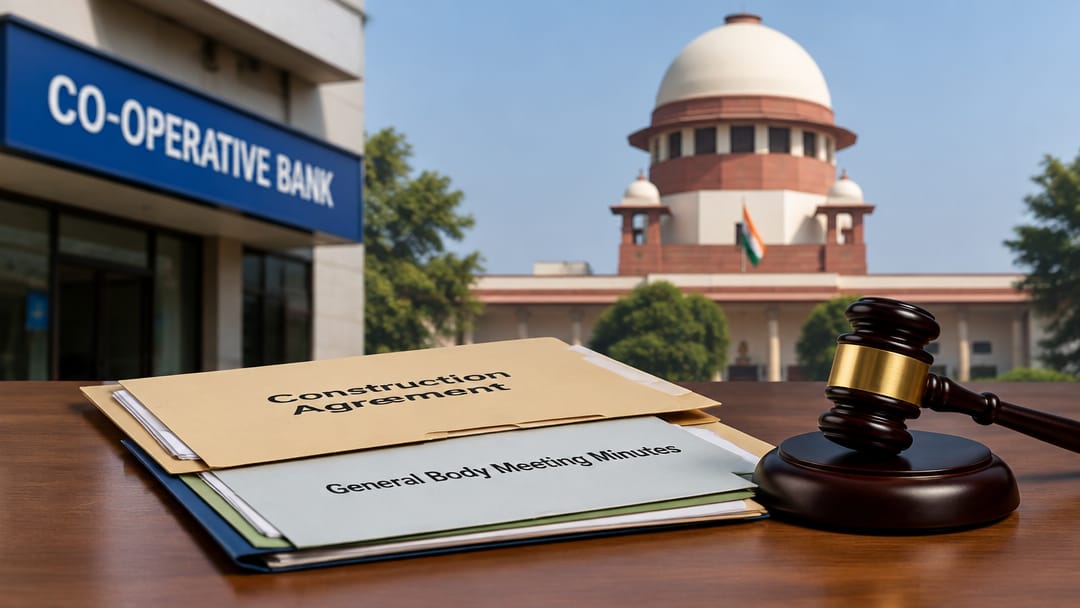
The Supreme Court dismissed appeals by a co-operative bank, upholding a member's right to obtain the bank's construction agreement and General Body Meeting minutes under the RTI Act. The court affirmed that co-operative banks, being substantially financed by or under the control of government, qualify as 'public authorities' under Section 2(h) of the RTI Act, obligating them to disclose internal documents to members who seek them.
02 Understand
Why it matters
This ruling clarifies a persistently contested question: do co-operative banks fall within the RTI Act's definition of 'public authority'? Section 2(h) of the RTI Act, 2005 defines a public authority as any body owned, controlled, or substantially financed by the appropriate government, or any non-government organisation substantially financed directly or indirectly by funds provided by the government. Co-operative banks occupy a hybrid space — they are formed under state co-operative societies legislation, are regulated by the Reserve Bank of India, and often receive government funds or guarantees, yet they claim the autonomy of private membership institutions.
The Supreme Court's reasoning here applies a functional test: what matters is not the formal label (private versus public) but the degree of government control or financing. This is consistent with the broader trajectory of RTI jurisprudence, which has progressively expanded the circle of accountable institutions — from government departments to statutory bodies, PSUs, and now co-operative entities.
For an aspirant, the critical principle is the two-part test under Section 2(h): (i) substantial financing by government, or (ii) government ownership or control. Meeting either limb suffices. A construction agreement between the bank and a contractor, and minutes of General Body Meetings, both relate to the bank's exercise of powers affecting its members, making disclosure consistent with RTI's core transparency objective.
The ruling also reinforces that internal governance documents of public authorities — not merely policy files — are disclosable, subject to exemptions under Sections 8 and 9 of the RTI Act.
The Supreme Court's reasoning here applies a functional test: what matters is not the formal label (private versus public) but the degree of government control or financing. This is consistent with the broader trajectory of RTI jurisprudence, which has progressively expanded the circle of accountable institutions — from government departments to statutory bodies, PSUs, and now co-operative entities.
For an aspirant, the critical principle is the two-part test under Section 2(h): (i) substantial financing by government, or (ii) government ownership or control. Meeting either limb suffices. A construction agreement between the bank and a contractor, and minutes of General Body Meetings, both relate to the bank's exercise of powers affecting its members, making disclosure consistent with RTI's core transparency objective.
The ruling also reinforces that internal governance documents of public authorities — not merely policy files — are disclosable, subject to exemptions under Sections 8 and 9 of the RTI Act.
Remember + Why it matters
The key recall facts and exact examiner angle for CLAT PG are in the Crux app.
01
Key figure and date from this topic
02
Specific number or threshold to remember
03
Policy or regulatory implication
Read + Understand free forever · 30-day free trial