01 Read
What happened
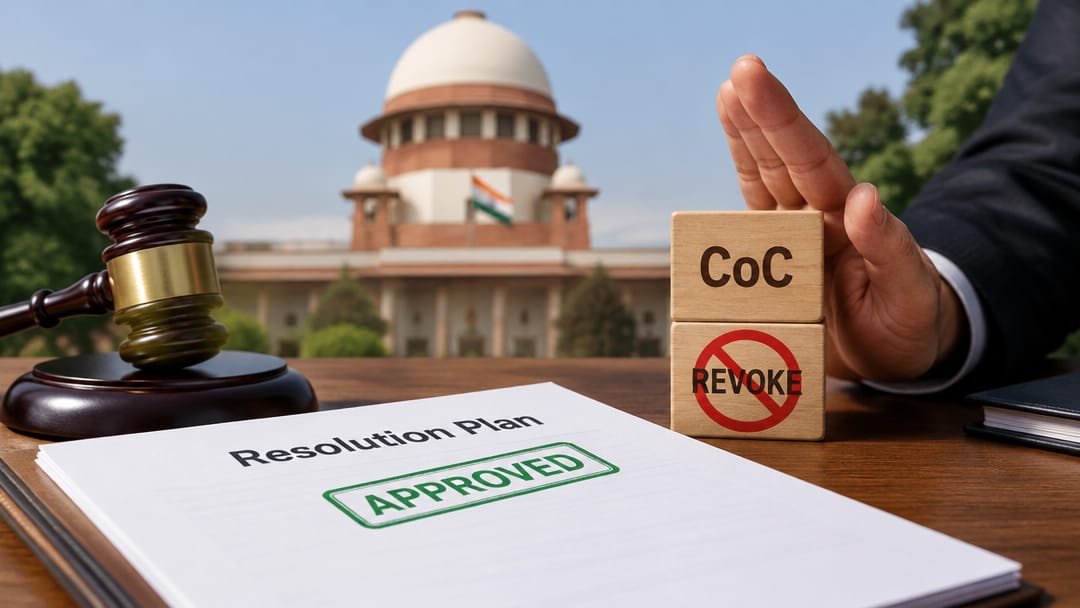
The Supreme Court on October 26 ruled that a Committee of Creditors cannot withdraw its approval of a resolution plan after voting in favour of it, even if the corporate debtor's financial position has improved since the vote. The Court held that CoC approval, once given, binds the process and cannot be reversed on commercial grounds. The ruling reinforces the finality of the insolvency resolution process under the Insolvency and Bankruptcy Code, 2016.
02 Understand
Why it matters
Under the Insolvency and Bankruptcy Code (IBC), 2016, once a Committee of Creditors approves a resolution plan by the required majority (66% voting share), the plan moves toward NCLT approval and eventual implementation. The CoC functions as the commercial decision-maker within the Corporate Insolvency Resolution Process (CIRP), but its authority is procedurally bounded — it cannot revisit a concluded vote simply because circumstances have changed.
This judgment addresses a situation where creditors, having approved a resolution plan, later sought to withdraw that approval citing improved financial health of the debtor. The Supreme Court rejected this, holding that the IBC does not contemplate a withdrawal mechanism at the post-approval stage on such grounds. The resolution plan, once approved by CoC, is meant to be submitted to NCLT under Section 30(6), and the CoC cannot stall or reverse this by claiming better recovery prospects now exist.
The significance for exam purposes is layered: (1) it tests understanding of the CoC's role and its limits under the IBC; (2) it clarifies that commercial wisdom of CoC, while wide in scope, is not unlimited in time — it crystallises at the point of voting; (3) it reinforces the IBC's core objective of time-bound resolution. For CLAT PG aspirants, this connects to questions on CoC powers, CIRP timelines, and the finality of resolution plans, all of which have been tested through statutory identification and case-law classification templates.
Remember + Why it matters
The key recall facts and exact examiner angle for CLAT PG are in the Crux app.
01
Key figure and date from this topic
02
Specific number or threshold to remember
03
Policy or regulatory implication
Read + Understand free forever · 30-day free trial