SC strikes down Karnataka's 2022 law validating a tainted 2011 civil service selection
What happened
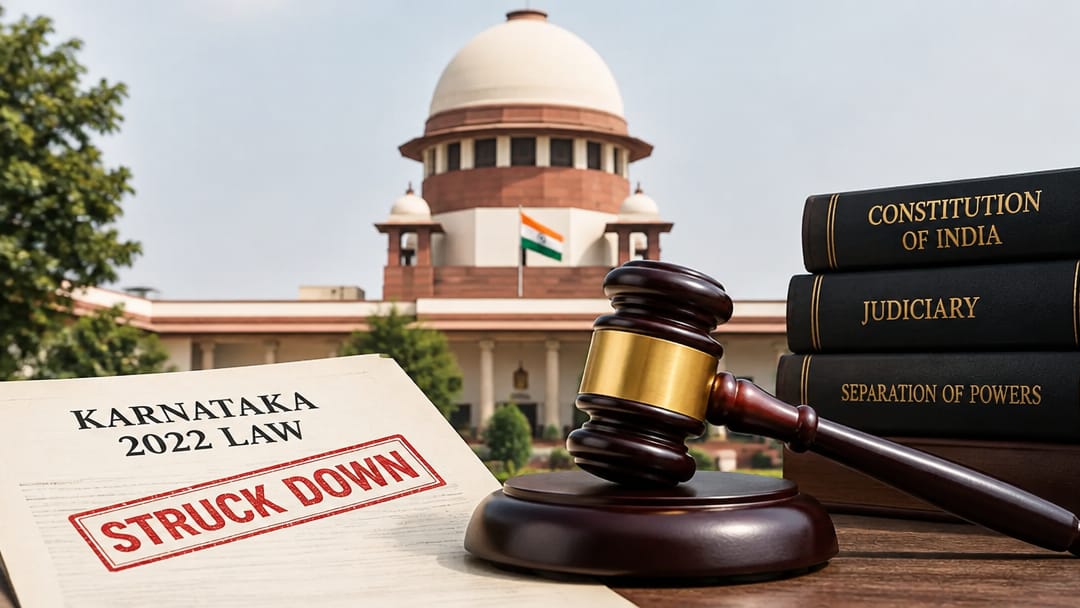
The Supreme Court struck down a 2022 Karnataka law that attempted to validate a 2011 civil service selection process already invalidated by courts. The Court held that a legislature cannot directly annul a judicial judgment; it may only remove the legal basis on which the judgment rested. Because the Karnataka legislature did neither — it simply declared the tainted selection valid — the law amounted to an unconstitutional legislative override of a judicial verdict, violating the separation of powers doctrine.
Why it matters
This ruling applies a well-established constitutional doctrine: the separation of powers bars the legislature from directly nullifying a court judgment. The doctrine originates in Madras & Southern Mahratta Railway Co. v. Bezwada Municipality (1944) and was crystallised by the Supreme Court in Shri Prithvi Cotton Mills Ltd. v. Broach Borough Municipality (1969), which laid down the test still used today.
The test has two limbs. First, a legislature may not simply declare that a specific court verdict shall not stand — that is a direct annulment and is unconstitutional. Second, a legislature may enact a law that removes or alters the very legal foundation (the statutory provision, rule, or factual basis) on which the court's decision rested. If the foundation is validly removed, the judgment becomes unenforceable not because the legislature overruled it, but because the law it applied no longer exists.
The distinction is critical for CLAT PG: the legislature acts on the law, not on the judgment. When Karnataka's 2022 law simply declared the 2011 selection 'valid' without touching the underlying Rules or criteria the court had found defective, it crossed the line — it targeted the verdict itself, not its legal basis.
This doctrine is rooted in Articles 50, 121, and 211 (separation of judiciary from executive/legislature) and the basic structure doctrine (Kesavananda Bharati, 1973), which protects judicial review as unamendable. The ruling also implicates Article 14 (arbitrariness in public employment) because reinstating a tainted selection without a valid legal cure treats similarly situated candidates unequally.
Bombay HC orders Rs 2 lakh compensation for activist's unlawful 2011 arrest
What happened
The Bombay High Court ruled that Maharashtra violated activist Arun Ferreira's fundamental rights during his 2011 arrest, linked to Elgar Parishad and Naxal-related charges. The court found breaches of Articles 21 and 22 of the Constitution and ordered the state to pay Rs 2 lakh as compensation. The ruling, delivered in 2026, came fifteen years after the arrest, reinforcing the principle that illegal detention entitles citizens to monetary remedy against the state.
Why it matters
This ruling operationalises a foundational principle in Indian constitutional law: the state is liable to pay compensation for violations of fundamental rights, particularly Article 21 (right to life and personal liberty) and Article 22 (protection against arbitrary arrest and detention).
The constitutional basis for compensation as a remedy was established in Rudal Shah v. State of Bihar (1983), where the Supreme Court held that the right to compensation flows directly from Article 21 — courts exercising writ jurisdiction can award monetary remedy without the victim needing to file a separate civil suit. This was reinforced in Bhim Singh v. State of J&K (1985), where a legislator's wrongful detention triggered compensation from the state.
Article 22 provides specific procedural safeguards: the arrested person must be informed of the grounds of arrest, must have the right to consult a legal practitioner of their choice, and must be produced before a magistrate within 24 hours. Violation of any of these requirements renders the arrest unlawful.
The Ferreira case is significant because it demonstrates that these protections are enforceable even years later through writ jurisdiction, and that the passage of time does not extinguish the constitutional claim. Under BNSS 2023 (replacing CrPC), Section 35 now codifies arrest safeguards, while Section 47 deals with production before a magistrate — the statutory descendants of CrPC Sections 50 and 57.
SC: banks face strict liability for cyber fraud if due diligence fails or collusion found
What happened
The Supreme Court, hearing a digital arrest fraud matter, held that banks must bear strict liability when customers suffer cyber fraud losses caused by the bank's failure to exercise due diligence or where collusion with fraudsters is established. The Court signalled that financial institutions cannot escape responsibility by treating such losses as purely a customer's problem, marking a significant shift in how banking negligence in cyber fraud cases will be adjudicated going forward.
Why it matters
This ruling sits at the intersection of constitutional rights under Article 21 (right to life and personal liberty, which includes the right to livelihood and financial security) and statutory banking law. The doctrine of strict liability, borrowed from tort law (Rylands v Fletcher, applied in Indian context through M.C. Mehta v Union of India), removes the requirement to prove intent — a bank is liable if fraud occurred due to its systemic failure, regardless of whether it intended harm.
The Court's reasoning rests on two distinct grounds: (1) negligence through failure of due diligence — banks are regulated entities under the Banking Regulation Act, 1949 and RBI guidelines, and have an affirmative duty to deploy fraud-detection systems, KYC protocols, and transaction monitoring; (2) collusion — if bank insiders assist fraudsters, liability is unambiguous.
For CLAT PG, the critical constitutional angle is that Article 21 has been read expansively since Maneka Gandhi v Union of India (1978) to protect dignified life, and loss of life savings through banker negligence arguably violates that guarantee. The Court's application of the 'just, fair, and reasonable' test (also from Maneka Gandhi) to bank conduct is the doctrinal bridge.
For RBI Grade B, the regulatory angle matters more: RBI's Master Directions on Fraud Classification and Reporting, and the obligation on banks under the Payment and Settlement Systems Act, 2007 are the statutory pillars the examiner will probe.
How Indian courts read substantive due process into Article 21 without amending it
What happened
India's Constitution adopted 'procedure established by law' under Article 21, rejecting the American 'due process of law' standard at the Constituent Assembly stage. Yet through landmark rulings — Maneka Gandhi (1978), Francis Coralie (1981), and the Right to Privacy judgment (2017) — the Supreme Court progressively read substantive fairness into Article 21, effectively importing due process values without amending the text. Today, any law curtailing life or liberty must be just, fair, and reasonable.
Why it matters
The distinction between 'procedure established by law' and 'due process of law' is one of the most consequential doctrinal choices in Indian constitutional history.
The American Fifth and Fourteenth Amendments guarantee that no person shall be deprived of life, liberty, or property without 'due process of law.' This standard has two components: procedural due process (notice, hearing, impartial tribunal) and substantive due process (the law itself must be reasonable, not arbitrary).
India's framers deliberately chose the narrower formula. Article 21 reads: 'No person shall be deprived of his life or personal liberty except according to procedure established by law.' Dr. B.R. Ambedkar and the Constituent Assembly rejected Sir Alladi Krishnaswami Ayyar's proposal to insert 'due process' fearing that judges might invalidate social welfare legislation as unreasonable — a concern drawn from early 20th-century American experience (Lochner era).
A.K. Gopalan v. State of Madras (1950) confirmed this narrow reading: the Supreme Court held that each Fundamental Right operates in a separate watertight compartment, and if the procedure prescribed by a valid law was followed, Article 21 was satisfied.
Maneka Gandhi v. Union of India (1978) demolished this reading. A seven-judge bench held that the word 'law' in Article 21 cannot be any law — it must be right, just, and fair. Procedural requirements must satisfy Articles 14 (non-arbitrariness) and 19 (reasonableness), creating a 'golden triangle.' This effectively introduced substantive due process through judicial interpretation.
Francis Coralie Mullin v. Administrator (1981) extended the right to life beyond mere animal existence to include the right to live with dignity.
The nine-judge bench in K.S. Puttaswamy v. Union of India (2017) unanimously held that the right to privacy is a fundamental right under Article 21, and expressly used substantive due process reasoning to test restrictions on it.
In practice, the current Indian position mirrors substantive due process: a law depriving life or liberty must (1) be a validly enacted law, (2) be just, fair, and reasonable (not arbitrary under Art. 14), and (3) not unreasonably restrict freedoms under Art. 19.
Re-arrested at the prison gate on release day: HC rules Ferreira's 2011 detention illegal
What happened
The Bombay High Court has ruled that the September 2011 re-arrest of activist Arun Ferreira violated his fundamental rights. Ferreira was detained at the gate of Nagpur Central Jail at the very moment he was being released in separate cases. The court found the re-arrest constitutionally impermissible, affirming that the right to personal liberty under Article 21 cannot be extinguished by successive detentions engineered to prevent actual release from custody.
Why it matters
This ruling engages three interlocking constitutional provisions: Article 21 (right to life and personal liberty), Article 22 (protection against arbitrary arrest and detention), and the broader doctrine of constitutional tort developed under Article 32 and Article 226.
The right to personal liberty under Article 21 is not merely procedural — the Supreme Court in Maneka Gandhi v. Union of India (1978) held that any procedure curtailing liberty must be just, fair, and reasonable, not merely lawfully authorised. That standard directly applies here: even if a fresh FIR existed, the manner of arrest — waiting at the prison gate to prevent physical release — was held to defeat the very substance of the liberty the court had granted.
Article 22(1) guarantees the right to be informed of grounds of arrest and to consult a lawyer. Article 22(2) requires production before a magistrate within 24 hours. A re-arrest engineered to neutralise a court order releasing the accused raises the further question of whether such conduct amounts to contempt and a constitutional tort — a concept examined in CLAT PG 2024.
The doctrine of constitutional tort, established in Rudal Shah v. State of Bihar (1983), permits courts to award compensation for illegal detention as a public law remedy under Article 21. This case sits squarely within that lineage: the state cannot use sequential FIRs or strategic re-arrests to hollow out liberty rights, and courts can strike down such detention and award damages.
For CLAT PG, the key principle is that liberty rights impose both a negative duty (not to detain without cause) and a positive duty (to ensure release is meaningful and real, not merely nominal).
DPDPA Section 36 lets the executive bypass privacy rules without Parliament
What happened
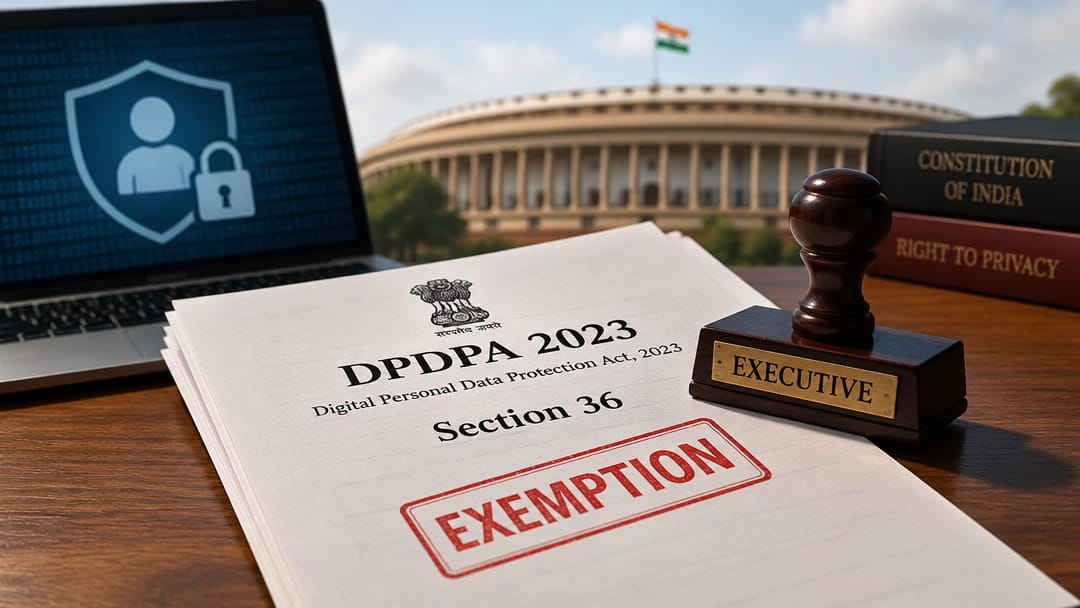
Section 36 of the Digital Personal Data Protection Act, 2023 empowers the Central Government to exempt any data fiduciary, including state agencies, from the Act's provisions through executive notification. Enacted as a consequence of the Supreme Court's Puttaswamy judgment recognising privacy as a fundamental right under Article 21, the section has drawn criticism for allowing the executive to hollow out privacy protections without parliamentary oversight, raising constitutional questions about proportionality and the right to privacy itself.
Why it matters
The Digital Personal Data Protection Act, 2023 was Parliament's legislative response to K.S. Puttaswamy v. Union of India (2017), where a nine-judge bench unanimously held that privacy is a fundamental right under Article 21. The Puttaswamy court laid down that any restriction on privacy must satisfy a three-part test: legality (a law must exist), legitimate aim (a compelling state interest), and proportionality (the means must be necessary and narrowly tailored).
Section 36 of the DPDPA 2023 allows the Central Government to issue notifications exempting any data fiduciary from one or more provisions of the Act in the interest of sovereignty, security, or friendly relations with foreign states, or for maintaining public order. Critically, this power is exercised by executive notification, not by legislation, which raises the question: does an executive exemption satisfy the Puttaswamy proportionality test, which demands a 'law' and not merely an executive order?
The constitutional tension is sharp. Article 21 rights can be curtailed only by 'procedure established by law,' and post-Maneka Gandhi (1978), that procedure must be fair, just, and reasonable. An open-ended executive power to grant exemptions — without a sunset clause, parliamentary scrutiny, or judicial oversight — arguably fails the proportionality and necessity tests the Supreme Court itself demanded in Puttaswamy.
For CLAT PG, Section 36 sits at the intersection of three tested doctrines: the right to privacy under Article 21, the proportionality standard from Puttaswamy, and the constitutional validity of delegated legislation that curtails fundamental rights.
SC: reopened tax assessment valid only if no opinion was formed the first time
What happened
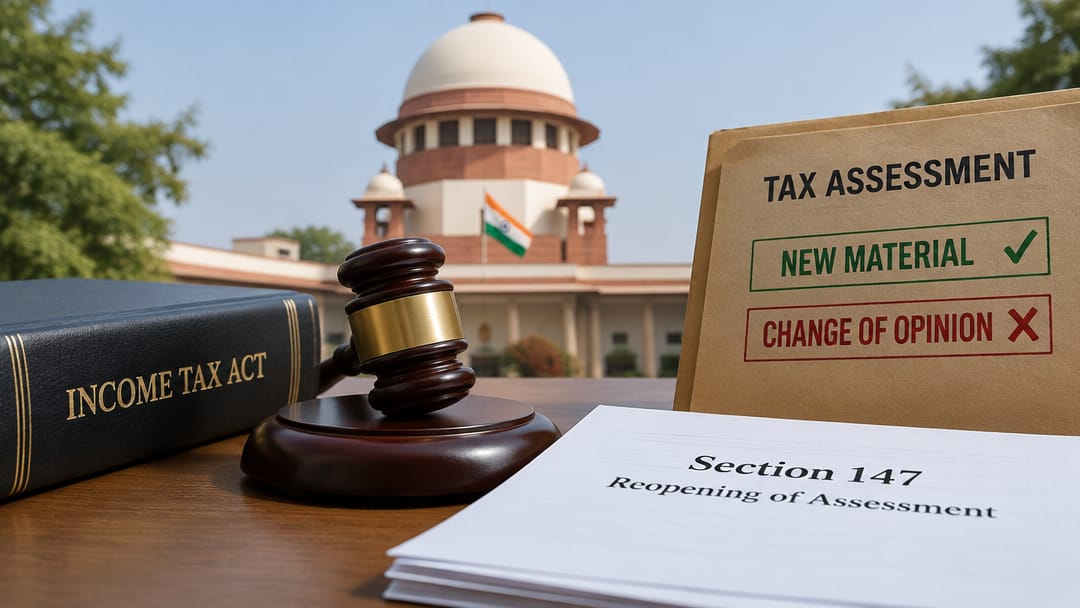
The Supreme Court ruled that a tax assessment under Section 147 of the Income Tax Act can be reopened on fresh material showing escaped income, but only if the Assessing Officer had not already formed an opinion on that issue during the original assessment. If an opinion was formed earlier, reopening amounts to a review of a concluded decision, which is impermissible. The ruling draws a clear line between reassessment based on new facts and impermissible change of opinion.
Why it matters
Section 147 of the Income Tax Act empowers the Assessing Officer to reopen a completed assessment if they have 'reason to believe' that income chargeable to tax has escaped assessment. However, judicial interpretation has consistently held that this power is not unlimited — it cannot be used as a second look at the same material already examined.
The Supreme Court's ruling crystallises the distinction between two situations: (1) where fresh tangible material surfaces that was not before the AO during the original assessment, and (2) where the AO simply changes their mind on material already examined. Only the first justifies reopening.
The critical condition is whether an 'opinion was formed' in the first instance. If the AO applied their mind to a particular issue and took a conscious position — even by not making an addition — reopening on the same facts is a review, not a reassessment. This is the doctrine against 'change of opinion,' recognised in landmark cases like CIT v. Kelvinator of India Ltd. (2010) 2 SCC 723.
For CLAT PG aspirants, this matters because the examiner frequently uses tax-law passages to test the ability to apply a restrictive statutory interpretation. The principle — power exists but is conditioned by prior non-application of mind — maps onto a broader jurisprudential theme: administrative and quasi-judicial powers cannot be used to review one's own earlier reasoned decisions.
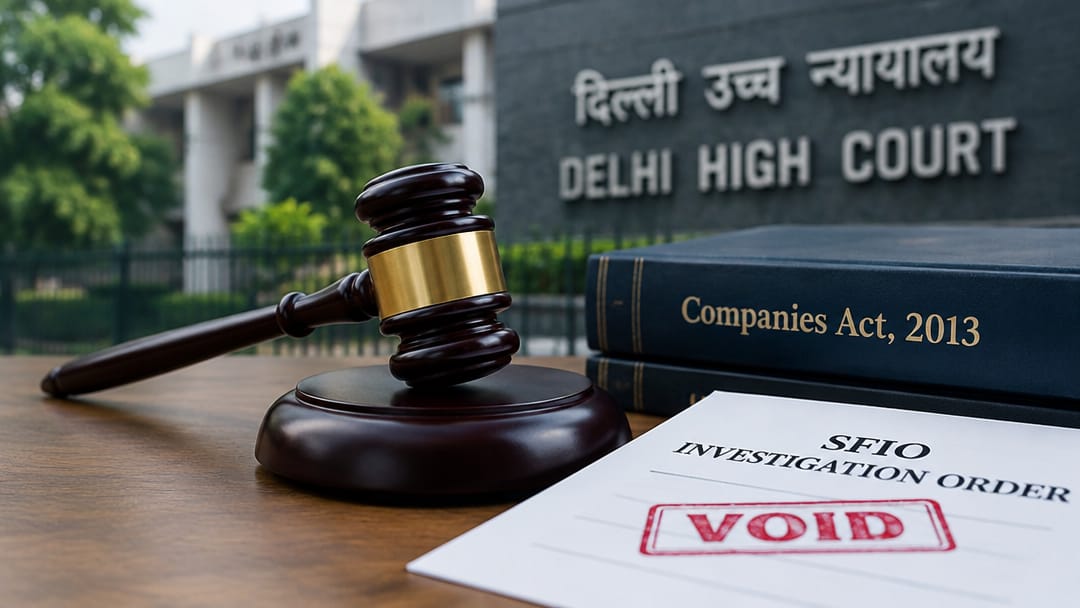
Delhi HC voids SFIO order under Section 212 for lack of application of mind
What happened
Justice Sachin Datta of the Delhi High Court struck down an SFIO investigation order issued under Section 212 of the Companies Act, 2013, holding it legally unsustainable. The court ruled that ordering an SFIO investigation is a serious statutory measure with substantial consequences for companies and individuals, and cannot be mechanically issued. The government must demonstrate genuine application of mind before directing the SFIO to investigate alleged corporate fraud.
Why it matters
Section 212 of the Companies Act, 2013 empowers the Central Government to assign investigation of a company's affairs to the Serious Fraud Investigation Office (SFIO) when it believes that the business of the company is being or has been conducted in a fraudulent or unlawful manner. Once an SFIO investigation is ordered, it carries serious consequences: directors can be arrested without bail under Section 212(8), and the SFIO Inspector's report is treated as a police report under the CrPC.
The Delhi HC ruling introduces a critical procedural safeguard: the order directing investigation must reflect genuine application of mind by the government authority. A mechanical or routine order — one that simply invokes the statutory language without engaging with the specific facts of the case — will not survive judicial scrutiny. This is consistent with the broader administrative law principle that statutory powers carrying penal or quasi-penal consequences demand reasoned, individualized exercise.
For CLAT PG aspirants, the significance is threefold. First, it reinforces that Section 212 powers are not absolute — they carry a reasonableness threshold. Second, it connects to the Supreme Court's earlier ruling in SFIO v. Rahul Modi, which addressed the time-period interpretation for SFIO investigations. Third, it clarifies that judicial review of SFIO orders is available, limiting the government's discretion under a statute that otherwise confers sweeping investigative authority. The examiner will test whether aspirants can distinguish between the power to order an investigation and the conditions that make that order legally valid.