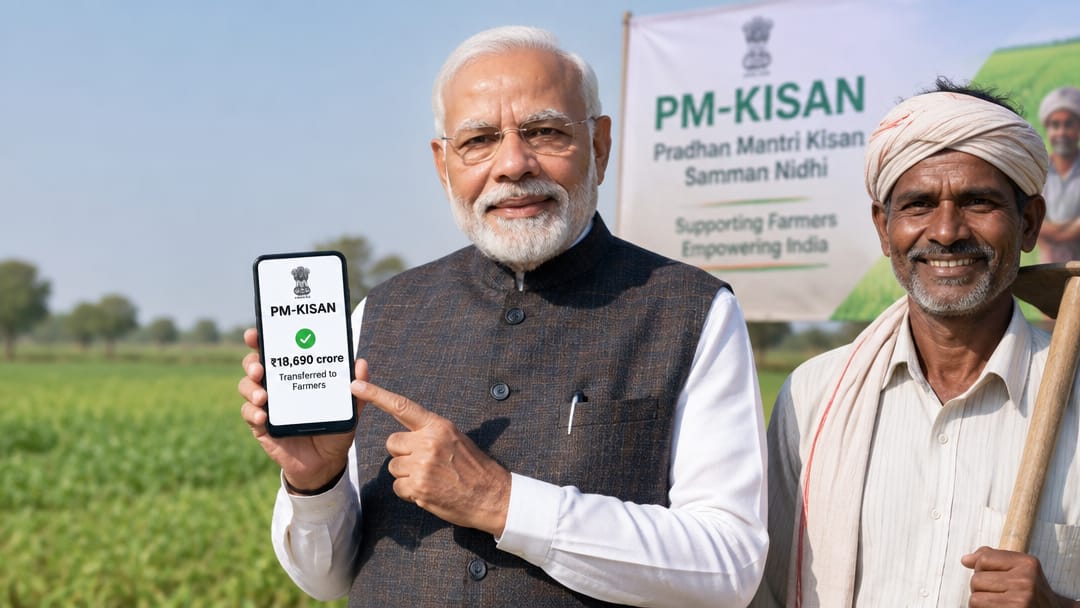
PM-KISAN 24th instalment: ₹18,690 crore in direct transfers to farmers
What happened
Prime Minister Narendra Modi released the 24th instalment of the PM-KISAN scheme, transferring over ₹18,690 crore directly to eligible farmer families via Direct Benefit Transfer. PM-KISAN provides ₹6,000 per year in three equal instalments of ₹2,000 each to small and marginal landholding farmer families. The scheme, launched in February 2019, is a central sector scheme funded entirely by the Government of India and administered by the Ministry of Agriculture and Farmers Welfare.
Why it matters
PM-KISAN (Pradhan Mantri Kisan Samman Nidhi) is a Central Sector Scheme — meaning it is 100% funded by the Union Government with no state share — that provides income support to farmer families holding cultivable land. The annual benefit of ₹6,000 is paid in three instalments of ₹2,000 each, credited directly to beneficiaries' Aadhaar-linked bank accounts through Direct Benefit Transfer (DBT), eliminating intermediaries and leakage.
The scheme was originally announced in the Interim Budget 2019 with effect from December 1, 2018, making all small and marginal farmers (up to 2 hectares) eligible. It was later expanded in June 2019 to cover all farmer families irrespective of landholding size, subject to exclusion criteria.
Key exclusions include institutional landholders, farmer families holding constitutional posts, serving or retired government employees, income tax payees, and professionals like doctors, engineers, and lawyers.
For competitive exams, three dimensions matter: (1) Financial inclusion — DBT through Jan Dhan-Aadhaar-Mobile (JAM) trinity is the delivery backbone; (2) Agricultural credit — NABARD's lens is whether income support reduces distress borrowing and strengthens rural credit repayment capacity; (3) Fiscal architecture — it is a Central Sector scheme, not Centrally Sponsored, a distinction examiners test frequently. The 24th instalment crossing ₹18,690 crore in a single transfer underscores the scheme's scale as one of the world's largest direct benefit transfer programmes.
SC: banks face strict liability for cyber fraud if due diligence fails or collusion found
What happened
The Supreme Court, hearing a digital arrest fraud matter, held that banks must bear strict liability when customers suffer cyber fraud losses caused by the bank's failure to exercise due diligence or where collusion with fraudsters is established. The Court signalled that financial institutions cannot escape responsibility by treating such losses as purely a customer's problem, marking a significant shift in how banking negligence in cyber fraud cases will be adjudicated going forward.
Why it matters
This ruling sits at the intersection of constitutional rights under Article 21 (right to life and personal liberty, which includes the right to livelihood and financial security) and statutory banking law. The doctrine of strict liability, borrowed from tort law (Rylands v Fletcher, applied in Indian context through M.C. Mehta v Union of India), removes the requirement to prove intent — a bank is liable if fraud occurred due to its systemic failure, regardless of whether it intended harm.
The Court's reasoning rests on two distinct grounds: (1) negligence through failure of due diligence — banks are regulated entities under the Banking Regulation Act, 1949 and RBI guidelines, and have an affirmative duty to deploy fraud-detection systems, KYC protocols, and transaction monitoring; (2) collusion — if bank insiders assist fraudsters, liability is unambiguous.
For CLAT PG, the critical constitutional angle is that Article 21 has been read expansively since Maneka Gandhi v Union of India (1978) to protect dignified life, and loss of life savings through banker negligence arguably violates that guarantee. The Court's application of the 'just, fair, and reasonable' test (also from Maneka Gandhi) to bank conduct is the doctrinal bridge.
For RBI Grade B, the regulatory angle matters more: RBI's Master Directions on Fraud Classification and Reporting, and the obligation on banks under the Payment and Settlement Systems Act, 2007 are the statutory pillars the examiner will probe.
Green, social, and sustainability-linked bonds: how the GSSS market works
What happened
The Sustainable Bonds Insight 2026 report, published by Environmental Finance, tracks global trends in green, social, sustainability, and sustainability-linked bonds — the GSSS market. It covers issuance volumes, use-of-proceeds frameworks, labelling standards, and emerging instruments such as blue and transition bonds. The report is freely downloadable and provides data-rich infographics on how capital markets are channelling private finance toward climate and social objectives, relevant to India's sovereign green bond programme and RBI's green finance guidelines.
Why it matters
The GSSS bond market is the primary mechanism through which capital markets finance the low-carbon transition. Each instrument within it has a distinct architecture worth understanding for exams.
**Green Bonds** raise capital exclusively for projects with measurable environmental benefits — renewable energy, clean transport, green buildings — verified against frameworks like the ICMA Green Bond Principles or the EU Green Bond Standard.
**Social Bonds** finance projects with positive social outcomes: affordable housing, healthcare, education, food security. They follow ICMA Social Bond Principles.
**Sustainability Bonds** combine both green and social use-of-proceeds categories.
**Sustainability-Linked Bonds (SLBs)** are structurally different: proceeds are not ring-fenced for specific projects. Instead, the bond's financial terms (typically the coupon rate) are tied to the issuer meeting pre-defined Sustainability Performance Targets (SPTs). If the issuer misses the target, the coupon steps up — creating a financial penalty. This instruments-vs-outcomes distinction is crucial for exam questions.
In India's context: SEBI issued its Green Bond framework in 2023 (renamed from 2017 circular), defining eligible categories. The RBI issued India's first Sovereign Green Bond (SGB) in January 2023, raising ₹8,000 crore at a 'greenium' (lower yield than comparable government bonds). NABARD issues green bonds for climate-resilient agriculture and acts as a National Implementing Entity under the Adaptation Fund and Green Climate Fund. The GSSS market globally crossed $4 trillion in cumulative issuance by 2024.
Ayushman Vay Vandana: free health cover of ₹5 lakh extended to all citizens aged 70+
What happened
Launched on 29 October 2024, Ayushman Vay Vandana extends Ayushman Bharat–Pradhan Mantri Jan Arogya Yojana coverage to all Indian citizens aged 70 years and above, regardless of income. Beneficiaries receive a dedicated annual health cover of ₹5 lakh per individual. Senior citizens already enrolled under AB-PMJAY get an additional top-up of ₹5 lakh. The scheme is implemented by the National Health Authority under the Ministry of Health and Family Welfare.
Why it matters
Ayushman Vay Vandana is a targeted extension of the flagship AB-PMJAY health insurance scheme, designed to address a critical gap: India's rapidly ageing population had no universal public health cover irrespective of economic status. Before this, AB-PMJAY covered only families below the income threshold. Vay Vandana removes the means-test criterion entirely for the 70+ age group, making it the first universally applicable health entitlement within the Ayushman Bharat architecture.
The scheme operates on a cashless, paperless model via the Ayushman app and ABHA (Ayushman Bharat Health Account) ID. Empanelled hospitals — both public and private — are obligated to provide treatment under the scheme's package rates, which is significant for financial inclusion: elderly citizens, often outside the formal workforce, face catastrophic out-of-pocket health expenditure.
From an RBI/NABARD angle, this scheme reduces household financial vulnerability among the elderly, which in turn protects rural credit portfolios — a sick elderly borrower defaulting is a well-documented rural NPA driver. From a UPSC governance angle, the scheme tests the Centre's ability to deliver cashless entitlements universally using digital health infrastructure (ABHA ID, PM-JAY portal). The '70+ age, income-independent' design is the core exam-testable distinguishing feature separating Vay Vandana from the parent PMJAY scheme.
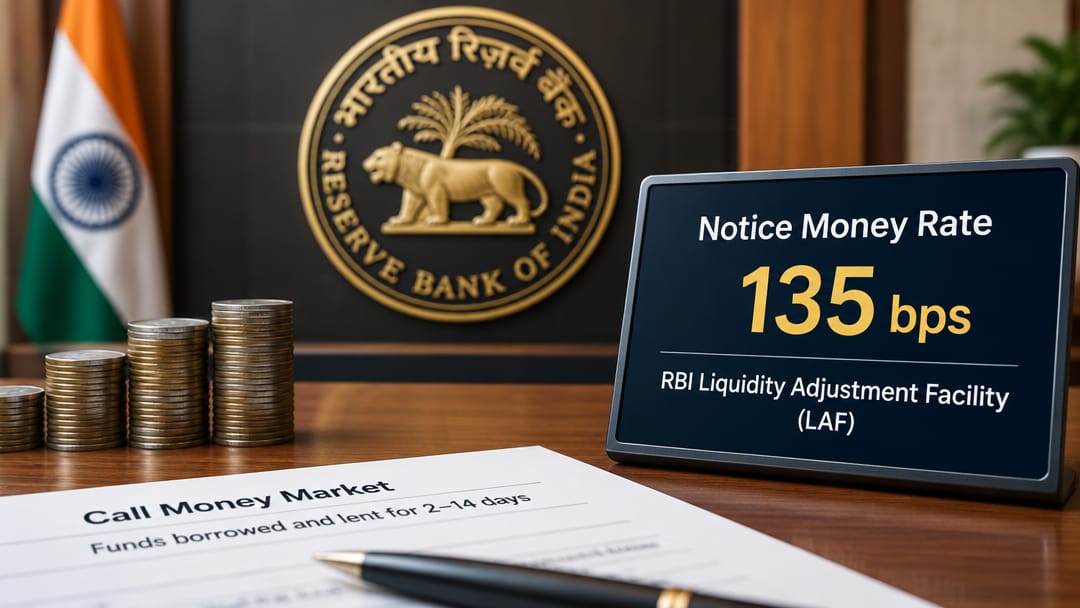
RBI's money market operations page shows the Notice Money rate at 135.00 basis points, referenced in Press Release No. 2025-2026/1201 dated September 30, 2025. Notice Money is a key segment of India's call money market where funds are borrowed and lent for 2–14 days. RBI monitors and publishes these rates as part of its Liquidity Adjustment Facility framework, which determines the operating corridor for short-term interest rates in the Indian financial system.
Why it matters
India's money market is segmented by tenor. Call Money covers overnight borrowing and lending between banks. Notice Money extends this to 2–14 days without requiring a fixed repayment schedule at the outset — the lender gives 'notice' before recall. Term Money covers 15 days to one year. All three segments are unsecured, meaning no collateral is pledged, which distinguishes them from repo and reverse repo operations under the LAF.
The RBI's Liquidity Adjustment Facility (LAF) corridor anchors these rates. The repo rate sets the ceiling for borrowing costs; the Standing Deposit Facility (SDF) rate acts as the floor since May 2022, replacing the reverse repo rate as the operative floor. The Marginal Standing Facility (MSF) sits 25 bps above repo as an emergency ceiling.
When the Notice Money rate prints at 135 bps (1.35%), it signals conditions in the overnight and near-overnight liquidity market. A rate significantly below the repo rate indicates surplus liquidity; a rate near or above repo signals tightness. The RBI publishes these rates daily as a transparency measure and as an input into its monetary policy transmission assessment.
For the exam, the critical chain is: MPC sets repo → LAF corridor forms → call/notice/term money rates anchor within it → bank lending rates adjust → credit growth and inflation respond. Understanding this transmission is exactly what RBI Grade B tests.
ESG as a regulatory standard: how SEBI, RBI, and NABARD are embedding it in Indian finance
What happened
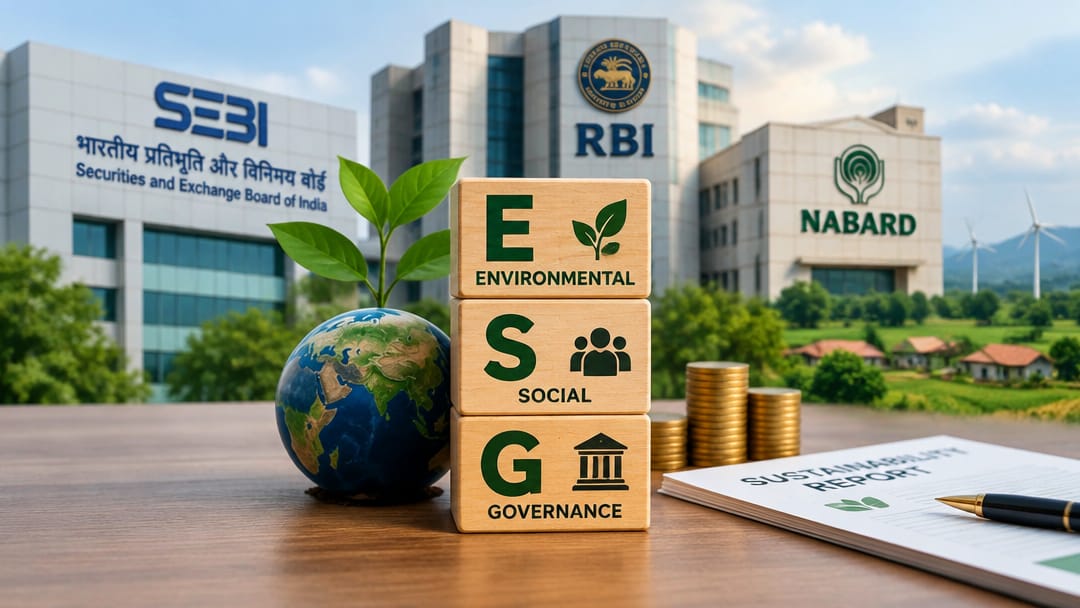
ESG — Environmental, Social, and Governance — is a framework that measures how companies manage climate risk, social responsibility, and board accountability. In India, SEBI mandates Business Responsibility and Sustainability Reporting for top-listed firms, RBI has issued a Discussion Paper on climate risk, and NABARD channels green credit for rural ecology. Globally, ESG ratings now influence sovereign and corporate borrowing costs, making it central to financial regulation and India's net-zero commitments under the Paris Agreement.
Why it matters
ESG is not merely a corporate buzzword — it is a structured risk-assessment and disclosure framework that regulators worldwide are converting into binding obligations.
**Environmental (E):** Covers carbon emissions, water use, biodiversity impact, and climate transition risk. For banks, the RBI has flagged physical risk (floods, droughts damaging loan collateral) and transition risk (stranded fossil-fuel assets) as material credit risks.
**Social (S):** Covers labour rights, supply-chain standards, community impact, and financial inclusion. NABARD's priority-sector lending and watershed programmes are evaluated against social ESG metrics.
**Governance (G):** Covers board composition, executive pay, audit independence, and anti-corruption. SEBI's Listing Obligations and Disclosure Requirements (LODR) embed governance norms for listed companies.
**India-specific architecture:** - SEBI introduced Business Responsibility and Sustainability Report (BRSR) mandatory for the top 1,000 listed companies by market capitalisation from FY 2022–23. - BRSR Core (assurance-backed) became mandatory for the top 150 listed entities from FY 2023–24. - RBI released a Discussion Paper on Climate Risk and Sustainable Finance (2023), proposing scenario analysis and stress-testing for banks. - NABARD issues Green Bonds and supports climate-resilient agriculture under the National Adaptation Fund for Climate Change (NAFCC). - India's NDC under the Paris Agreement targets 50% cumulative electric power from non-fossil sources by 2030, directly driving ESG-aligned investment flows.
ESG connects to three exam pillars: climate policy (UPSC), financial regulation and green finance (RBI), and rural credit and ecology (NABARD).