India's foodgrain output hits 376.56 MT in 2025-26, up from 265 MT a decade ago
What happened
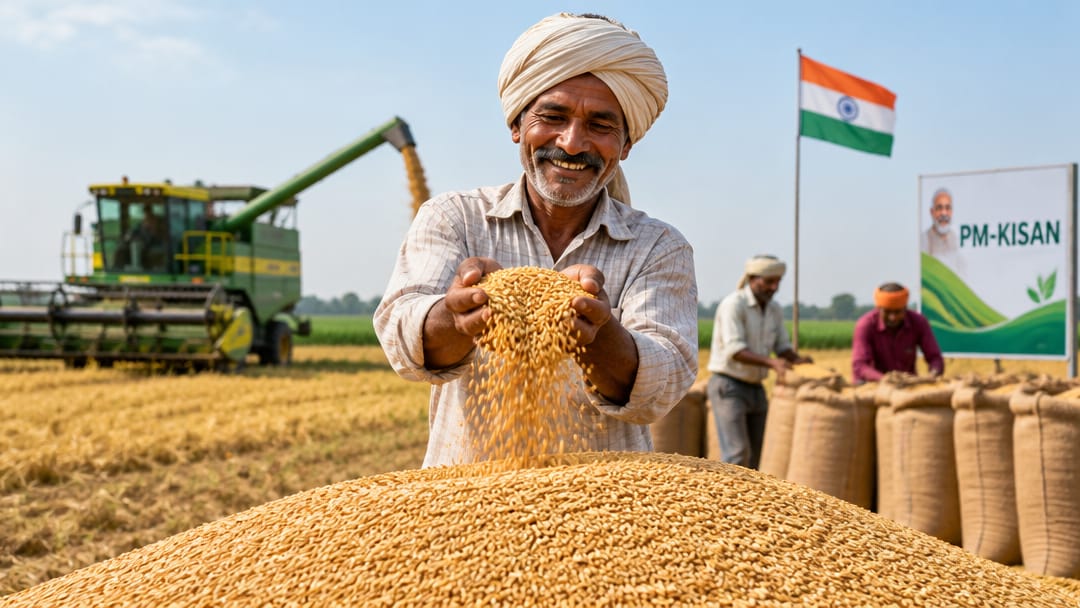
A government factsheet released in August 2026 compiles a decade of agricultural progress. Foodgrain production rose from 265.05 million tonnes in 2013-14 to 376.56 million tonnes in 2025-26. PM-KISAN has transferred over Rs.4.47 lakh crore across 23 instalments to 9.49 crore farmers. Agricultural exports reached USD 54.70 billion in 2025-26. The agriculture budget rose from Rs.27,663 crore in 2013-14 to Rs.1,40,528.78 crore in 2026-27, reflecting sustained policy investment across credit, insurance, and digital infrastructure.
Why it matters
This factsheet consolidates the numerical benchmarks across every major agricultural scheme — making it a one-stop revision source for exams that test scheme-specific figures. The core architecture of India's farm support rests on five pillars: income support (PM-KISAN), crop insurance (PMFBY), price assurance (MSP), credit access (KCC), and market connectivity (e-NAM). Each scheme has distinct parameters that examiners blank out as withheld data.
PM-KISAN provides Rs.6,000 per year in three equal instalments directly to farmers' accounts — a Direct Benefit Transfer (DBT) mechanism. PMFBY, launched in 2016-17, is a premium-based crop insurance scheme where the farmer's share is capped at 2% for Kharif, 1.5% for Rabi, and 5% for commercial/horticultural crops. The KCC scheme provides revolving credit for agricultural operations at concessional interest rates.
On the sustainability side, PKVY promotes cluster-based organic farming, while the National Mission on Natural Farming (NMNF) is a newer flagship promoting chemical-free farming with its own certification system (NFCS). PM KUSUM addresses farm-level energy security through solar pump installation and feeder-level solarisation.
The Digital Agriculture Mission introduces Farmer IDs and Digital Crop Surveys — a structural shift toward data-driven governance of agriculture. e-NAM integrates mandis into a single national electronic market, reducing intermediary dependence. For NABARD aspirants, AIF, PACS computerisation, and FPO formation are credit-infrastructure angles the examiner returns to repeatedly.
Financial Inclusion in India: Banking Every Citizen ...
What happened
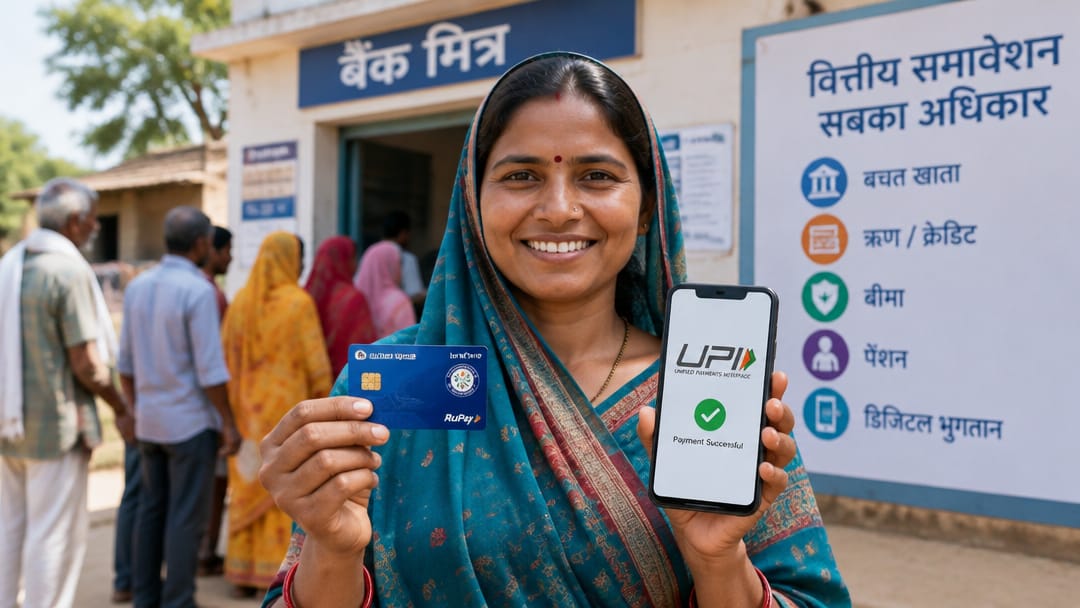
India's financial inclusion drive spans banking, credit, insurance, pensions, and digital payments. The Jan Dhan Yojana has opened over 53 crore accounts since 2014, linking beneficiaries to DBT transfers, RuPay cards, and micro-insurance. UPI now processes over 100 crore transactions daily. PM-JJBY, PM-SBY, and APY extend life, accident, and pension cover to low-income citizens. The push integrates BC networks, Aadhaar-linked KYC, and PMMY credit to close gaps in rural and semi-urban access.
Why it matters
Financial inclusion means ensuring every citizen can access affordable, formal financial services — savings, credit, insurance, remittances, and pensions — without discrimination based on income or geography. India's approach is built on five pillars: banking access (PMJDY), payment infrastructure (UPI, RuPay), credit (PMMY, KCC), social security (PM-JJBY, PM-SBY, APY), and investment access (small savings, mutual funds via AMFI's B30 cities push).
The policy problem being solved: before 2014, over 40% of Indian adults were unbanked. Cash-based welfare delivery suffered from leakages. The JAM Trinity — Jan Dhan accounts, Aadhaar biometric ID, and Mobile phones — created the infrastructure for direct benefit transfer (DBT), eliminating middlemen and reducing leakage.
For RBI, the examiner focuses on the regulatory mechanism: Business Correspondents (BCs) as last-mile agents, priority sector lending (PSL) targets requiring 40% of ANBC toward agriculture, MSMEs, and weaker sections, and the RBI's Financial Inclusion Index (FI-Index), which is published annually and captures inclusion across access, usage, and quality dimensions.
For NABARD, rural credit flow, Kisan Credit Cards (KCC), Self-Help Group–Bank Linkage Programme, and cooperative credit structure are the core angles.
For SEBI, the investor inclusion dimension — AMFI's B30 initiative, Investor Education and Protection Fund (IEPF), and mobile-first demat penetration — is the relevant angle.
For UPSC, the governance lens matters most: JAM Trinity as a welfare delivery reform, DBT impact on leakage reduction, and financial inclusion as a tool for poverty alleviation and gender empowerment (women account for 55%+ of PMJDY accounts).
SC orders Punjab and Haryana to supply 11,973 MU of electricity to Himachal Pradesh
What happened
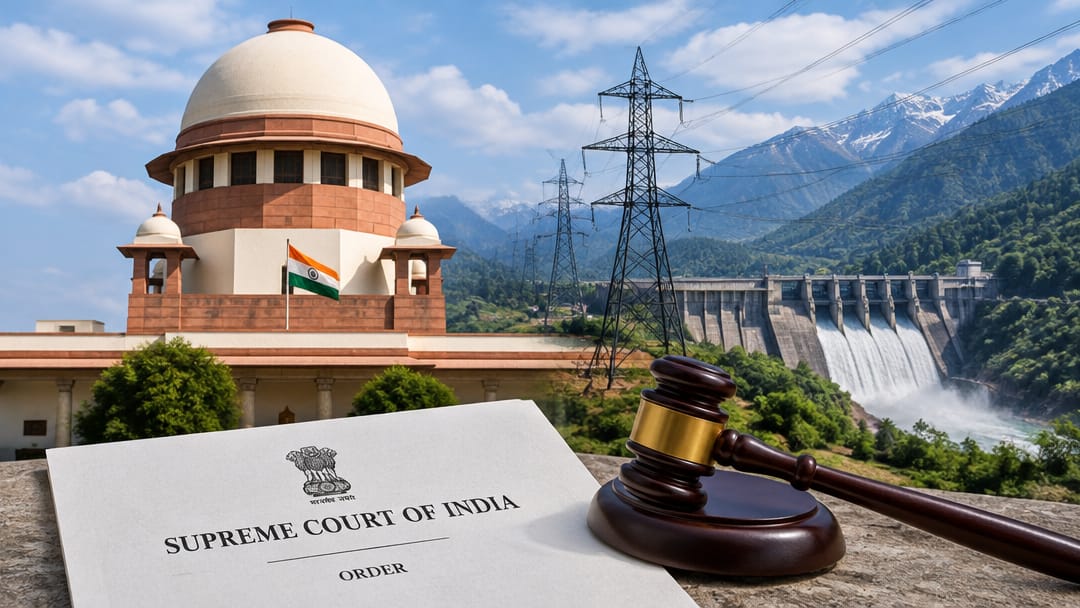
The Supreme Court directed Punjab and Haryana to supply approximately 11,973 million units of electricity to Himachal Pradesh, intervening in an interstate energy dispute. The order enforces Himachal Pradesh's entitlement to power, likely arising from hydroelectric projects located within its territory but whose output is shared among northern states under historical agreements. The Court's directive underscores judicial enforcement of interstate resource-sharing obligations rooted in constitutional and statutory frameworks governing water and power allocation.
Why it matters
This dispute sits at the intersection of constitutional federalism, interstate resource rights, and the judicial enforcement of statutory entitlements. Electricity generated from hydroelectric projects in Himachal Pradesh is typically shared among beneficiary states — Punjab, Haryana, Rajasthan, Delhi, and Himachal Pradesh — under agreements framed after the reorganisation of Punjab in 1966 under the Punjab Reorganisation Act. Himachal Pradesh's share ('free power' and allocated units) is a legal entitlement, not a discretionary benefit.
Constitutionally, Entry 17 of the State List (water, water courses) and Entry 38 of the Concurrent List (electricity) govern this domain. The Inter-State River Water Disputes Act, 1956, and the Electricity Act, 2003, provide the statutory backbone. When states default on supply obligations, Article 32 or Article 136 petitions before the Supreme Court become the enforcement route — which is precisely what this order represents.
For CLAT PG, the critical doctrinal point is that the Court's power to direct compliance flows from its jurisdiction to enforce constitutional and statutory rights, not from any original power over electricity policy. The 'right' being enforced here is Himachal Pradesh's vested entitlement under an agreed framework — analogous to property rights under Article 300A, where deprivation requires legal authority. Punjab and Haryana's withholding of supply, absent legal justification, amounts to a denial of that entitlement, triggering judicial correction.
Fifth Kautilya Economic Conclave debates India's growth amid global fragmentation
What happened
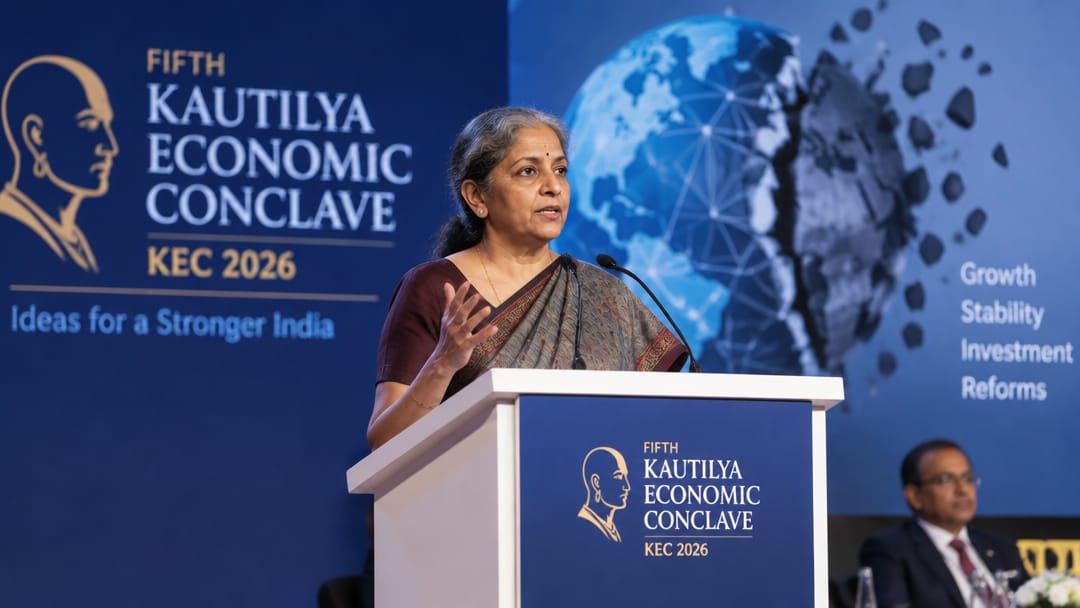
The Fifth Kautilya Economic Conclave (KEC 2026) convened to examine how India can sustain growth, maintain macroeconomic stability, and expand investment amid global fragmentation and technological disruption. Organised by the Institute of Economic Growth, the annual conclave brings together policymakers, economists, and global leaders to deliberate on India's economic strategy. The 2026 edition focused on navigating a fractured world order while keeping India's development trajectory on course through structural reforms and resilient institutions.
Why it matters
The Kautilya Economic Conclave is an annual high-level policy forum organised by the Institute of Economic Growth (IEG), New Delhi — a premier autonomous research institution established in 1958. Named after Kautilya (Chanakya), the ancient Indian economist and statesman whose Arthashastra laid foundational principles of statecraft and economic governance, the conclave serves as India's equivalent of Davos-style economic dialogue with a distinctly domestic and emerging-market focus.
For competitive exam aspirants, the KEC is significant across multiple dimensions. First, it reflects India's foreign economic policy posture — particularly how India positions itself amid de-globalisation, supply chain realignment, and the China+1 strategy. Second, it surfaces key macroeconomic themes that RBI and NABARD examiners frequently test: inflation management, fiscal consolidation, capital account convertibility, and agricultural investment flows.
The 2026 theme — sustaining growth amid global fragmentation — directly connects to static concepts like the World Trade Organisation's crisis of relevance, the rise of plurilateral trade agreements, and India's membership in forums like G20, BRICS, and SCO. Examiners often use such conclaves as a hook to test knowledge of India's bilateral trade commitments, the role of multilateral development banks, or the mandate of bodies like the IMF and World Bank in stabilising fragmented global economies.
The IEG itself, as the organising body, is an autonomous institution under the Ministry of Education, funded partly by the ICSSR — a distinction that sometimes appears in institutional-identification questions.