Financial Inclusion in India: Banking Every Citizen ...
What happened
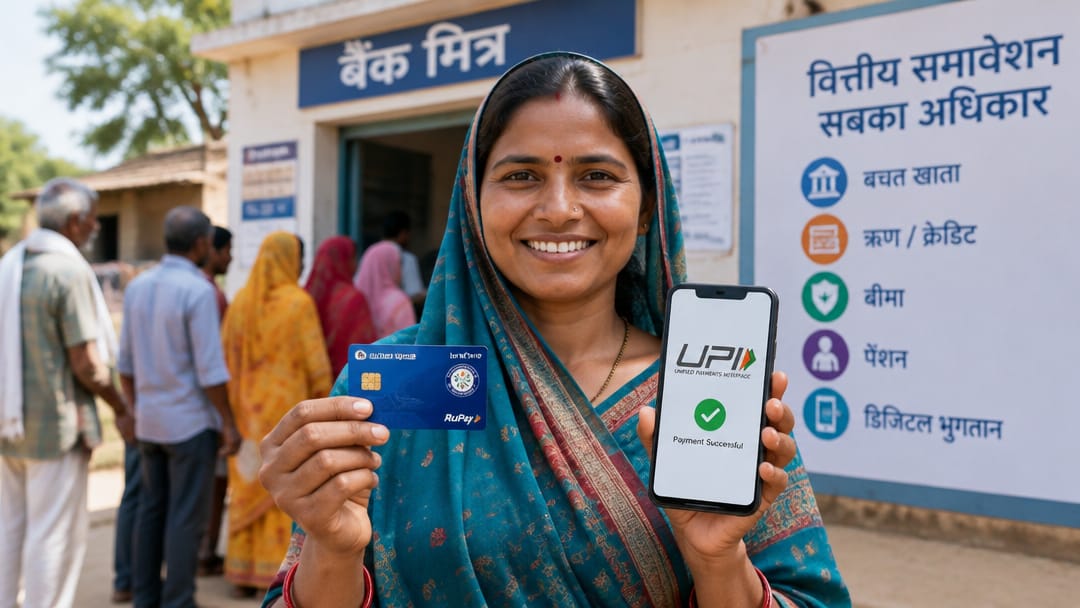
India's financial inclusion drive spans banking, credit, insurance, pensions, and digital payments. The Jan Dhan Yojana has opened over 53 crore accounts since 2014, linking beneficiaries to DBT transfers, RuPay cards, and micro-insurance. UPI now processes over 100 crore transactions daily. PM-JJBY, PM-SBY, and APY extend life, accident, and pension cover to low-income citizens. The push integrates BC networks, Aadhaar-linked KYC, and PMMY credit to close gaps in rural and semi-urban access.
Why it matters
Financial inclusion means ensuring every citizen can access affordable, formal financial services — savings, credit, insurance, remittances, and pensions — without discrimination based on income or geography. India's approach is built on five pillars: banking access (PMJDY), payment infrastructure (UPI, RuPay), credit (PMMY, KCC), social security (PM-JJBY, PM-SBY, APY), and investment access (small savings, mutual funds via AMFI's B30 cities push).
The policy problem being solved: before 2014, over 40% of Indian adults were unbanked. Cash-based welfare delivery suffered from leakages. The JAM Trinity — Jan Dhan accounts, Aadhaar biometric ID, and Mobile phones — created the infrastructure for direct benefit transfer (DBT), eliminating middlemen and reducing leakage.
For RBI, the examiner focuses on the regulatory mechanism: Business Correspondents (BCs) as last-mile agents, priority sector lending (PSL) targets requiring 40% of ANBC toward agriculture, MSMEs, and weaker sections, and the RBI's Financial Inclusion Index (FI-Index), which is published annually and captures inclusion across access, usage, and quality dimensions.
For NABARD, rural credit flow, Kisan Credit Cards (KCC), Self-Help Group–Bank Linkage Programme, and cooperative credit structure are the core angles.
For SEBI, the investor inclusion dimension — AMFI's B30 initiative, Investor Education and Protection Fund (IEPF), and mobile-first demat penetration — is the relevant angle.
For UPSC, the governance lens matters most: JAM Trinity as a welfare delivery reform, DBT impact on leakage reduction, and financial inclusion as a tool for poverty alleviation and gender empowerment (women account for 55%+ of PMJDY accounts).
Fifth Kautilya Economic Conclave debates India's growth amid global fragmentation
What happened
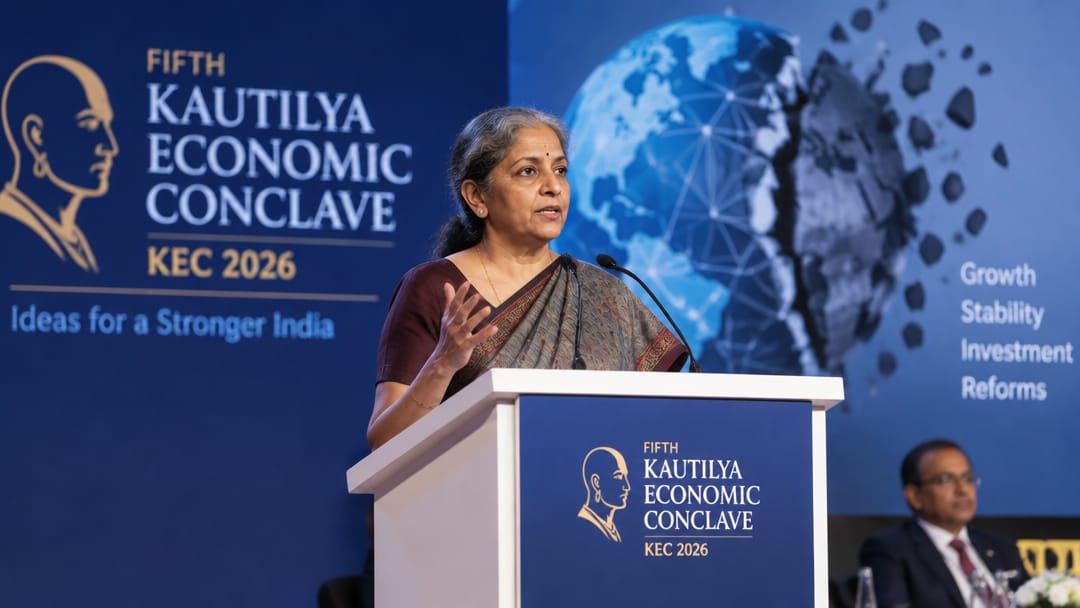
The Fifth Kautilya Economic Conclave (KEC 2026) convened to examine how India can sustain growth, maintain macroeconomic stability, and expand investment amid global fragmentation and technological disruption. Organised by the Institute of Economic Growth, the annual conclave brings together policymakers, economists, and global leaders to deliberate on India's economic strategy. The 2026 edition focused on navigating a fractured world order while keeping India's development trajectory on course through structural reforms and resilient institutions.
Why it matters
The Kautilya Economic Conclave is an annual high-level policy forum organised by the Institute of Economic Growth (IEG), New Delhi — a premier autonomous research institution established in 1958. Named after Kautilya (Chanakya), the ancient Indian economist and statesman whose Arthashastra laid foundational principles of statecraft and economic governance, the conclave serves as India's equivalent of Davos-style economic dialogue with a distinctly domestic and emerging-market focus.
For competitive exam aspirants, the KEC is significant across multiple dimensions. First, it reflects India's foreign economic policy posture — particularly how India positions itself amid de-globalisation, supply chain realignment, and the China+1 strategy. Second, it surfaces key macroeconomic themes that RBI and NABARD examiners frequently test: inflation management, fiscal consolidation, capital account convertibility, and agricultural investment flows.
The 2026 theme — sustaining growth amid global fragmentation — directly connects to static concepts like the World Trade Organisation's crisis of relevance, the rise of plurilateral trade agreements, and India's membership in forums like G20, BRICS, and SCO. Examiners often use such conclaves as a hook to test knowledge of India's bilateral trade commitments, the role of multilateral development banks, or the mandate of bodies like the IMF and World Bank in stabilising fragmented global economies.
The IEG itself, as the organising body, is an autonomous institution under the Ministry of Education, funded partly by the ICSSR — a distinction that sometimes appears in institutional-identification questions.
Tax reporting lapses by Indian banks risk sovereign rating and FATCA penalties
What happened
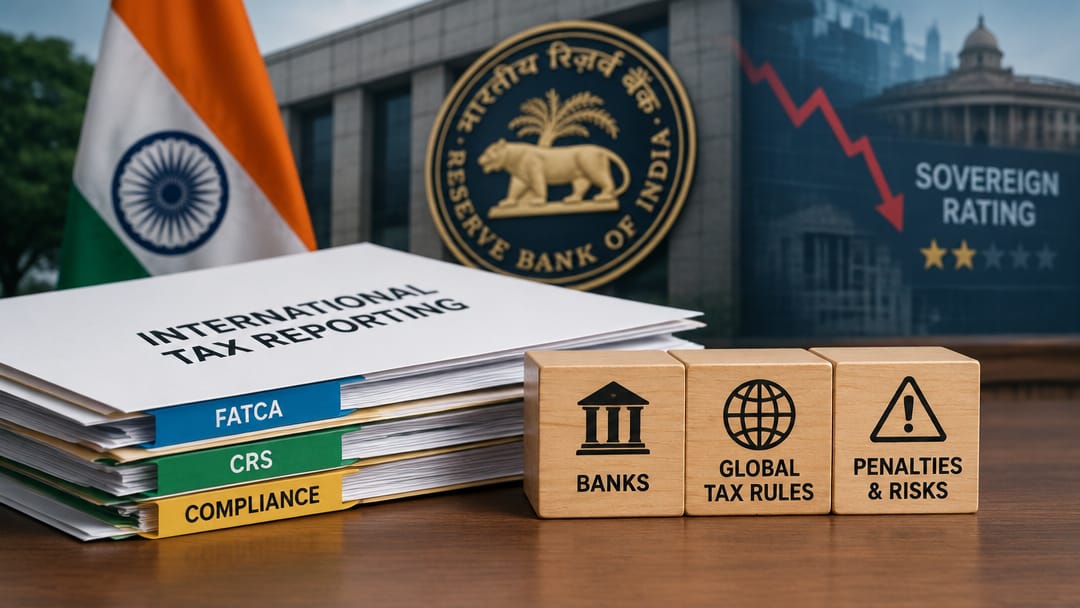
India's Principal Director General of Income Tax, Debjyoti Das, has warned that persistent lapses in international tax reporting by Indian financial institutions could jeopardise the country's sovereign credit rating and trigger withholding tax penalties under the FATCA and Common Reporting Standard frameworks. Non-compliant institutions risk being treated as recalcitrant by partner jurisdictions, inviting a 30% withholding tax on US-source payments and broader reputational damage to India's financial credibility internationally.
Why it matters
This warning sits at the intersection of international tax compliance, financial regulation, and sovereign creditworthiness — three themes the examiner tests separately but which this event connects.
The Foreign Account Tax Compliance Act (FATCA), enacted by the US in 2010, requires foreign financial institutions (FFIs) to report information on US account holders to the IRS. India signed an Intergovernmental Agreement (IGA) with the US in 2015, making compliance mandatory for Indian FFIs. Non-compliant FFIs face a 30% withholding tax on all US-sourced income — dividends, interest, and gross proceeds.
The Common Reporting Standard (CRS), developed by the OECD, is the multilateral equivalent: participating countries automatically exchange financial account information. India is a CRS-signatory. Persistent reporting failures signal to partner jurisdictions that India's institutions cannot be trusted to exchange tax information accurately — a reputational risk that credit rating agencies can factor into sovereign assessments.
The transmission mechanism matters for the exam: lapses → loss of 'compliant' status → withholding tax penalties on cross-border transactions → reduced foreign capital flows → pressure on current account and forex reserves → potential sovereign rating downgrade. This chain connects tax administration to macroeconomic stability, making it relevant to both UPSC macro questions and RBI/SEBI regulatory compliance questions.
The Income Tax Department's Principal DG flagging this publicly suggests enforcement is being stepped up, which is itself an exam-relevant administrative development.
CBDT exempts IFSC aircraft leasing units from TDS on inter-unit dividends
What happened
CBDT issued Notification No. 141/2026 on November 4, 2026, via S.O. 6016(E), under the Income Tax Act 2025, exempting dividend payments made between aircraft leasing units operating within International Financial Services Centres from Tax Deducted at Source. The exemption targets intra-IFSC dividend flows, reducing tax friction for aircraft leasing structures housed in GIFT City, India's designated IFSC, and aligns with India's broader push to develop a globally competitive aircraft leasing hub domestically.
Why it matters
India imports almost all its aircraft leasing services, with GIFT City IFSC established partly to capture this business onshore. Aircraft leasing is capital-intensive and structurally complex: a parent leasing entity often holds aircraft through subsidiary special purpose vehicles, all co-located within the IFSC. When one IFSC unit pays a dividend to another IFSC unit within the same structure, applying TDS creates a cash-flow drag and administrative burden without any real fiscal gain — the funds stay within the same regulatory perimeter.
By notifying an exemption under the Income Tax Act 2025, CBDT removes this friction. The move mirrors global IFSC best practices, where jurisdictions like Ireland and Singapore offer pass-through tax treatment for intra-group flows within ring-fenced financial zones.
For India's financial system, this matters because aircraft leasing represents over $150 billion in global annual transactions. If GIFT City can attract even a fraction of this business, it reduces India's current account outflows on lease rentals, strengthens the IFSC's competitive positioning, and builds specialised financial expertise domestically. For RBI Grade B aspirants, this sits at the intersection of IFSC regulation, capital account management, and India's financial sector development strategy — all core ESI themes. The notification also signals how tax policy is being used as an active instrument to shape the structure of India's emerging financial centres.