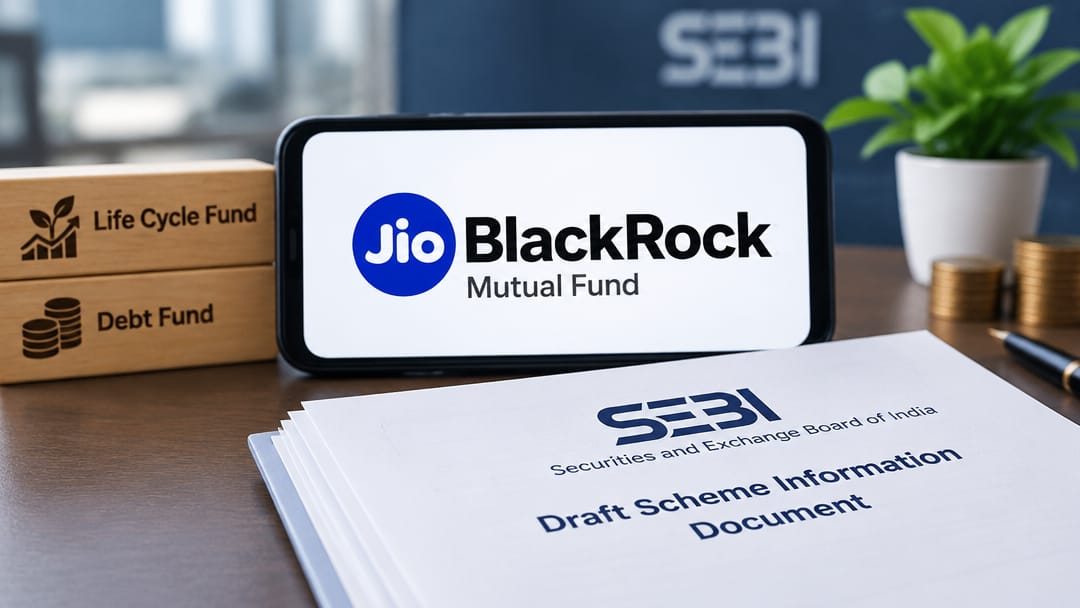
JioBlackRock files draft schemes with SEBI: life cycle and debt funds join the queue
What happened
JioBlackRock Mutual Fund, the joint venture between Reliance's Jio Financial Services and BlackRock, has filed draft scheme information documents with SEBI to launch two new funds: a JioBlackRock Life Cycle Fund and a debt fund. The filing marks the AMC's formal product-expansion move after receiving SEBI registration. These are open-ended schemes pending SEBI's observation letter before public subscription can commence.
Why it matters
When an asset management company (AMC) wants to launch a new mutual fund scheme in India, it must first file a Draft Scheme Information Document (DSID) with SEBI. SEBI then reviews the draft and issues an 'observation letter' — popularly called approval — typically within 21 working days. Only after receiving this letter can the AMC open a New Fund Offer (NFO) to the public.
JioBlackRock Mutual Fund is a joint venture between Jio Financial Services Ltd (a Reliance Industries subsidiary) and BlackRock Inc., the world's largest asset manager. The JV received its SEBI AMC registration in 2024, making it a new entrant in India's crowded mutual fund industry.
The two schemes filed are significant for their design: a Life Cycle Fund is typically an asset-allocation fund that automatically shifts from equity-heavy to debt-heavy portfolios as the investor ages or approaches a target date, making it suitable for long-term retirement planning. A debt fund invests predominantly in fixed-income instruments.
For SEBI Grade A aspirants, this filing sits at the intersection of mutual fund regulation (SEBI MF Regulations 1996), the NFO process, scheme categorisation norms (SEBI's October 2017 circular on scheme categorisation), and the regulatory oversight role of SEBI over AMCs. The JioBlackRock JV also tests knowledge of institutional promoters and foreign-domestic partnership structures in the financial sector.
IFSCA lets fintech firms test products in GIFT City without a full licence
What happened
The International Financial Services Centres Authority introduced its FinTech Sandbox Framework in 2026, allowing fintech entities to test innovative financial products and services within GIFT City's IFSC under relaxed regulatory conditions before obtaining a full licence. Firms operating inside the sandbox may maintain an INR account solely for administrative expenses but must record accounts in a freely convertible currency. The framework sits atop IFSCA's existing 2020 regulations and is designed to balance innovation with investor protection.
Why it matters
A regulatory sandbox is a controlled environment where innovators can test new financial products with real customers under a regulator's supervision, but with temporary exemptions from some standard rules. IFSCA — the unified regulator for India's International Financial Services Centres, primarily GIFT City in Gujarat — introduced this framework to lower the barrier for fintech startups that cannot afford full compliance costs before proving their concept works.
The key regulatory logic is asymmetry of risk: sandbox firms get relaxed norms during a defined testing window, but the regulator retains the right to revoke, modify, or refuse a full licence if the test reveals systemic risks. This protects investors while encouraging innovation.
The currency rule is exam-critical: sandbox entities must maintain books in a freely convertible foreign currency (not INR), but are permitted one INR account exclusively for administrative expenses. This mirrors the broader IFSC architecture, where transactions are dollar- or foreign-currency-denominated to integrate with global capital markets.
For SEBI aspirants, sandboxes matter because SEBI also runs its own regulatory sandbox (notified 2020) for securities-market innovators. IFSCA's framework extends this concept specifically to the IFSC jurisdiction. The distinction between IFSCA's remit (IFSC-based entities) and SEBI's remit (domestic securities markets) is a classic examiner boundary question. Knowing which regulator governs which sandbox, under which parent statute (IFSCA Act 2019 vs. SEBI Act 1992), is the precision that separates scores.
Riksbank warns digital euro and stablecoins could displace the krona in payments
What happened
Sweden's central bank, the Riksbank, has revived the e-krona debate, warning that the European Central Bank's planned digital euro and the rise of private stablecoins could erode the Swedish krona's role in domestic and cross-border payments. The Riksbank argues that without a central bank digital currency of its own, Sweden risks losing monetary sovereignty as privately issued and foreign digital currencies increasingly intermediate everyday transactions.
Why it matters
A Central Bank Digital Currency (CBDC) is a digital form of sovereign money issued directly by a central bank — essentially a digital equivalent of cash, carrying no credit risk because it is a direct liability of the issuing authority.
Sweden is an unusually instructive case because it is among the world's most cashless societies, making it a real-world stress test for what happens when physical currency fades. The Riksbank launched its e-krona pilot in 2020, but no final decision to issue has been made.
The current concern has two triggers: 1. The ECB's digital euro project — if adopted, EU citizens (and, by extension, residents of non-euro countries closely integrated with the eurozone like Sweden) could transact in a foreign CBDC, reducing demand for the domestic currency. 2. Stablecoins (private digital tokens pegged to fiat currencies) — their growing use in payments could fragment the monetary transmission mechanism, weakening a central bank's ability to implement interest-rate policy.
For India, the RBI launched its own CBDC — the Digital Rupee (e₹) — in two tracks: the wholesale pilot (e₹-W) in November 2022 and the retail pilot (e₹-R) in December 2022. The RBI's stated rationale mirrors the Riksbank's concern: preserving monetary sovereignty, reducing settlement risk, and providing a programmable, interoperable alternative to private stablecoins.
Exam relevance: CBDC architecture (account-based vs token-based), two-tier distribution model, and the distinction between wholesale and retail CBDC are all active testing zones for RBI Grade B and UPSC GS-III.