SC orders rehabilitation funds within 7 days of bonded labour release
What happened
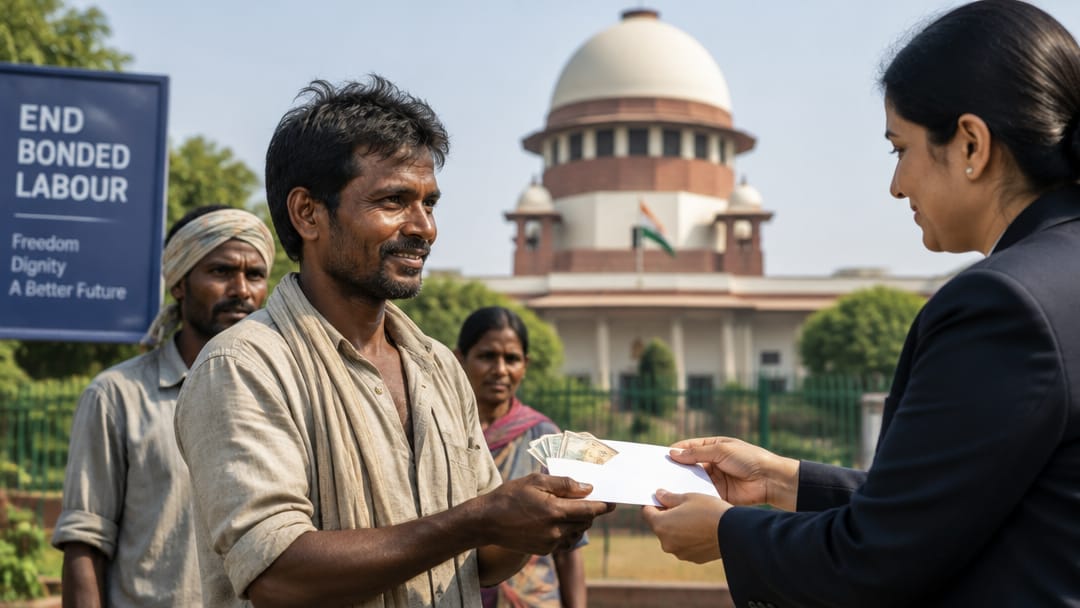
The Supreme Court issued pan-India directions mandating that financial assistance for rescued bonded labourers must be disbursed within seven days of release. The ruling reinforces that delayed rehabilitation effectively denies the right guaranteed under Article 21 and the Bonded Labour System (Abolition) Act, 1976. The Court directed district authorities and state governments to ensure prompt payment of rehabilitation grants, treating unreasonable delay as a violation of the freed labourer's fundamental right to life and dignity.
Why it matters
Bonded labour — where a person is compelled to work to repay a debt — is both a form of forced labour and a denial of personal liberty. Article 23 of the Constitution expressly prohibits traffic in human beings and forced labour, making it a Fundamental Right enforceable against the State. The Bonded Labour System (Abolition) Act, 1976 gives statutory teeth to Article 23: it extinguishes the bonded debt ipso facto upon commencement, criminalises enforcement of bonded labour, and mandates rehabilitation through the Centrally Sponsored Scheme.
The Supreme Court has long treated rehabilitation as integral to, not separate from, liberation. In Bandhua Mukti Morcha v. Union of India (1984), the Court held that bonded labourers are entitled to the benefit of all labour laws and social welfare legislation, and that the State's obligation does not end with rescue. This ruling extended Article 21's right to live with dignity into the rehabilitation phase itself.
The 2025–26 directions go further: they set a hard seven-day timeline for financial assistance. The doctrinal move here is significant — the Court is treating administrative delay as a constitutional violation, not merely an administrative lapse. This echoes the principle from Arnab Goswami (2020) that 'the deprivation of liberty even for a single day is one day too many,' transposed now to the socio-economic rights context: delay in restoring dignity equals denial of dignity.
For CLAT PG, the examiner will test whether you can apply Article 21 and Article 23 together, identify the correct statute, and distinguish the Court's role in Bandhua Mukti Morcha from later cases like People's Union for Democratic Rights v. Union of India (1982), which first interpreted 'forced labour' under Article 23.
Chhattisgarh HC: a fatwa ordering social boycott carries no legal force
What happened
The Chhattisgarh High Court ruled that a fatwa has no legal sanctity to impose social boycott on individuals, reaffirming that religious edicts cannot override constitutional rights. The court dismissed a petition filed by a brother-sister duo who were ostracised after a relative married a Shia Muslim man. While affirming the legal principle against faith-based boycotts, the court found the petitioners lacked sufficient standing on the specific facts presented to grant relief.
Why it matters
This ruling engages three intersecting constitutional guarantees. First, Article 17 abolishes untouchability and forbids its practice in any form — courts have extended its spirit to cover caste or community-based social exclusion even when not rooted in caste hierarchy. Second, Article 19(1)(a) and 19(1)(c) protect freedom of expression and association; a fatwa that socially coerces individuals into silence or conformity infringes these freedoms. Third, Article 21 protects the right to live with dignity — the Supreme Court in Vishakha and later in Shakti Vahini v. Union of India (2018) held that honour-based community sanctions violate the right to life and liberty.
The critical legal principle here is that personal law or religious opinion — however sincerely held — does not acquire the force of state law. The Supreme Court settled this in Vishwaloknath Shastri (1954) and more directly in Mohd. Qasim (Allahabad HC) and the landmark All India Muslim Personal Law Board cases: a fatwa is merely a religious opinion and cannot be enforced by courts, nor can it be used to punish individuals for choices that are otherwise lawful under civil law.
The court's dismissal of the petition on facts — not on principle — is equally important. It demonstrates how courts distinguish between affirming a right in the abstract and granting relief on a specific set of facts. This distinction is a classic CLAT PG trap: the principle was upheld, but the petitioners lost. Aspirants must track both the ratio decidendi (legal rule) and the disposition (outcome) separately.
SC refuses to relax bar practice requirement for court staff seeking judicial service
What happened
The Supreme Court declined to grant a one-time relaxation of the mandatory practice requirement for in-service court employees seeking entry into judicial service. Petitioners, working as court staff, argued their court-side experience should substitute for formal advocacy practice. The Court rejected this, holding that the practice condition is a substantive eligibility criterion, not a procedural formality, and that judicial service recruitment rules cannot be relaxed even for experienced court employees through judicial intervention.
Why it matters
This ruling reinforces a foundational principle governing judicial service recruitment in India: eligibility conditions prescribed under service rules are substantive requirements, not mere formalities that courts can waive in the interest of equity or administrative convenience.
In India, recruitment to the subordinate judiciary (civil judge/judicial magistrate cadre) is regulated under High Court rules framed under Articles 233 and 234 of the Constitution. These rules typically require candidates to have practised as an advocate for a specified period — commonly two to three years — before they can sit for the Provincial Civil Service (Judicial) examination or equivalent.
The petitioners, being court staff (stenographers, clerks, readers, etc.), argued that their proximity to court proceedings effectively constituted practical legal training. The Supreme Court's refusal signals that the purpose of the practice requirement is not merely familiarity with court procedure but the development of independent legal reasoning, client representation, and adversarial advocacy skills — qualities not acquired through administrative court service.
Crucially, the Court signalled that such relaxations cannot be granted by judicial order; any modification must come through the rule-making authority itself — typically the High Court in consultation with the State Government under Article 234. This distinguishes between the Court's power to strike down rules and its power to modify or relax them, the latter being a legislative/regulatory function.
For CLAT PG aspirants, this connects to Articles 233 and 234 (appointment of district judges and subordinate judiciary), the limits of judicial review over service rules, and the principle that constitutional eligibility conditions cannot be judicially diluted.