
RBI Grade B Current Affairs — 5 November 2026

3 topics · RBI Grade B · 5 November 2026
Agriculture budget up five-fold in 13 years: ₹27,663 cr to ₹1,40,529 cr
●●

Agriculture budget up five-fold in 13 years: ₹27,663 cr to ₹1,40,529 cr

What happened

India's Department of Agriculture and Farmers Welfare budget rose from ₹27,663 crore in 2013-14 to ₹1,40,528.78 crore in 2026-27, a five-fold increase over thirteen years. This expansion reflects successive government pushes toward input subsidies, direct income support through PM-KISAN, digital agriculture, natural farming, and allied sector development including fisheries and animal husbandry, aiming to double farmer incomes and modernise the rural agrarian economy.

Why it matters

India's agricultural budget trajectory encapsulates a fundamental shift in how the state engages with farming: from input-side subsidies and procurement support to direct income transfers, digital infrastructure, and market integration.

The five-fold budget increase signals several structural changes examiners test:

1. PM-KISAN (2019): ₹6,000/year direct income transfer to landholding farmers — the largest direct benefit transfer in agriculture. Funded 100% by the Centre. Over 11 crore beneficiaries.

2. PM Fasal Bima Yojana: Crop insurance with capped farmer premiums (2% Kharif, 1.5% Rabi, 5% commercial/horticultural crops). The balance premium is shared by Centre and States.

3. e-NAM: Electronic National Agriculture Market — integrates APMC mandis digitally across states, enabling price discovery beyond local markets.

4. PM-KUSUM: Solar-powered irrigation pumps for farmers, reducing diesel dependency and providing supplementary income through surplus solar power sale.

5. Natural Farming / PKVY (Paramparagat Krishi Vikas Yojana): Promotes organic and natural farming clusters.

6. Digital Agriculture Mission: AI, remote sensing, and farmer ID (Agri Stack) infrastructure.

For RBI aspirants, the key angle is agricultural credit flow, Kisan Credit Card (KCC), and Priority Sector Lending norms (18% of ANBC to agriculture). For NABARD aspirants, the Rural Infrastructure Development Fund (RIDF) and refinance operations connect directly to this budget expansion. For UPSC aspirants, the governance architecture — Centre-State cost sharing, DBT mechanisms, and food security linkages — is what examiners probe.
🔒
Key figure and date from this topic
Specific number or threshold to remember
Policy or regulatory implication

Open in Crux app
Read full analysis →
PM Surya Ghar: free electricity scheme reaches mass scale across India
●●

PM Surya Ghar: free electricity scheme reaches mass scale across India

What happened

PM Surya Ghar: Muft Bijli Yojana, launched in February 2024, has achieved mass-movement scale with over one crore registrations and lakhs of rooftop solar installations sanctioned across India. The scheme provides up to 300 units of free electricity monthly to households installing rooftop solar panels, with central subsidies channelled directly to beneficiaries. It targets one crore households and aims to deliver savings for families, reduce state electricity subsidies, and advance India's renewable energy capacity goals.

Why it matters

PM Surya Ghar: Muft Bijli Yojana sits at the intersection of three major policy priorities: household welfare (free electricity), energy transition (rooftop solar), and fiscal management (reducing state discoms' subsidy burden). Launched on 13 February 2024 with a budgetary outlay of ₹75,021 crore, it is implemented by the Ministry of New and Renewable Energy (MNRE) through the National Programme on Advanced Chemistry Cell Battery Storage and distributed via DISCOMs.

The scheme's delivery mechanism is distinctive: central financial assistance (CFA) is paid directly to beneficiaries' bank accounts after installation and net-metering connection — making it a Direct Benefit Transfer model for a physical infrastructure scheme. For RBI aspirants, this DBT channel and the involvement of scheduled commercial banks in loan facilitation (with REC Limited and PFC as nodal financing agencies) is the critical angle. For NABARD aspirants, the rural and semi-urban household dimension — energy self-sufficiency reducing household expenditure — connects to rural livelihoods. For UPSC aspirants, the governance architecture (MNRE → DISCOMs → beneficiary), the scheme's role in India's 500 GW renewable target by 2030, and the welfare-fiscal federalism balance are all testable. The scheme offers 1–2 kW installations (subsidised at ₹30,000/kW) and 2–3 kW systems (₹18,000/kW for the incremental unit), with an upper cap. Net metering allows surplus power to be fed back, further reducing effective electricity costs.
🔒
Key figure and date from this topic
Specific number or threshold to remember
Policy or regulatory implication
Open in Crux app
Read full analysis →
India has regulators for every financial sector, but no one watches the whole system
●

India has regulators for every financial sector, but no one watches the whole system

What happened

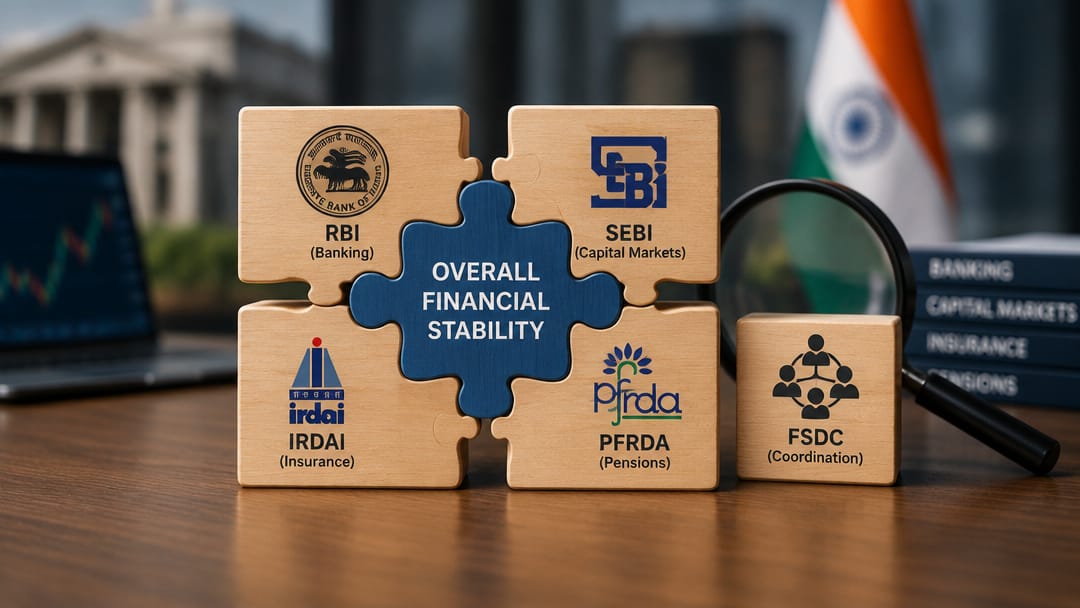
India's financial architecture features multiple sector regulators — RBI for banking, SEBI for capital markets, IRDAI for insurance, PFRDA for pensions — plus coordination bodies like the Financial Stability and Development Council. Despite this dense regulatory presence, a systemic gap persists: no single authority monitors cross-sectoral risks or interconnections. The article argues that India needs a macro-prudential, big-picture regulatory framework to identify systemic vulnerabilities before they cascade across the financial system.

Why it matters

India's financial regulation follows a 'sectoral silo' model — each regulator governs its own domain with limited formal authority over risks that cut across sectors. This contrasts with a macro-prudential approach, which monitors system-wide vulnerabilities such as interconnectedness, leverage cycles, and contagion risks.

The Financial Stability and Development Council (FSDC), established in 2010, was designed to bridge this gap. Chaired by the Finance Minister, it brings together the heads of RBI, SEBI, IRDAI, PFRDA, IBBI, and other bodies. However, FSDC has no independent statutory basis — it was created by an executive order, not an Act of Parliament — and lacks direct regulatory or enforcement powers. It functions as a coordination forum, not a super-regulator.

The static concept being tested here is the architecture of India's financial regulatory framework: who regulates what, what FSDC's mandate and limitations are, and how macro-prudential oversight differs from micro-prudential (entity-level) supervision.

Examiners frequently test whether aspirants can distinguish between the roles of RBI (systemic risk in banking), SEBI (market integrity), and coordination bodies. The absence of a statutory super-regulator is the key structural gap — the UPSC and RBI Grade B examiner will probe this distinction. India's model is sometimes compared to the UK's Financial Policy Committee or the US Financial Stability Oversight Council (FSOC), which have broader macro-prudential mandates.
🔒
Key figure and date from this topic
Specific number or threshold to remember
Policy or regulatory implication
Open in Crux app
Read full analysis →

← More current affairs for November 2026

Study smarter with Crux

Get Remember + Why it matters layers, spaced repetition, and paper-pattern questions for RBI Grade B.

Download Crux free
Same day — other exams