SEBI's MF Lite framework gives passive fund schemes a lighter regulatory path
What happened
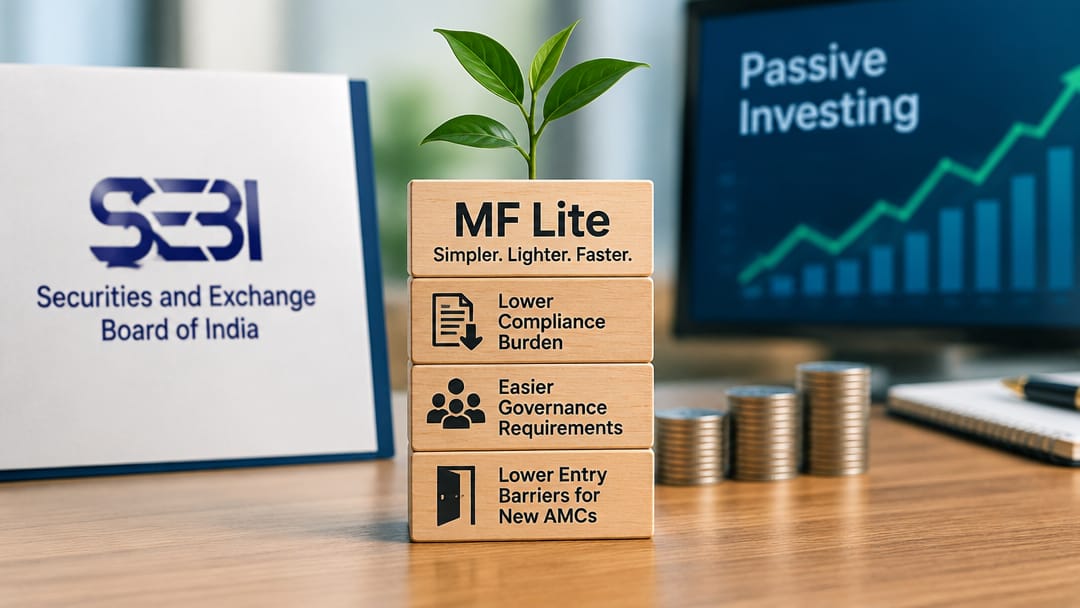
SEBI introduced the Mutual Fund Lite (MF Lite) framework to create a separate, simplified regulatory route exclusively for passive mutual fund schemes such as index funds and ETFs. The framework reduces compliance burdens, eases governance requirements, and lowers entry barriers for new asset management companies wanting to operate only passive schemes. Active fund sponsors remain under the existing, stricter MF regulations. The move is intended to deepen participation in India's passive investing market by reducing operational costs and regulatory overhead for passive-only AMCs.
Why it matters
Passive mutual funds — primarily index funds and Exchange Traded Funds (ETFs) — replicate a benchmark index rather than relying on active fund manager decisions. Because the investment universe is pre-defined by the index, their risk profile, decision-making complexity, and potential for manager-driven misconduct are structurally lower than active funds. SEBI's MF Lite framework recognises this distinction and creates a proportionate regulatory regime.
Key relaxations under MF Lite include reduced net worth requirements for sponsors, simplified scheme information documents (SIDs), lighter trustee and board governance obligations, and streamlined compliance reporting. Critically, only entities offering exclusively passive schemes — index funds, ETFs, Fund of Funds investing in ETFs — qualify for MF Lite registration. Any AMC wishing to launch active schemes must register under the full MF Regulations.
This is consistent with SEBI's broader principle of risk-proportionate regulation: the stricter the product's complexity and discretion, the heavier the regulatory overhead. MF Lite also lowers barriers to entry, potentially encouraging new specialised passive-only AMCs, which could increase competition and reduce expense ratios for retail investors.
From an exam perspective, this framework is directly connected to SEBI's 2024 initiative to simplify SIDs (Scheme Information Documents) — a topic already tested in SEBI Grade A 2024. MF Lite builds on that reform direction, making the definitional boundaries (passive vs. active, MF Lite vs. full MF Regulations) prime MCQ territory.
SEBI forms working group to relax startup listing rules on Innovators Growth Platform
What happened
SEBI has constituted a working group to review the regulatory framework of the Innovators Growth Platform, a dedicated stock exchange segment for startups and technology companies. The review aims to ease capital access for startups by potentially relaxing eligibility criteria and listing norms. IGP was introduced to allow high-growth, loss-making startups to list without meeting conventional profitability thresholds required on the main board of Indian stock exchanges.
Why it matters
The Innovators Growth Platform is a SEBI-created alternative listing segment designed specifically for startups, new-age technology companies, and other innovative enterprises that may not satisfy the profitability and track-record conditions of main-board listing. It was originally called the Institutional Trading Platform (ITP) and was renamed IGP in 2019 following SEBI amendments.
IGP allows companies with at least 25% of pre-issue capital held by eligible institutional investors to list. Importantly, 75% of the funds raised must be deployed toward disclosed objects, and the minimum application size for investors was set at ₹2 lakh, reflecting its sophisticated-investor character. Lock-in norms and minimum public offer sizes also differ from the main board.
The platform addresses a structural gap: India's startup ecosystem has grown dramatically, but many high-growth companies avoid listing because existing rules penalise companies without profits. By forming a working group now, SEBI signals intent to make the IGP more accessible — possibly by revisiting investor eligibility thresholds, minimum issue size, or the institutional holding pre-condition.
For SEBI Grade A aspirants, IGP is a classic 'static concept triggered by current news' scenario. The examiner tests exact IGP parameters — the 25% institutional holding threshold, the ₹2 lakh minimum application size, the 2019 renaming — not just the fact that SEBI is reviewing it. Understanding the architecture of IGP alongside its contrast with the main-board SME platform is essential.
India has regulators for every financial sector, but no one watches the whole system
What happened
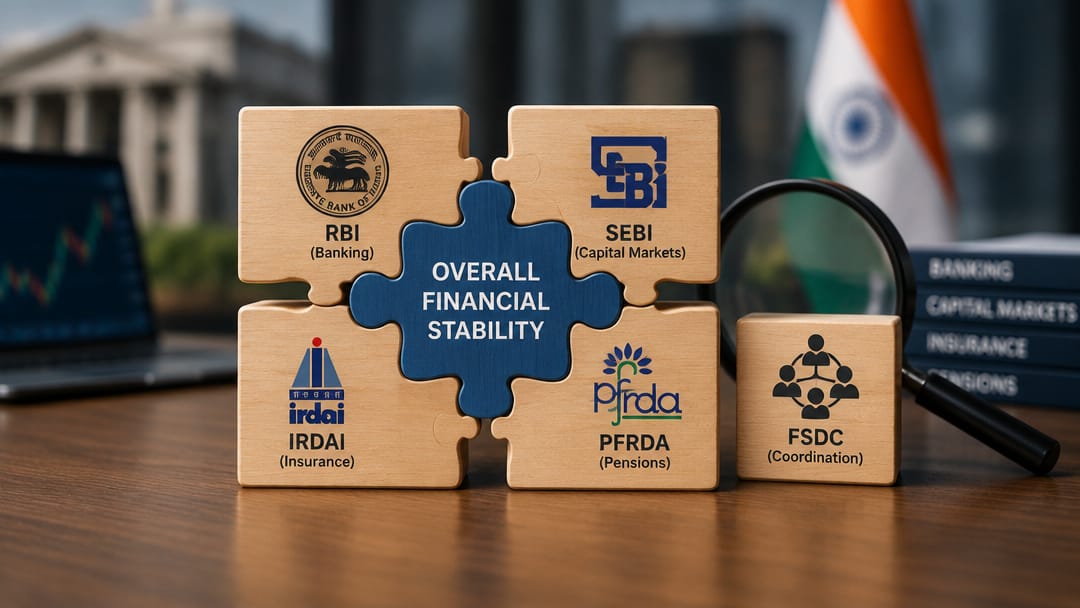
India's financial architecture features multiple sector regulators — RBI for banking, SEBI for capital markets, IRDAI for insurance, PFRDA for pensions — plus coordination bodies like the Financial Stability and Development Council. Despite this dense regulatory presence, a systemic gap persists: no single authority monitors cross-sectoral risks or interconnections. The article argues that India needs a macro-prudential, big-picture regulatory framework to identify systemic vulnerabilities before they cascade across the financial system.
Why it matters
India's financial regulation follows a 'sectoral silo' model — each regulator governs its own domain with limited formal authority over risks that cut across sectors. This contrasts with a macro-prudential approach, which monitors system-wide vulnerabilities such as interconnectedness, leverage cycles, and contagion risks.
The Financial Stability and Development Council (FSDC), established in 2010, was designed to bridge this gap. Chaired by the Finance Minister, it brings together the heads of RBI, SEBI, IRDAI, PFRDA, IBBI, and other bodies. However, FSDC has no independent statutory basis — it was created by an executive order, not an Act of Parliament — and lacks direct regulatory or enforcement powers. It functions as a coordination forum, not a super-regulator.
The static concept being tested here is the architecture of India's financial regulatory framework: who regulates what, what FSDC's mandate and limitations are, and how macro-prudential oversight differs from micro-prudential (entity-level) supervision.
Examiners frequently test whether aspirants can distinguish between the roles of RBI (systemic risk in banking), SEBI (market integrity), and coordination bodies. The absence of a statutory super-regulator is the key structural gap — the UPSC and RBI Grade B examiner will probe this distinction. India's model is sometimes compared to the UK's Financial Policy Committee or the US Financial Stability Oversight Council (FSOC), which have broader macro-prudential mandates.