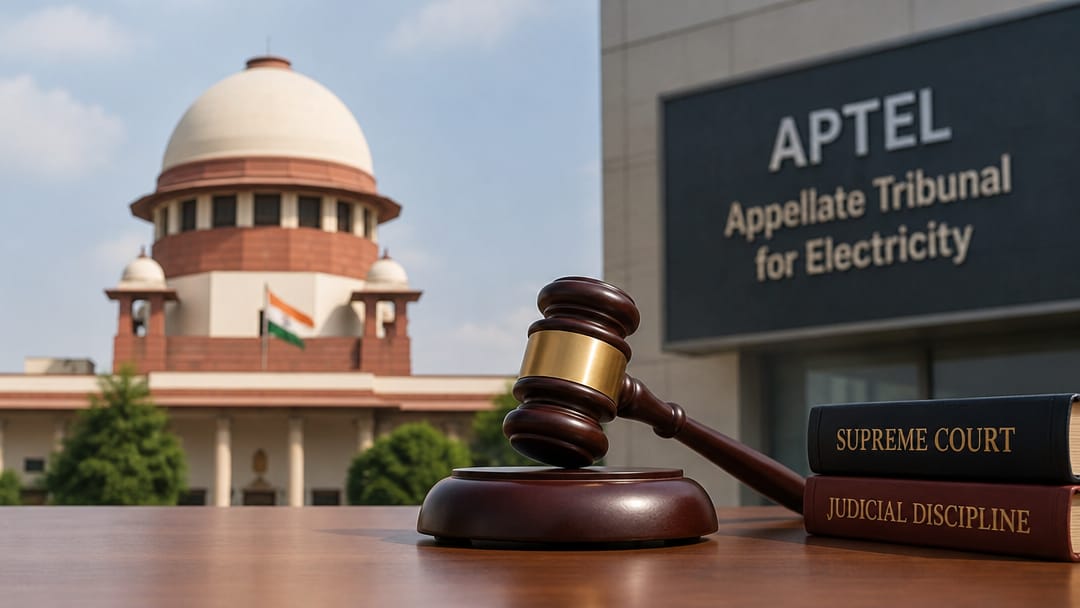
APTEL reviewed an SC-upheld order; Supreme Court calls it a breach of discipline
What happened
The Supreme Court sharply criticised the Appellate Tribunal for Electricity (APTEL) for conducting a review of an order that the Supreme Court had itself previously upheld. The Court held that this conduct amounted to a breach of judicial discipline, as a lower tribunal cannot revisit or effectively overrule a matter already settled by a higher court. The observation signals a significant reminder about the hierarchy of courts and the binding nature of Supreme Court precedent on all subordinate tribunals.
Why it matters
This episode turns on a foundational constitutional principle: judicial hierarchy and the binding effect of Supreme Court decisions under Article 141 of the Constitution, which declares that the law declared by the Supreme Court shall be binding on all courts within the territory of India. The word 'courts' in Article 141 has been interpreted to include tribunals exercising judicial or quasi-judicial functions — APTEL being one such statutory tribunal established under the Electricity Act, 2003.
When APTEL reviewed an order that the Supreme Court had already upheld, it effectively attempted to reopen a settled legal position. This violates two interlocking principles: first, the doctrine of judicial discipline, which requires lower forums to follow and not circumvent Supreme Court rulings; second, the doctrine of merger, under which once a superior court rules on a matter, the original order merges with the superior court's decision and a lower forum has no residual jurisdiction to revisit it.
The review power of tribunals is a limited, exceptional power. It cannot be invoked to override what a superior court has already decided — that would invert the appellate hierarchy. The Supreme Court's rebuke signals that tribunals exercising review jurisdiction must first check whether the subject matter has already been conclusively determined by a higher court. For CLAT PG aspirants, this event tests understanding of Article 141, the doctrine of merger, judicial discipline, and the constitutional position of tribunals vis-à-vis the Supreme Court.
SC reiterates: a stranger can appeal a consent decree if prejudice is shown
What happened
The Supreme Court on October 30 reiterated that a person who is not a party to a suit — a 'stranger' or third party — is not barred from appealing a consent decree if they can demonstrate that the decree prejudicially affects their interests. The ruling reinforces a settled but frequently overlooked principle: a consent decree, though agreed upon by the original parties, cannot bind or harm a non-party who had no voice in its making.
Why it matters
A consent decree is a court order recording a compromise reached between the parties to a suit under Order XXIII Rule 3 of the Code of Civil Procedure, 1908. Because it flows from mutual agreement rather than adjudication, courts have sometimes assumed it cannot be questioned. The Supreme Court's restatement corrects that assumption for third parties.
The foundational rule is that a consent decree binds only the parties to the compromise. It cannot, by its own force, extinguish the rights of a stranger — a person who was neither a plaintiff nor a defendant in the original suit. If such a stranger can show that the decree, despite being a product of consent between others, operates to their prejudice — for instance, by settling a property dispute in a way that encroaches on their title or extinguishes their interest — they retain the right to challenge it in appeal.
The doctrinal basis connects to the privity principle: a person not party to a proceeding ordinarily cannot be bound by its outcome. This mirrors the contract-law rule that only parties to a contract can sue on it (privity of contract under Section 2(h) of the Indian Contract Act). A consent decree is essentially a contractual settlement elevated to a court order; the elevation does not cure the absence of consent from affected non-parties.
For CLAT PG, the examiner tests whether aspirants can distinguish (a) a party challenging a consent decree — which requires showing fraud, misrepresentation, or a vitiating factor under Order XXIII Rule 3A — from (b) a stranger challenging it — which requires only proof of prejudice. The two routes and their distinct conditions are the core testable distinction.
SC Collegium recommends six advocates for Chhattisgarh High Court
What happened
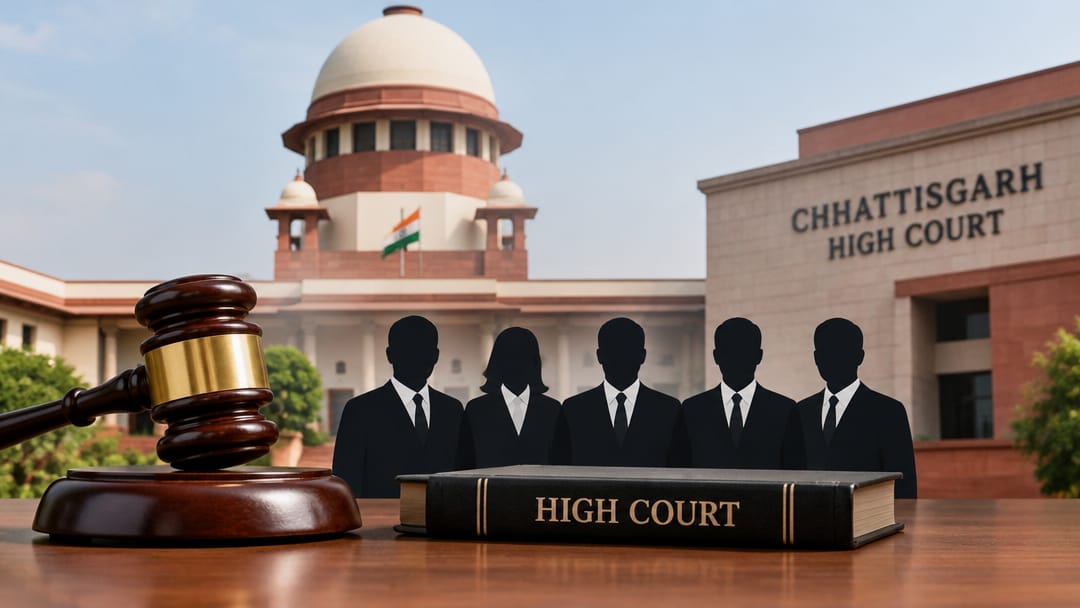
The Supreme Court Collegium has recommended six names for appointment as judges of the Chhattisgarh High Court. The advocates named include Anand Shukla, Ratna Nidhi Pusty (also known as R.N. Pusty or Ratan Pusty), Shashank Thakur, and Sourabh Sharma. The Collegium, headed by the Chief Justice of India, exercises the power of judicial appointments under the constitutional framework established through the Three Judges Cases, making such recommendations binding on the executive.
Why it matters
The Collegium system is the mechanism by which judges of the Supreme Court and High Courts are appointed in India. It evolved through three landmark Supreme Court decisions — the First Judges Case (S.P. Gupta v. Union of India, 1981), the Second Judges Case (Supreme Court Advocates-on-Record Association v. Union of India, 1993), and the Third Judges Case (Presidential Reference, 1998). Together, these cases shifted appointment power from the executive to the judiciary, establishing that the Chief Justice of India's opinion, formed collectively through the Collegium, is binding.
For High Court appointments, the Collegium consists of the CJI and the two senior-most judges of the Supreme Court. The recommendation must also involve the Chief Justice of the relevant High Court and the Governor and Chief Minister of the concerned state. Once the Collegium reiterates a recommendation, the government is constitutionally bound to act on it.
The NJAC (National Judicial Appointments Commission) — created by the 99th Constitutional Amendment in 2014 to replace the Collegium — was struck down by the Supreme Court in 2015 (Fourth Judges Case / NJAC Case) as violating judicial independence, a basic structure element. The Collegium system therefore continues to operate. This recommendation for Chhattisgarh High Court illustrates the live operation of that system, making it directly relevant for understanding Articles 124, 217, and 224 of the Constitution.