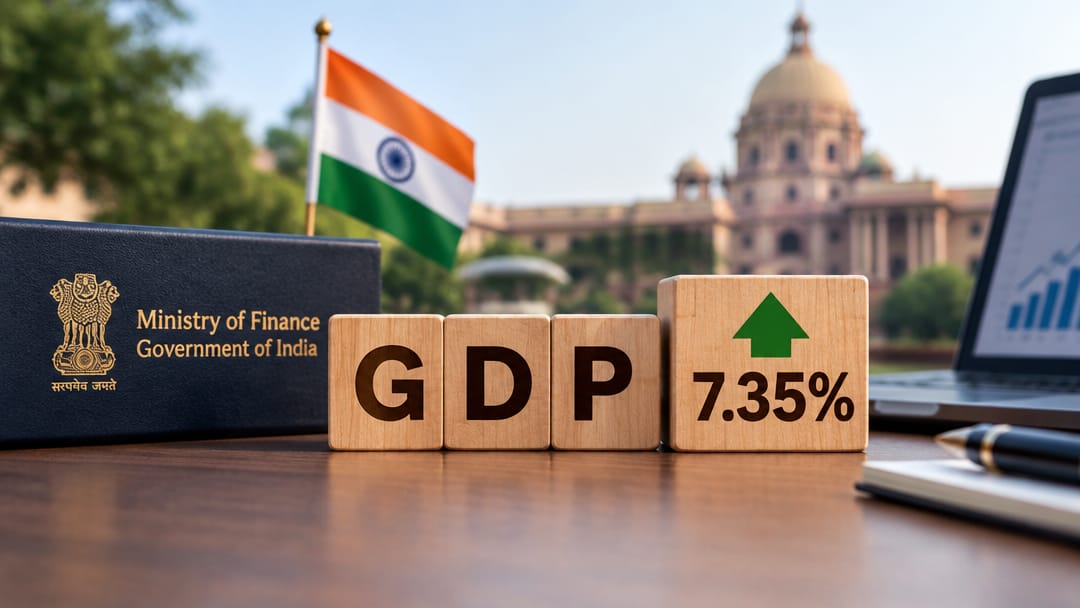
Finance Ministry nowcast puts Q2 FY27 GDP growth at 7.35%
What happened
India's Ministry of Finance, using its nowcasting model, estimates GDP growth at 7.35 per cent for the second quarter of FY27 (July–September 2026), according to its monthly economic report. The projection signals continued resilience but is accompanied by acknowledged downside risks. Nowcasting differs from official GDP estimates by using high-frequency real-time indicators to generate forward-looking growth readings before formal data is released by the National Statistical Office.
Why it matters
A nowcasting model uses high-frequency, real-time data — such as GST collections, PMI readings, power consumption, rail freight, and credit offtake — to estimate GDP growth before the National Statistical Office publishes official quarterly figures. This is important because official GDP data arrives with a lag of roughly two months after the quarter ends, creating a window during which policymakers and analysts rely on such proxies.
The Finance Ministry's Monthly Economic Review is the vehicle for this estimate. When it projects 7.35% for Q2 FY27, it is drawing on contemporaneous indicators rather than a structural model alone.
For exam purposes, understand three distinctions: (1) Nowcasting vs. forecasting — nowcasting uses current-period data to estimate the present, while forecasting projects future periods; (2) NSO vs. Ministry of Finance — the NSO publishes the Advance Estimate, First Revised Estimate, and Second Revised Estimate, while the Finance Ministry's nowcast is an independent real-time tool; (3) India's GDP measurement uses the expenditure method (C+I+G+NX) and the production/value-added method, with the base year currently 2011-12.
The 7.35% figure, if realised, would place India comfortably among the fastest-growing major economies, consistent with IMF and RBI projections for FY27. The caveat of 'risks' typically refers to global trade uncertainty, geopolitical shocks, and domestic inflation pressures — all of which affect the MPC's rate decisions and fiscal consolidation calculus.
PHDCCI urges government to scrap LTCG tax on listed equities and cut STCG rate
What happened
The PHD Chamber of Commerce and Industry (PHDCCI) has formally urged the Indian government to abolish long-term capital gains (LTCG) tax on listed equities and reduce the short-term capital gains (STCG) tax rate. Currently, LTCG above ₹1.25 lakh on listed equities is taxed at 12.5%, while STCG is taxed at 20%. PHDCCI argues these rates discourage retail equity investment and dampen capital market participation, and has submitted its recommendations ahead of the Union Budget.
Why it matters
Capital gains taxes on equities sit at the intersection of fiscal policy, capital market regulation, and investment incentives — making this topic testable across UPSC, SEBI, and RBI exams.
Long-term capital gains (LTCG) tax applies when listed equity shares or equity mutual fund units are held for more than 12 months before sale. Before the Finance Act 2018, LTCG on listed equities was fully exempt. The 2018 Budget reintroduced LTCG at 10% (above ₹1 lakh exemption), and the 2024 Budget revised it to 12.5% (above ₹1.25 lakh exemption). Short-term capital gains (STCG) — for holdings under 12 months — rose from 15% to 20% in 2024.
The PHDCCI's argument rests on a transmission logic: lower or zero LTCG encourages retail investors to hold equities longer, deepening market liquidity. This benefits firms seeking equity capital and reduces dependence on bank credit for long-term funding — a concern directly relevant to RBI's credit transmission analysis.
For SEBI aspirants, the relevance is regulatory: capital gains tax policy affects market microstructure, turnover, and investor participation — all areas SEBI monitors.
For UPSC, this connects to the broader debate on progressive versus growth-oriented taxation, and the fiscal cost of tax exemptions (revenue foregone).
The key exam trap: LTCG and STCG rates have changed in both 2018 and 2024 — aspirants must track current rates, the exemption threshold, and the holding period, as examiners routinely blank these out.
IDBI Bank disinvestment: government sells stake but retains a regulatory floor
What happened
India's strategic disinvestment of IDBI Bank involves selling a substantial government equity stake to a private buyer along with transfer of management control. The government and LIC together hold over 94% in IDBI Bank. The process allows flexibility in structuring the deal, including permitting the acquirer to retain IDBI's banking licence. RBI approval is mandatory for any change in ownership of a private bank, making this a rare case of a PSU bank transitioning to private hands.
Why it matters
Strategic disinvestment differs from mere stake sale. In ordinary disinvestment, the government reduces its shareholding but retains control. In strategic disinvestment, management control is transferred to a private entity — the government exits the business of running the enterprise. IDBI Bank is a distinctive case because it sits at the intersection of two regulatory worlds: it is a scheduled commercial bank (regulated by RBI) and a company under the Companies Act, with LIC as its majority shareholder.
For the disinvestment to succeed, the acquirer must receive a 'fit and proper' clearance from RBI under the Banking Regulation Act, 1949. This is not a formality — RBI's Guidelines for Licensing of New Private Sector Banks and its fit-and-proper criteria apply. The government has indicated flexibility on the exact quantum of stake to be sold, as long as management control transfers.
The policy rationale is fiscal: proceeds go to the Consolidated Fund of India, not earmarked but used to finance the fiscal deficit. From a financial inclusion angle, the transition raises questions about whether a privately managed IDBI Bank will continue priority sector lending (PSL) obligations — it will, because PSL norms apply to all scheduled commercial banks regardless of ownership. From a capital market angle, SEBI's SAST (Substantial Acquisition of Shares and Takeovers) Regulations are relevant to the open-offer requirement that a strategic acquirer must follow if crossing the 25% trigger in a listed entity.
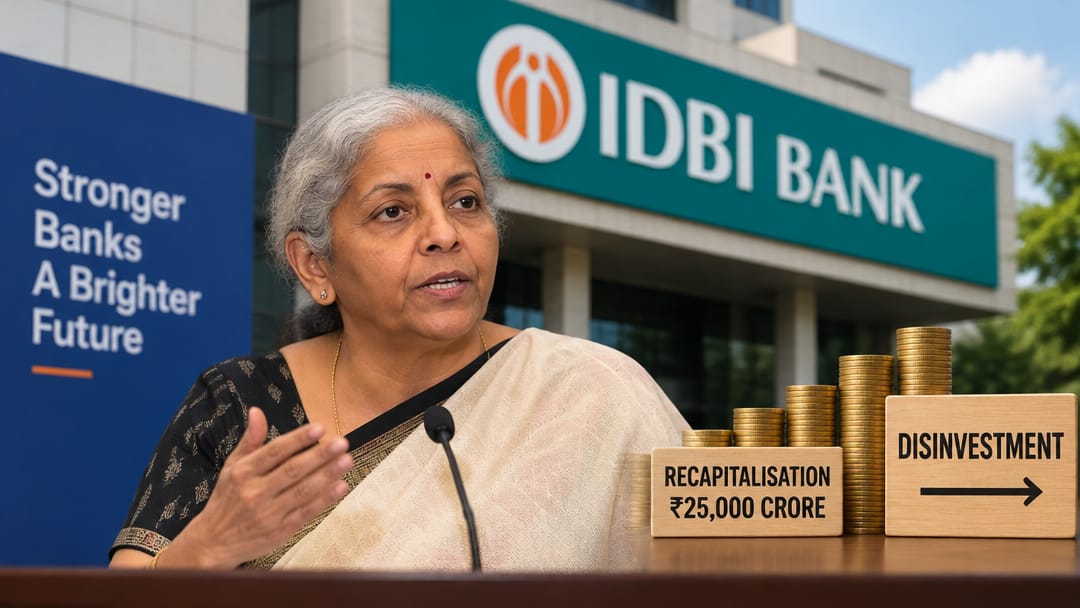
IDBI Bank recapitalised with ₹25,000 crore, now headed for disinvestment
What happened
Finance Minister Nirmala Sitharaman credited the NDA government with reviving IDBI Bank through a ₹25,000 crore recapitalisation, contrasting it with what she described as a bad-loan crisis inherited from the UPA era. The government subsequently initiated strategic disinvestment, with LIC and the Centre together divesting their combined majority stake. IDBI Bank's turnaround — from Prompt Corrective Action framework to profitability — is now cited as a case study in public sector bank revival.
Why it matters
IDBI Bank's story encapsulates the full arc of India's public sector banking crisis and reform. During the UPA era, aggressive lending — particularly to infrastructure — produced a surge in non-performing assets (NPAs). IDBI Bank was placed under the RBI's Prompt Corrective Action (PCA) framework in 2017, which restricted its lending, branch expansion, and dividend payments due to high NPAs and negative return on assets.
The NDA government recapitalised IDBI Bank with ₹25,000 crore as part of a broader ₹2.11 lakh crore bank recapitalisation programme announced in 2017. In 2019, LIC acquired a 51% controlling stake in IDBI Bank, effectively making it LIC's subsidiary — a unique arrangement where an insurance giant became the promoter of a bank. This required RBI and IRDAI approvals and raised regulatory questions about the boundary between banking and insurance.
The government then announced strategic disinvestment of IDBI Bank in 2021, with the Centre and LIC together proposing to divest over 60% stake. This remains one of the most watched privatisation bids in India. For exam purposes, key angles include: the PCA framework and its exit conditions, the LIC-IDBI ownership structure, the recapitalisation mechanism (recap bonds vs. direct equity), and the ongoing disinvestment process. RBI examiners test the banking supervision angle; UPSC tests the governance and disinvestment policy angle; SEBI tests any capital market dimension of the stake sale.