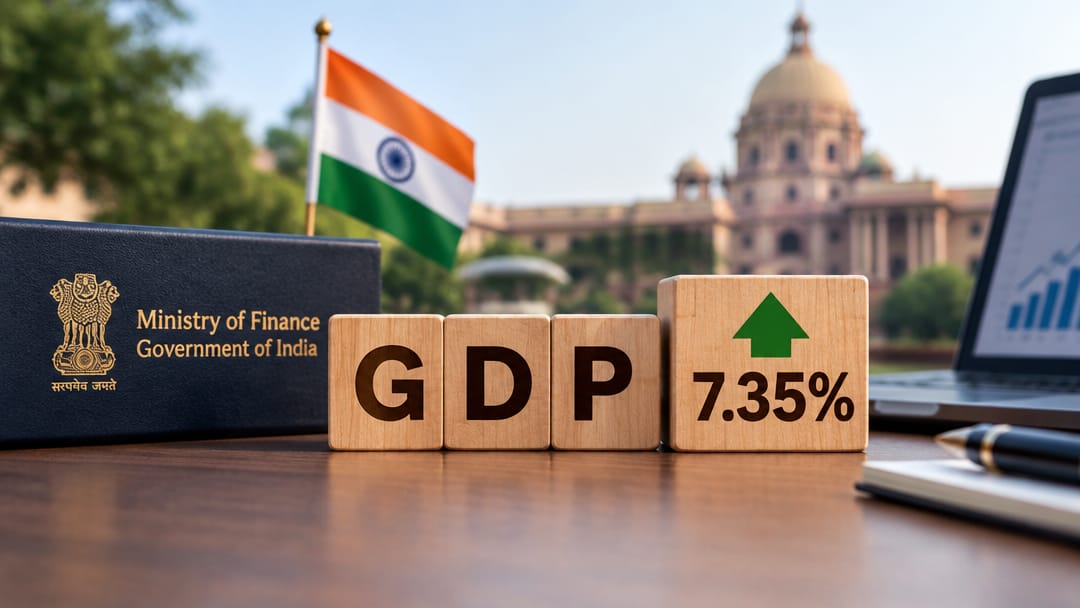
Finance Ministry nowcast puts Q2 FY27 GDP growth at 7.35%
What happened
India's Ministry of Finance, using its nowcasting model, estimates GDP growth at 7.35 per cent for the second quarter of FY27 (July–September 2026), according to its monthly economic report. The projection signals continued resilience but is accompanied by acknowledged downside risks. Nowcasting differs from official GDP estimates by using high-frequency real-time indicators to generate forward-looking growth readings before formal data is released by the National Statistical Office.
Why it matters
A nowcasting model uses high-frequency, real-time data — such as GST collections, PMI readings, power consumption, rail freight, and credit offtake — to estimate GDP growth before the National Statistical Office publishes official quarterly figures. This is important because official GDP data arrives with a lag of roughly two months after the quarter ends, creating a window during which policymakers and analysts rely on such proxies.
The Finance Ministry's Monthly Economic Review is the vehicle for this estimate. When it projects 7.35% for Q2 FY27, it is drawing on contemporaneous indicators rather than a structural model alone.
For exam purposes, understand three distinctions: (1) Nowcasting vs. forecasting — nowcasting uses current-period data to estimate the present, while forecasting projects future periods; (2) NSO vs. Ministry of Finance — the NSO publishes the Advance Estimate, First Revised Estimate, and Second Revised Estimate, while the Finance Ministry's nowcast is an independent real-time tool; (3) India's GDP measurement uses the expenditure method (C+I+G+NX) and the production/value-added method, with the base year currently 2011-12.
The 7.35% figure, if realised, would place India comfortably among the fastest-growing major economies, consistent with IMF and RBI projections for FY27. The caveat of 'risks' typically refers to global trade uncertainty, geopolitical shocks, and domestic inflation pressures — all of which affect the MPC's rate decisions and fiscal consolidation calculus.
PM-KISAN reaches 9.34 crore farmers with ₹6,000 annual direct cash transfer
What happened
PM-KISAN, the Pradhan Mantri Kisan Samman Nidhi scheme, provides direct income support of ₹6,000 per year to eligible farmer families across India, disbursed in three equal instalments of ₹2,000 each. Currently benefiting over 9.34 crore farmers, it operates through Direct Benefit Transfer. ICAR-CIFRI observed PM-KISAN Utsav Diwas alongside Khet Jagrukta Diwas, highlighting the scheme's role in strengthening rural economies and promoting awareness among farming communities about government welfare outreach.
Why it matters
PM-KISAN (Pradhan Mantri Kisan Samman Nidhi) was launched in February 2019 under the Ministry of Agriculture and Farmers' Welfare. It is a Central Sector Scheme — meaning it is fully funded by the Government of India, unlike Centrally Sponsored Schemes where states share costs. This distinction is frequently tested.
The scheme provides ₹6,000 per year in three instalments of ₹2,000 each, credited directly to the bank accounts of eligible farmer families through the Direct Benefit Transfer (DBT) mechanism. This eliminates middlemen and reduces leakage, making it a model for last-mile financial delivery.
Eligibility covers all landholding farmer families with cultivable land, subject to exclusion criteria: income taxpayers, institutional landholders, constitutional post-holders, and serving/retired government employees above a threshold are excluded. The scheme uses the Aadhaar-seeded land records database for identification.
For NABARD aspirants, the scheme connects to rural credit: the cash transfer supplements farm income, reducing distress borrowing and improving loan repayment capacity. For UPSC aspirants, PM-KISAN exemplifies DBT-based welfare architecture under the JAM Trinity (Jan Dhan–Aadhaar–Mobile). The current beneficiary count of 9.34 crore is a precision figure the examiner will test. PM-KISAN Utsav Diwas is observed on February 24, marking the scheme's anniversary.
PHDCCI urges government to scrap LTCG tax on listed equities and cut STCG rate
What happened
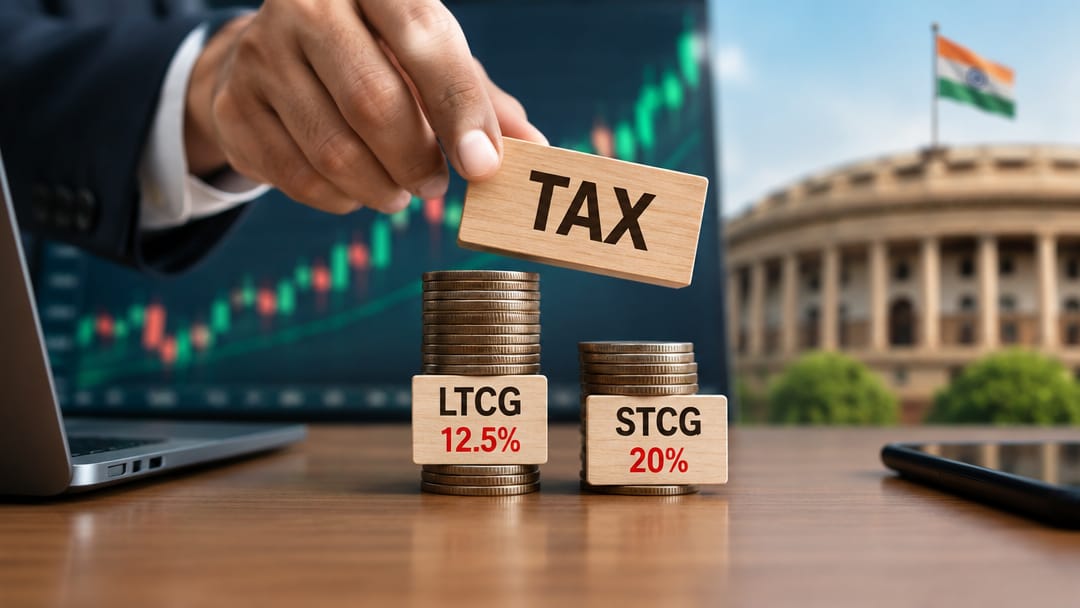
The PHD Chamber of Commerce and Industry (PHDCCI) has formally urged the Indian government to abolish long-term capital gains (LTCG) tax on listed equities and reduce the short-term capital gains (STCG) tax rate. Currently, LTCG above ₹1.25 lakh on listed equities is taxed at 12.5%, while STCG is taxed at 20%. PHDCCI argues these rates discourage retail equity investment and dampen capital market participation, and has submitted its recommendations ahead of the Union Budget.
Why it matters
Capital gains taxes on equities sit at the intersection of fiscal policy, capital market regulation, and investment incentives — making this topic testable across UPSC, SEBI, and RBI exams.
Long-term capital gains (LTCG) tax applies when listed equity shares or equity mutual fund units are held for more than 12 months before sale. Before the Finance Act 2018, LTCG on listed equities was fully exempt. The 2018 Budget reintroduced LTCG at 10% (above ₹1 lakh exemption), and the 2024 Budget revised it to 12.5% (above ₹1.25 lakh exemption). Short-term capital gains (STCG) — for holdings under 12 months — rose from 15% to 20% in 2024.
The PHDCCI's argument rests on a transmission logic: lower or zero LTCG encourages retail investors to hold equities longer, deepening market liquidity. This benefits firms seeking equity capital and reduces dependence on bank credit for long-term funding — a concern directly relevant to RBI's credit transmission analysis.
For SEBI aspirants, the relevance is regulatory: capital gains tax policy affects market microstructure, turnover, and investor participation — all areas SEBI monitors.
For UPSC, this connects to the broader debate on progressive versus growth-oriented taxation, and the fiscal cost of tax exemptions (revenue foregone).
The key exam trap: LTCG and STCG rates have changed in both 2018 and 2024 — aspirants must track current rates, the exemption threshold, and the holding period, as examiners routinely blank these out.
IDBI Bank disinvestment: government sells stake but retains a regulatory floor
What happened
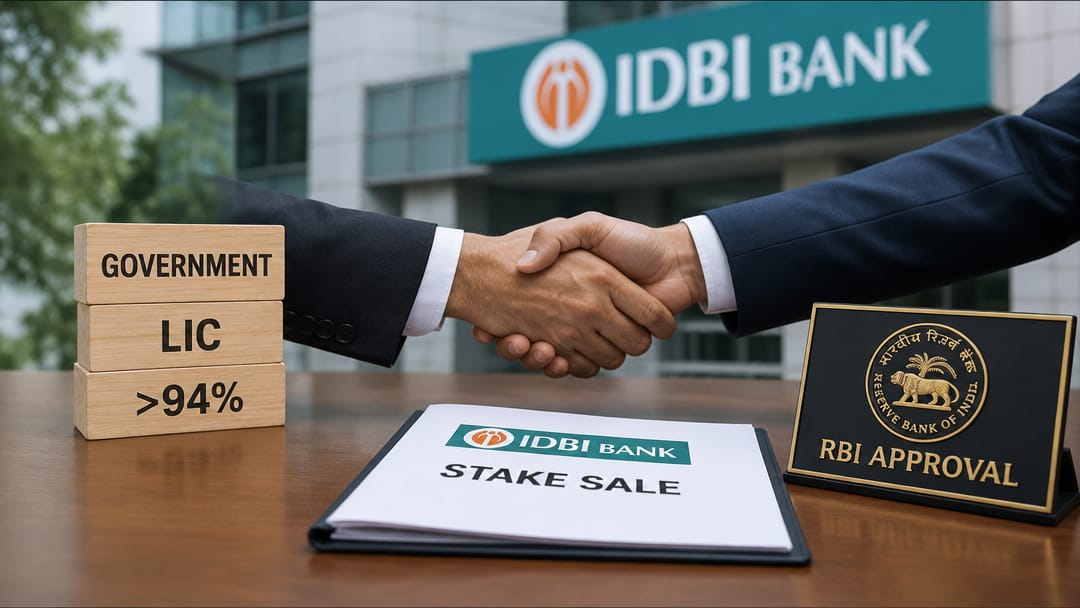
India's strategic disinvestment of IDBI Bank involves selling a substantial government equity stake to a private buyer along with transfer of management control. The government and LIC together hold over 94% in IDBI Bank. The process allows flexibility in structuring the deal, including permitting the acquirer to retain IDBI's banking licence. RBI approval is mandatory for any change in ownership of a private bank, making this a rare case of a PSU bank transitioning to private hands.
Why it matters
Strategic disinvestment differs from mere stake sale. In ordinary disinvestment, the government reduces its shareholding but retains control. In strategic disinvestment, management control is transferred to a private entity — the government exits the business of running the enterprise. IDBI Bank is a distinctive case because it sits at the intersection of two regulatory worlds: it is a scheduled commercial bank (regulated by RBI) and a company under the Companies Act, with LIC as its majority shareholder.
For the disinvestment to succeed, the acquirer must receive a 'fit and proper' clearance from RBI under the Banking Regulation Act, 1949. This is not a formality — RBI's Guidelines for Licensing of New Private Sector Banks and its fit-and-proper criteria apply. The government has indicated flexibility on the exact quantum of stake to be sold, as long as management control transfers.
The policy rationale is fiscal: proceeds go to the Consolidated Fund of India, not earmarked but used to finance the fiscal deficit. From a financial inclusion angle, the transition raises questions about whether a privately managed IDBI Bank will continue priority sector lending (PSL) obligations — it will, because PSL norms apply to all scheduled commercial banks regardless of ownership. From a capital market angle, SEBI's SAST (Substantial Acquisition of Shares and Takeovers) Regulations are relevant to the open-offer requirement that a strategic acquirer must follow if crossing the 25% trigger in a listed entity.
IDBI Bank recapitalised with ₹25,000 crore, now headed for disinvestment
What happened
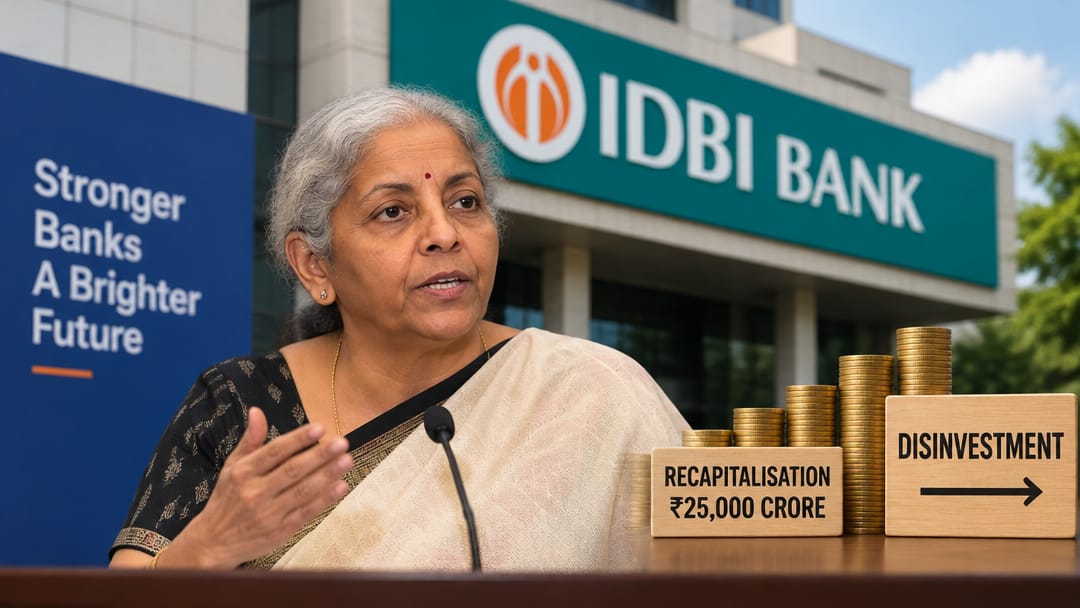
Finance Minister Nirmala Sitharaman credited the NDA government with reviving IDBI Bank through a ₹25,000 crore recapitalisation, contrasting it with what she described as a bad-loan crisis inherited from the UPA era. The government subsequently initiated strategic disinvestment, with LIC and the Centre together divesting their combined majority stake. IDBI Bank's turnaround — from Prompt Corrective Action framework to profitability — is now cited as a case study in public sector bank revival.
Why it matters
IDBI Bank's story encapsulates the full arc of India's public sector banking crisis and reform. During the UPA era, aggressive lending — particularly to infrastructure — produced a surge in non-performing assets (NPAs). IDBI Bank was placed under the RBI's Prompt Corrective Action (PCA) framework in 2017, which restricted its lending, branch expansion, and dividend payments due to high NPAs and negative return on assets.
The NDA government recapitalised IDBI Bank with ₹25,000 crore as part of a broader ₹2.11 lakh crore bank recapitalisation programme announced in 2017. In 2019, LIC acquired a 51% controlling stake in IDBI Bank, effectively making it LIC's subsidiary — a unique arrangement where an insurance giant became the promoter of a bank. This required RBI and IRDAI approvals and raised regulatory questions about the boundary between banking and insurance.
The government then announced strategic disinvestment of IDBI Bank in 2021, with the Centre and LIC together proposing to divest over 60% stake. This remains one of the most watched privatisation bids in India. For exam purposes, key angles include: the PCA framework and its exit conditions, the LIC-IDBI ownership structure, the recapitalisation mechanism (recap bonds vs. direct equity), and the ongoing disinvestment process. RBI examiners test the banking supervision angle; UPSC tests the governance and disinvestment policy angle; SEBI tests any capital market dimension of the stake sale.
SC Collegium recommends six advocates for Chhattisgarh High Court
What happened
The Supreme Court Collegium has recommended six names for appointment as judges of the Chhattisgarh High Court. The advocates named include Anand Shukla, Ratna Nidhi Pusty (also known as R.N. Pusty or Ratan Pusty), Shashank Thakur, and Sourabh Sharma. The Collegium, headed by the Chief Justice of India, exercises the power of judicial appointments under the constitutional framework established through the Three Judges Cases, making such recommendations binding on the executive.
Why it matters
The Collegium system is the mechanism by which judges of the Supreme Court and High Courts are appointed in India. It evolved through three landmark Supreme Court decisions — the First Judges Case (S.P. Gupta v. Union of India, 1981), the Second Judges Case (Supreme Court Advocates-on-Record Association v. Union of India, 1993), and the Third Judges Case (Presidential Reference, 1998). Together, these cases shifted appointment power from the executive to the judiciary, establishing that the Chief Justice of India's opinion, formed collectively through the Collegium, is binding.
For High Court appointments, the Collegium consists of the CJI and the two senior-most judges of the Supreme Court. The recommendation must also involve the Chief Justice of the relevant High Court and the Governor and Chief Minister of the concerned state. Once the Collegium reiterates a recommendation, the government is constitutionally bound to act on it.
The NJAC (National Judicial Appointments Commission) — created by the 99th Constitutional Amendment in 2014 to replace the Collegium — was struck down by the Supreme Court in 2015 (Fourth Judges Case / NJAC Case) as violating judicial independence, a basic structure element. The Collegium system therefore continues to operate. This recommendation for Chhattisgarh High Court illustrates the live operation of that system, making it directly relevant for understanding Articles 124, 217, and 224 of the Constitution.