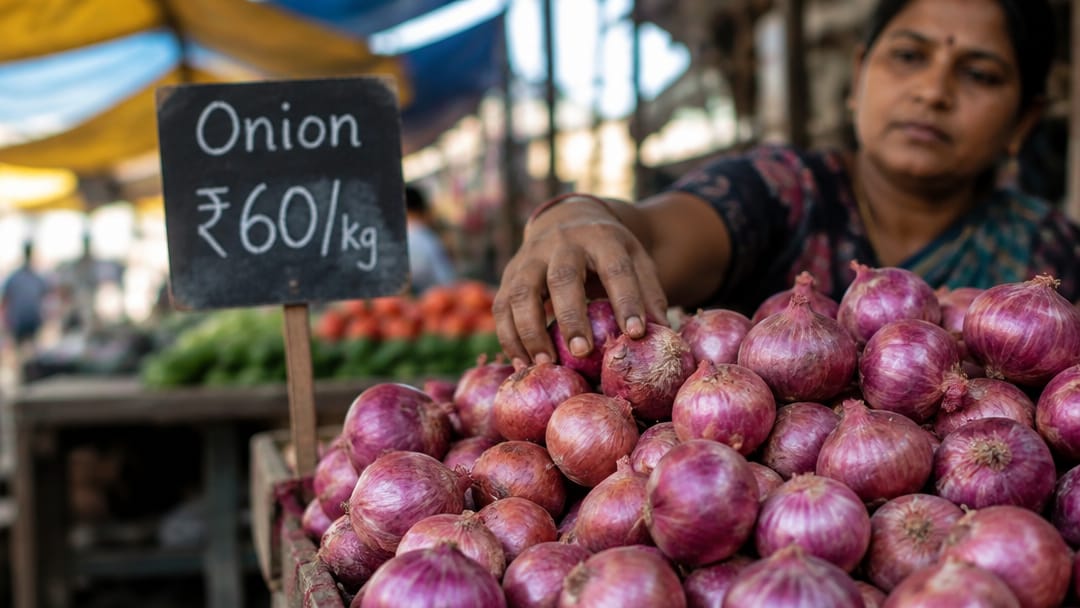
Onion prices up 99.6% year-on-year as El Niño pushes October inflation near 6%
What happened
India's October 2023 retail inflation is expected to breach 6%, breaching the RBI's upper tolerance band, driven by a 99.6% year-on-year spike in onion prices. Bank of Baroda flagged El Niño-linked weather risks compounding food inflation pressures. With the MPC's December meeting approaching, sustained food price shocks complicate any pivot toward rate cuts, keeping the RBI in a holding pattern despite broader disinflation in core categories.
Why it matters
India's inflation targeting framework, adopted under the amended RBI Act 1934, mandates the MPC to keep CPI inflation at 4% with a tolerance band of ±2% — meaning the upper limit is 6%. When headline CPI breaches this band, the RBI is legally required to submit an explanation to the Government detailing the reasons and the remedial path.
Food and beverages carry roughly 45.86% weight in India's CPI basket, making vegetable price spikes — especially onions — disproportionately impactful. Onions are a classic example of supply-side inflation, where a monetary policy rate hike has limited effectiveness. Raising the repo rate cannot plant more onions or reverse a monsoon deficit.
This creates a policy dilemma: the MPC must respond to headline inflation breaching the target, but the instrument available (repo rate) addresses demand-pull inflation more effectively than cost-push or supply-shock inflation. The RBI typically 'looks through' transient food shocks, but El Niño risks make the duration of the shock uncertain — which is what the article highlights.
El Niño events historically reduce India's southwest monsoon rainfall, hurting kharif output. If the weather shock persists into rabi sowing, it could trigger second-round effects, turning a temporary food spike into a broader inflationary episode. This uncertainty is precisely what complicates the December 2023 MPC decision — the committee must weigh the risk of premature rate cuts against choking already-slowing growth.
India's first grasslands guide, launched at UNCCD COP17, ends wasteland misclassification
What happened
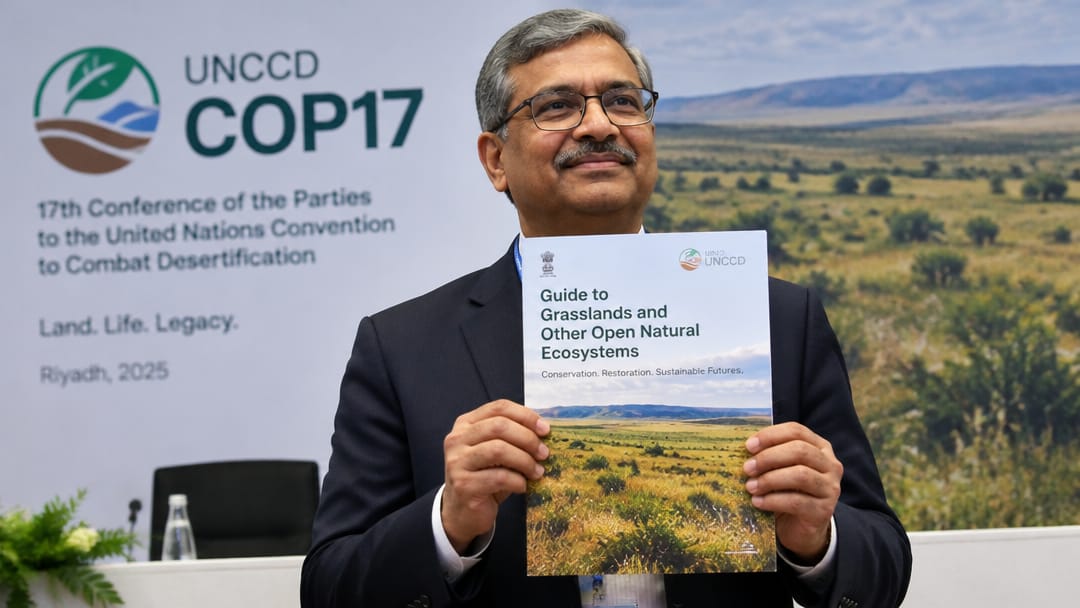
India released its first-ever Guide to Grasslands and Other Open Natural Ecosystems at the 17th Conference of Parties of the UN Convention to Combat Desertification, held in 2025. The guide formally recognises grasslands, savannas, scrublands, and other open natural ecosystems as distinct biomes requiring dedicated conservation — a significant policy shift from treating them as degraded forests or wasteland available for diversion.
Why it matters
India's grasslands and open natural ecosystems (ONEs) have historically suffered a classification problem: government land records labelled them 'wastelands' or 'degraded forests,' making them easy targets for diversion to solar parks, plantations, and infrastructure. This guide, launched at UNCCD COP17, is the first official national document to map, describe, and assert conservation value for these ecosystems.
The UNCCD (United Nations Convention to Combat Desertification) is the third Rio Convention alongside UNFCCC and CBD, adopted in 1994 and entered into force in 1996. India is a signatory. COP17 is a critical moment because the convention's 2022–2030 strategic framework explicitly targets Land Degradation Neutrality (LDN), and India has committed to restoring 26 million hectares of degraded land by 2030 under its NDC.
Grasslands cover roughly 12% of India's geographic area and support species like the Great Indian Bustard (Critically Endangered), Blackbuck, Chinkara, and Indian Wolf — all heavily dependent on open landscapes. Because grasslands store carbon in soil rather than biomass, they are systematically undercounted in carbon accounting, making them invisible in green-finance frameworks.
For NABARD aspirants: rural pastoral communities depend on these commons for livestock grazing. Their degradation directly affects rural livelihoods, making this relevant to NABARD's mandate on rural development and ecosystem services. The guide could unlock climate finance for grassland restoration projects under the Green Climate Fund and NABARD's own NCEF (National Clean Energy Fund) channels.
India-Japan 7th forestry JWG meets in Bengaluru to review bilateral cooperation
What happened
India and Japan held their 7th Joint Working Group meeting on forestry cooperation in Bengaluru, reviewing progress and strengthening collaboration in the sector. The meeting, convened under the bilateral forestry framework between the two countries, examined areas including forest management, afforestation, timber trade, and climate-linked forest conservation. This JWG mechanism forms part of India-Japan Special Strategic and Global Partnership, which covers environment and natural resource cooperation alongside defence, technology, and economic ties.
Why it matters
India and Japan established a bilateral forestry cooperation framework under their broader Special Strategic and Global Partnership, which was elevated to that status in 2014. The Joint Working Group on Forestry is the institutional mechanism through which both countries exchange technical expertise, share best practices in sustainable forest management, and coordinate on issues like agroforestry, bamboo, timber legality, and forest-based carbon sequestration.
Japan is a world leader in forest management — over 67% of its land is forested, and it has developed sophisticated community forestry and disaster-prevention forestry models. India, with roughly 24% of its geographical area under forest and tree cover (as per India State of Forest Report 2023), is actively pursuing forest restoration under its Nationally Determined Contributions (NDCs) which commit to creating an additional carbon sink of 2.5 to 3 billion tonnes of CO₂ equivalent through forest and tree cover by 2030.
The JWG mechanism allows India to draw on Japanese expertise in watershed forestry, urban greening, and climate-resilient plantations. For UPSC aspirants, the connection between bilateral forestry frameworks and India's international climate commitments is key. For NABARD aspirants, the agroforestry, bamboo economy, and forest-based livelihood dimensions are directly relevant to rural credit and green finance policy.