SC in Sujit Das: detaining someone beyond 24 hours without a magistrate is unlawful arrest
What happened
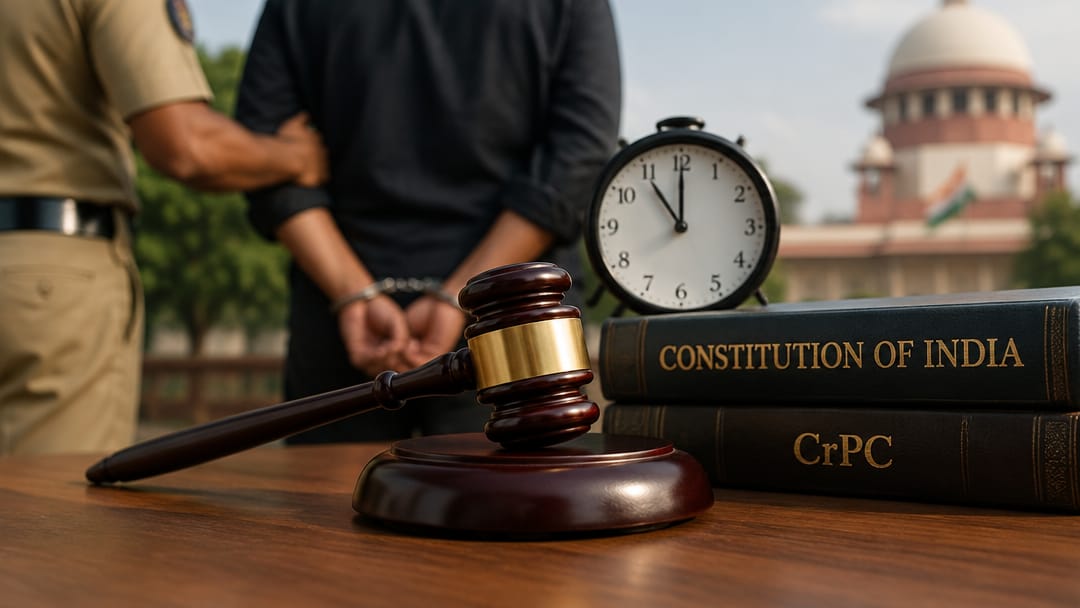
The Supreme Court in Sujit Das v Union of India drew a firm constitutional line between lawful arrest and unlawful detention by holding that any person taken into police custody must be produced before a magistrate within 24 hours. Failure to comply transforms the detention into an illegal arrest regardless of the original justification. The ruling reinforces Article 22(2) of the Constitution and Section 57 of the CrPC, making the 24-hour rule a mandatory screening mechanism, not a procedural formality.
Why it matters
The judgment operationalises two parallel guarantees that have coexisted in Indian law since 1950 but were rarely enforced with equal rigour.
Article 22(2) of the Constitution states that every arrested person must be produced before the nearest magistrate within 24 hours of arrest, excluding travel time. Section 57 of the CrPC (now Section 35 of the BNSS, 2023) mirrors this in statute. Together they create what the Court described as a mandatory screening process — the magistrate is not a rubber stamp but an independent authority whose role is to decide whether continued custody is justified.
The critical doctrinal move in Sujit Das is the Court's characterisation of non-compliance: keeping a person beyond 24 hours without magistrate production does not merely violate procedure — it retroactively converts the original detention into an illegal arrest. This matters because an illegally arrested person has the right to be released immediately and cannot be remanded under Section 167 CrPC.
The judgment also distinguishes arrest from detention. Arrest is a formal legal act with defined consequences. Informal detention — holding someone for 'questioning' or 'verification' — without following arrest procedure is constitutionally impermissible. Police cannot avoid the 24-hour clock by labelling custody as something other than arrest.
For CLAT PG, this connects directly to the bail and custody framework: the magistrate's power to remand under Section 167, the outer limit of 15-day police custody, and the right of the accused to be informed of grounds of arrest under Article 22(1).
India's Constitution rejects absolute separation of powers, but not the principle itself
What happened
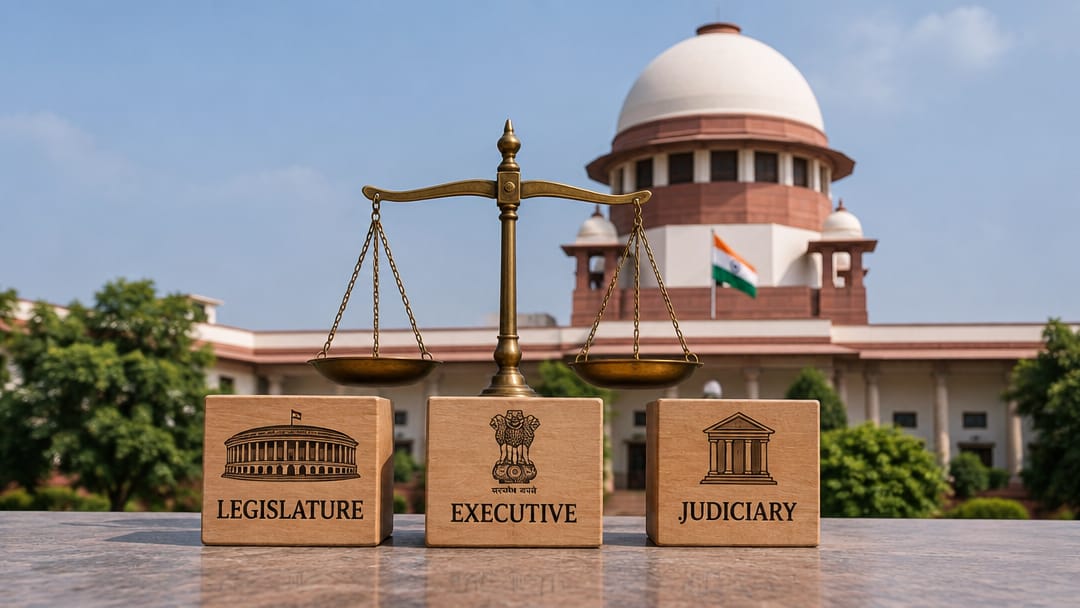
The Supreme Court has consistently held that India's Constitution does not adopt the doctrine of separation of powers in its strict or absolute form. The three organs — Legislature, Executive, and Judiciary — are not watertight compartments. However, the Constitution does distribute functions and builds in checks and balances. Each organ exercises some functions of the other, yet the core constitutional functions of each are protected from usurpation by another organ.
Why it matters
The doctrine of separation of powers, classically articulated by Montesquieu in 'The Spirit of the Laws' (1748), proposes that the legislative, executive, and judicial powers of a state must be vested in distinct and independent organs to prevent tyranny. The United States Constitution comes closest to a strict separation model.
India adopted a modified version. The Constitution does not expressly use the term 'separation of powers,' yet Articles 50, 121, 122, 211, and 212 reflect the principle in specific contexts — for instance, Article 50 directs separation of the judiciary from the executive in public services.
The Supreme Court in Ram Jawaya Kapur v. State of Punjab (1955) first clarified that India does not follow the strict doctrine, but its Constitution does differentiate and assign functions. In Indira Nehru Gandhi v. Raj Narain (1975), the Supreme Court held that separation of powers is part of the basic structure of the Constitution — meaning Parliament cannot destroy it through amendment. The Kesavananda Bharati (1973) judgment underpins this by establishing that core constitutional features, including checks and balances, are unamendable.
Practically, the overlap is real: the President (executive) summons Parliament (legislative); ordinances are executive legislation; judges are appointed through a collegium system that keeps executive interference limited. The key test is whether the essential function of one organ is being usurped, not merely whether some functions overlap. Judicial review — the court's power to strike down laws — is itself a check by the judiciary on the legislature and executive, and is a cornerstone of this modified doctrine.
CAT quashes transfer of disabled IAS officer for ignoring her medical needs
What happened
The Central Administrative Tribunal quashed the transfer of India's first visually impaired woman IAS officer from Delhi to Arunachal Pradesh. The Tribunal held that before transferring an employee with a disability, the government must consider their medical needs and cannot treat transfer orders as routine administrative decisions. The ruling reinforces the reasonable accommodation principle under the Rights of Persons with Disabilities Act, 2016, making medical necessity a binding consideration in transfer decisions affecting disabled civil servants.
Why it matters
This ruling applies the principle of reasonable accommodation — a cornerstone of disability rights law — to the administrative context of service transfers. Under the Rights of Persons with Disabilities Act, 2016 (RPwD Act), 'reasonable accommodation' means necessary and appropriate modifications or adjustments that do not impose a disproportionate or undue burden, to ensure persons with disabilities enjoy equal rights on par with others.
The CAT held that a transfer order, even if made in the ordinary exercise of executive power, cannot be insulated from scrutiny when the transferee is a person with a disability. The government's obligation is not merely to refrain from discriminating; it must positively accommodate the medical and accessibility requirements of the disabled employee before making the transfer.
This distinction matters enormously: it shifts disability protection from a negative right (no discrimination) to a positive duty (active accommodation). The court implicitly applied the social model of disability — the view that barriers are created by society's failure to adjust, not by the individual's condition — which is the philosophical foundation of the RPwD Act and international frameworks like the UN Convention on the Rights of Persons with Disabilities (UNCRPD), which India ratified.
For CLAT PG, the examinable principle is: transfer of a disabled government employee without considering their medical needs violates the reasonable accommodation obligation under the RPwD Act, 2016, and such a transfer order is liable to be quashed.
Dicey's rule of law meets its limits in the modern administrative state
What happened
Dicey's rule of law doctrine holds that no one is above the law, equality before law must prevail, and constitutional rights flow from judicial decisions rather than government grants. Administrative law grows directly from this foundation by subjecting executive action to legal scrutiny. Indian courts have used this relationship to strike arbitrary state action under Articles 14, 19, and 21. The NALSA judgment on transgender rights reinforced that rule of law demands equal legal recognition regardless of identity.
Why it matters
The rule of law, as formulated by A.V. Dicey in 1885, rests on three pillars: (1) supremacy of law — no punishment except for a breach of established law; (2) equality before law — every person, including government officials, is subject to the ordinary courts; and (3) the constitution is a consequence of individual rights, not their source.
Administrative law is the direct institutional response to Dicey's second pillar. As the state expanded its welfare functions in the 20th century, executive agencies multiplied. Administrative law developed to ensure these agencies acted within their statutory powers (intra vires), followed natural justice, and did not exercise arbitrary discretion. This is where Dicey's model shows its limits: he distrusted French-style droit administratif (separate administrative courts), yet the complexity of modern governance forced India to develop specialised administrative tribunals under Article 323-A and 323-B.
In India, the rule of law operates through several constitutional guarantees. Article 14 (equality before law and equal protection), Article 21 (right to life and liberty), and Article 32/226 (judicial review) collectively operationalise Dicey's principles. The Supreme Court in NALSA v. Union of India (2014) extended this logic: denying legal recognition to transgender persons violated the rule of law because it placed them outside the equal protection of law — precisely the inequality Dicey's second pillar was designed to eliminate.
The critical tension for the examiner: administrative discretion is necessary for governance, but uncanalised discretion is antithetical to the rule of law. The test Indian courts apply is whether the discretion is guided by intelligible differentia with a rational nexus to the object — the Article 14 doctrine of reasonable classification.
SC tells Uttar Pradesh: granting bail means nothing if the undertrial stays in jail
What happened
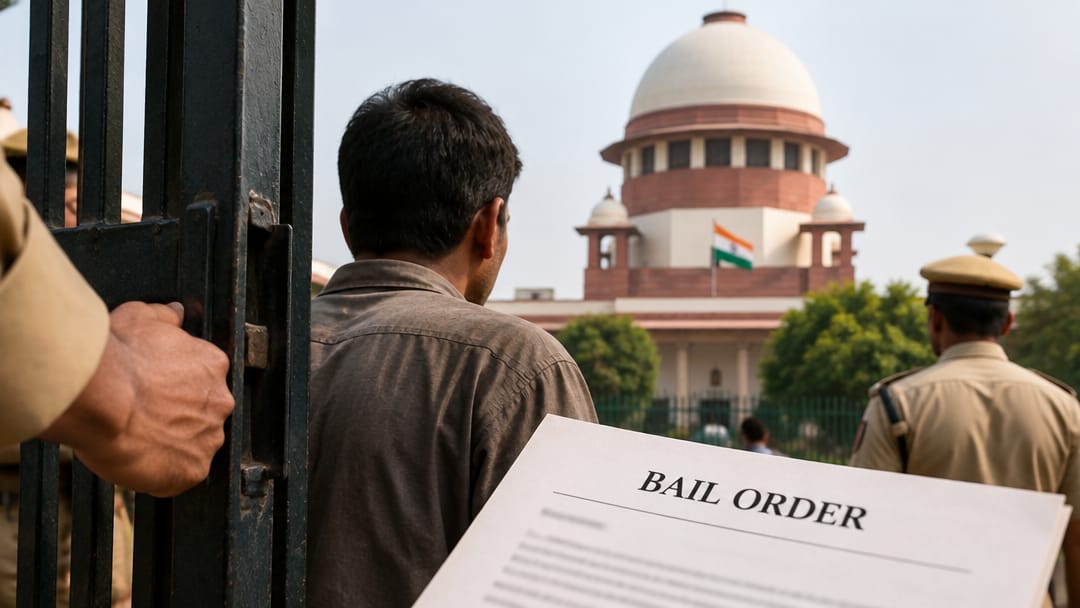
The Supreme Court has held that the State of Uttar Pradesh bears direct responsibility for ensuring undertrials who have been granted bail are actually released from custody. The Court directed the state to make bail conditions flexible and to ensure legal aid reaches those who cannot afford to comply with standard surety requirements. The ruling targets the gap between a court granting bail and the undertrial physically walking free — a gap the Court said the state must close.
Why it matters
Bail in India operates on a simple premise: an accused is presumed innocent until proven guilty, and pre-trial detention should be the exception, not the rule. Yet in practice, thousands of undertrial prisoners remain in jail even after a court has granted them bail — not because they lost the application, but because they cannot meet the conditions attached to it, chiefly furnishing sureties or depositing bail bonds.
The Supreme Court's ruling against Uttar Pradesh addresses this structural failure. By placing the onus on the state government — rather than leaving it to the undertrial to navigate the system alone — the Court is enforcing the principle established in Arnesh Kumar v. State of Bihar (2014) and reinforced in Satender Kumar Antil v. CBI (2022): that liberty is the rule and custody is the exception.
Section 436A of CrPC (Section 479 BNSS) allows an undertrial who has served half the maximum sentence for the offence to be released on bail. Section 440 empowers courts to reduce the amount of surety. The problem is that these provisions exist on paper but go unused when no one — counsel, state, or court — takes responsibility for implementation.
This ruling is significant because it converts a passive judicial permission (bail granted) into an active state obligation (ensure release). It connects to Articles 21 and 22 of the Constitution — right to life and personal liberty — and to the ongoing discourse on prison reform and undertrial rights in India.
SC: balance sheet entry acknowledging a debt can restart the limitation clock
What happened
The Supreme Court held that entries recorded in a company's balance sheet can constitute an acknowledgment of liability under Section 18 of the Limitation Act, 1963, thereby extending the period of limitation for filing a suit. The ruling restored a money recovery suit that had been dismissed as time-barred. The court reasoned that a balance sheet entry, if it admits an outstanding debt, satisfies the legal requirements of acknowledgment even without a separate signed document.
Why it matters
Section 18 of the Limitation Act, 1963 provides that if a person acknowledges liability in respect of any property or right before the limitation period expires, a fresh period of limitation begins from the date of acknowledgment. The acknowledgment must be in writing and signed by the party or their agent.
The Supreme Court's ruling addresses a commercially significant question: does a balance sheet entry — which is not a standalone acknowledgment letter but an accounting document signed by company directors — satisfy Section 18? The Court held that it does, provided the entry clearly reflects an admission of an outstanding debt.
This matters because companies routinely record outstanding liabilities in their balance sheets, and creditors sometimes discover a debt is time-barring only after several years. If the debtor's own audited balance sheet records the liability, that entry can serve as acknowledgment, giving the creditor a fresh limitation period from the date of the balance sheet.
The key doctrinal elements are: (1) the acknowledgment must be before the original period expires; (2) it must be in writing; (3) it must be signed — balance sheets signed by directors satisfy this; and (4) it must acknowledge the specific liability, not merely refer to accounts generally. This aligns with the broader principle that acknowledgment need not be a formal admission — an implied recognition of subsisting liability is sufficient.
Dead ex parte respondent does not void a judgment if appeal was available
What happened
The Jammu & Kashmir High Court ruled that the death of a respondent who had been proceeded against ex parte does not, by itself, nullify a judgment or entitle the losing petitioner to have it recalled. Where a statutory appeal remedy exists, the court held that recalling the judgment is not permissible merely because the respondent died before the matter concluded. The proper course is to pursue the available appellate remedy, not to invoke the court's inherent power to recall.
Why it matters
This ruling engages two important procedural principles tested regularly in CLAT PG: the doctrine of ex parte proceedings and the limits of a court's inherent power to recall its own judgments.
An ex parte order or judgment is one passed in the absence of a party — typically the respondent — who was duly served but chose not to appear. The death of such a respondent, while procedurally significant, does not automatically render the judgment a nullity. A judgment becomes a nullity only when the court lacked inherent jurisdiction, not merely because a party died during or after proceedings.
The second and more important principle concerns the recall of judgments. Indian courts exercise inherent power (under Section 482 CrPC / Section 528 BNSS or the civil court equivalent) to prevent abuse of process or to correct jurisdictional errors. However, this power is not a substitute for a statutory appeal. Where an appeal lies — whether under CrPC, CPC, or a special statute — the party must exhaust that remedy. Courts have consistently refused to use recall jurisdiction as a parallel appellate channel.
For CLAT PG, the examiner typically frames a passage on inherent powers or ex parte decrees and then tests whether the aspirant can identify the correct remedy. The key distinction is: inherent power corrects jurisdictional voids; it does not reopen a case where an appeal was available but not pursued. The J&K HC ruling reinforces this principle with the added twist of a deceased respondent, making it a richer hypothetical for passage-based MCQs.
Madras HC directs Tamil Nadu to assess need for more corruption courts
What happened
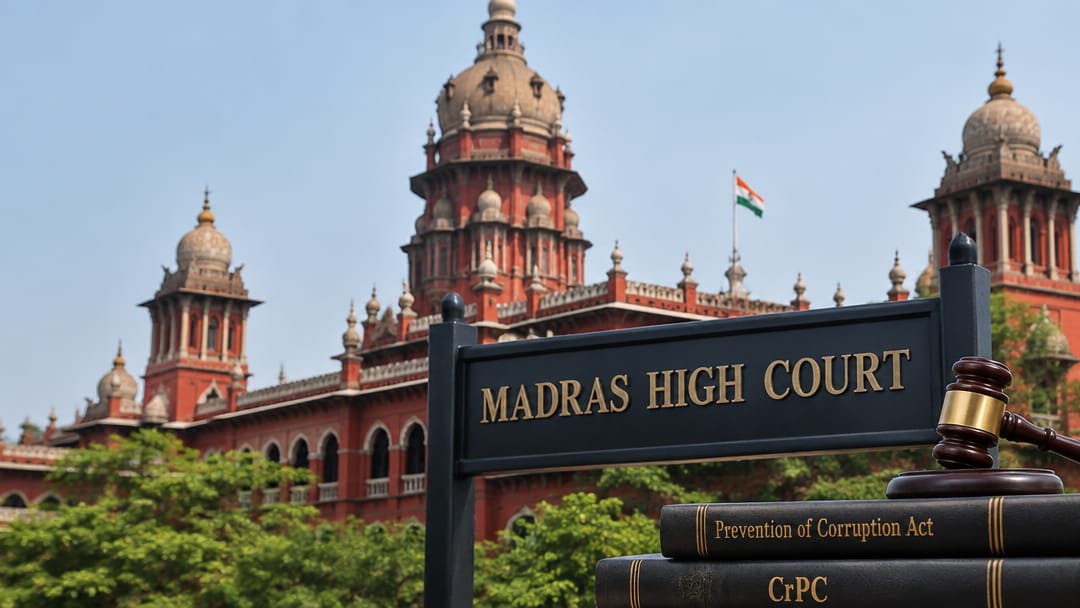
The Madras High Court has directed the Tamil Nadu government to examine whether additional special courts are needed to try pending corruption cases in the state. The direction reflects concern over the backlog of cases under the Prevention of Corruption Act. Special courts for corruption cases derive their authority from the PC Act and CrPC, and their establishment requires state government action, often prompted by judicial direction or central government recommendation.
Why it matters
Special courts for corruption cases in India are established primarily under Section 3 of the Prevention of Corruption Act, 1988, which empowers the Central or State Government, in consultation with the High Court, to designate Sessions Courts as Special Judges to try offences under the PC Act. The rationale is expeditious trial: corruption cases involving public servants require dedicated judicial infrastructure so that proceedings are not delayed by ordinary trial court backlogs.
The Madras High Court's direction sits within a broader constitutional and procedural framework. Under Article 227, High Courts have superintendence over all courts within their territorial jurisdiction, and they frequently exercise this power to issue administrative directions on court infrastructure and pendency. The direction to the Tamil Nadu government is not a writ of mandamus in the strict sense — it is an administrative-judicial nudge rooted in superintendence jurisdiction.
For CLAT PG, the examiner often tests the distinction between Special Courts under the PC Act, Special Courts under PMLA (which are designated as Special Courts under Section 43 of PMLA 2002), and Fast Track Courts established under central schemes. These are frequently conflated in MCQ distractors. The key distinction: PC Act Special Courts try scheduled offences under the PC Act; PMLA Special Courts (also called designated courts) try money-laundering offences and may also try the scheduled offences.
For UPSC, the institutional angle — that the state government acts in consultation with the High Court, not unilaterally — is the precision point most likely to be tested in a statement-evaluation format.