SC's 2025 constitutional rulings: Art 14, 19, 21, and 300A tested across new fact patterns
What happened
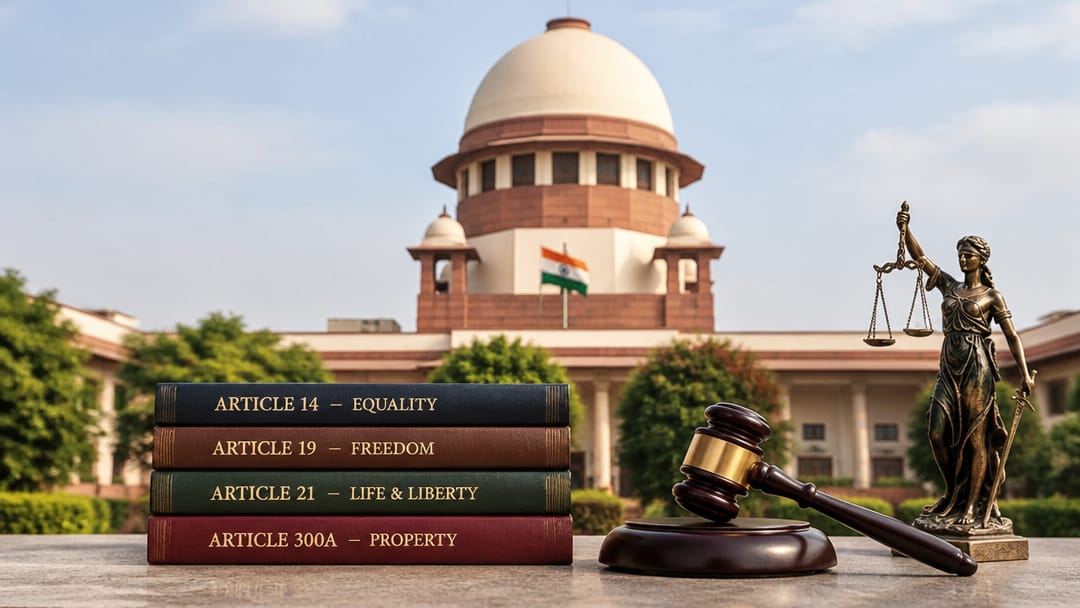
The Supreme Court of India delivered several landmark constitutional law judgments in the second half of 2025, shaping the interpretation of Articles 14, 19, 21, and 300A. The rulings refined the tests for reasonable classification, deprivation of liberty, procedural fairness, and compulsory acquisition of property without compensation. These judgments are part of an ongoing series cataloguing constitutional evolution and are directly relevant for aspirants preparing for CLAT PG and UPSC CSE.
Why it matters
India's constitutional rights jurisprudence evolves primarily through Supreme Court judgments. The four articles most frequently litigated — Art 14 (equality), Art 19 (freedoms), Art 21 (life and liberty), and Art 300A (property) — each carry a distinct doctrinal architecture that the Court refines with each ruling.
Art 14 prohibits arbitrary state action. The Court applies the 'reasonable classification' test: a classification must have an intelligible differentia and a rational nexus with the object of the law. Post-Maneka Gandhi (1978), the Court also reads Art 14 as requiring procedural fairness wherever the state acts.
Art 19 protects six freedoms (speech, assembly, movement, etc.) subject to 'reasonable restrictions' under clauses (2)–(6). The Court applies a proportionality standard: the restriction must be proportionate to the legitimate aim pursued.
Art 21 has expanded from a narrow 'procedure established by law' guarantee to a substantive right after Maneka Gandhi, encompassing the right to health, environment, livelihood, dignity, and speedy trial. The test now demands that any procedure depriving life or liberty be fair, just, and reasonable.
Art 300A, inserted by the 44th Amendment (1978), protects against deprivation of property except by 'authority of law.' The Supreme Court has progressively held that this requires not just legal authority but a fair and reasonable process, including notice, hearing, and compensation where applicable.
The 2025 rulings reportedly advance each of these doctrines — making them prime material for passage-based questions where the examiner will test whether you can apply the principle stated in the passage to a novel fact situation.
SC rules courts cannot impose costs when summoning a witness is necessary for justice
What happened
The Supreme Court has held that when a court exercises its power under Section 311 CrPC — now Section 348 of the BNSS — to summon a witness or recall evidence it considers necessary for a just decision, it cannot impose costs on any party as a condition. The power under Section 311 is discretionary but once the court finds the evidence essential, costs become impermissible. This ruling clarifies the limits of judicial discretion at the intersection of evidence-gathering and procedural fairness.
Why it matters
Section 311 CrPC (now Section 348 BNSS) grants courts a wide, almost plenary power to summon any person as a witness, examine any person already present in court, or recall and re-examine any witness already examined — at any stage of a trial, inquiry, or other proceeding. The critical feature of this section is its dual character: the first part is mandatory ('shall') when the evidence is essential to a just decision; the second part is discretionary ('may') for general purposes of justice.
The Supreme Court's ruling resolves a practical confusion: can courts impose costs — say, requiring the party who benefits from additional evidence to pay the other side's expenses — when exercising this power? The answer is no, at least when the court itself has found the evidence necessary for a just decision. The rationale is that when a court acts under the mandatory limb of Section 311, it acts in the interest of justice itself, not in the interest of any party. Imposing costs would create a chilling effect, deterring courts from exercising a power the legislature made mandatory.
For CLAT PG aspirants, this ruling sits at the intersection of two frequently tested themes: the scope of judicial discretion under Section 311/348, and the principle that procedural powers aimed at truth-finding cannot be weaponised as cost-imposing tools. The transition from CrPC to BNSS also means aspirants must know both the old and new section numbers, as CLAT PG examiners have already begun testing BNSS provisions alongside legacy CrPC references.
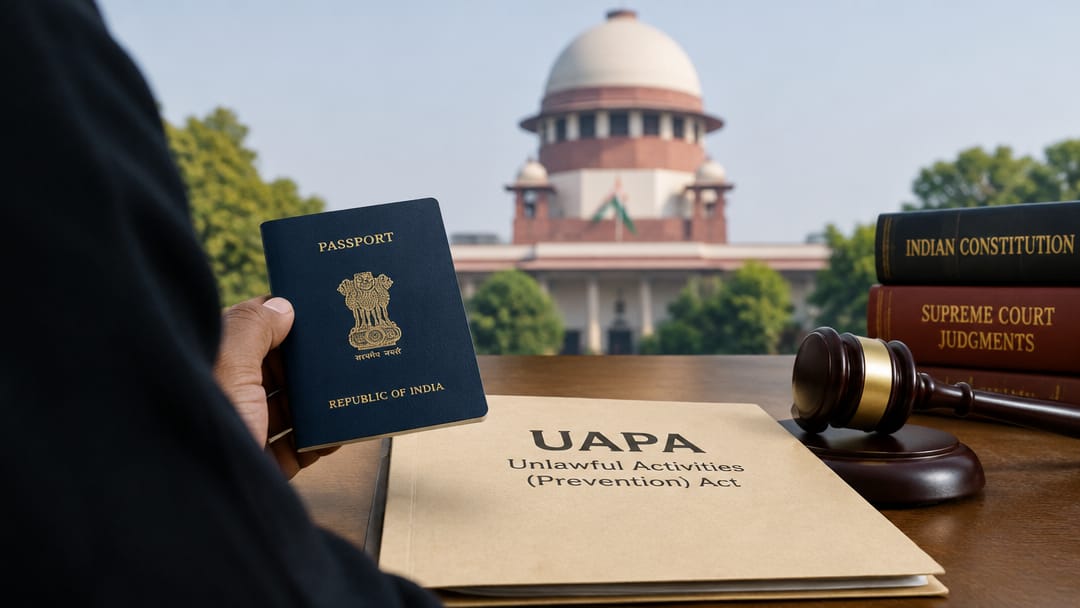
The Supreme Court has held that Section 43D(7) of the Unlawful Activities (Prevention) Act does not automatically bar bail for foreign nationals accused under UAPA. The bar applies only where the court, after examining the case diary and chargesheet, is satisfied that the accusations are prima facie true. Illegal entry into India or mere foreign nationality cannot, by itself, be treated as an independent ground to deny bail under the UAPA framework.
Why it matters
Section 43D(5) of UAPA is the well-known bail restriction — it bars courts from granting bail if, on a perusal of the case diary or chargesheet, there are reasonable grounds to believe the accusation is prima facie true. Section 43D(7) is a separate, less-discussed sub-section that restricts bail specifically in certain categories. The Supreme Court's ruling clarifies that this sub-section is not triggered automatically by the accused's nationality or immigration status.
This distinction matters enormously. Courts have sometimes used foreign nationality or illegal entry as a proxy for flight risk or threat to national security, layering those facts on top of UAPA's already high bail threshold. The Supreme Court has now drawn a clear line: the statutory bar operates on the merits of the accusation as revealed in court documents, not on personal attributes of the accused like nationality.
For CLAT PG, this ruling is a textbook application of the principle that penal statutes must be construed strictly — a restriction on personal liberty cannot be extended by implication to categories the legislature did not expressly mention. It also connects to the constitutional guarantee under Article 21, which applies to 'any person' on Indian soil, including foreign nationals, and to the interpretive canon that bail conditions in special statutes override the general CrPC (now BNSS) regime only to the extent expressly provided.
Justice Oka: SC's roster is not genuine while CJI discretion over cases remains
What happened
Retired Supreme Court judge Justice A.S. Oka has stated that the Supreme Court currently lacks a proper roster system because case categories can be assigned to multiple benches, leaving room for manual intervention by the Chief Justice of India. He argued that a genuine roster must eliminate discretionary assignment altogether. Without a fixed, automated roster, the court cannot ensure that litigants receive cases heard by benches determined by rule rather than by the CJI's personal discretion.
Why it matters
The 'roster' refers to the system by which the Chief Justice of India, as 'Master of the Roster,' allocates cases to specific benches. The CJI's power in this regard was affirmed in Campaign for Judicial Accountability and Reforms v. Union of India (2018) and the Supreme Court Advocates on Record Association cases. The Master of the Roster doctrine holds that only the CJI has the exclusive prerogative to constitute benches and assign cases — no other judge can direct which bench hears a matter.
Justice Oka's critique targets a structural gap: if a category of cases — say, constitutional matters or PIL matters — can go to any of several benches, then the CJI retains de facto discretion over which judge ultimately decides sensitive cases. This undermines judicial impartiality and public confidence in random or rule-based allocation.
For CLAT PG, this connects to two tested areas: (1) the constitutional position of the CJI as Master of the Roster — its source, scope, and limits; and (2) separation of powers and judicial independence principles. The examiner has consistently tested landmark rulings on judicial appointments and court administration. Justice Oka's statement introduces a reform dimension: a proper roster system would be algorithmic or fixed by subject-matter rules, removing human choice entirely. This mirrors debates in comparative jurisdictions where random case assignment is treated as a cornerstone of judicial independence.