RBI holds repo rate at 5.25%, cites global trade uncertainty and inflation risk
What happened
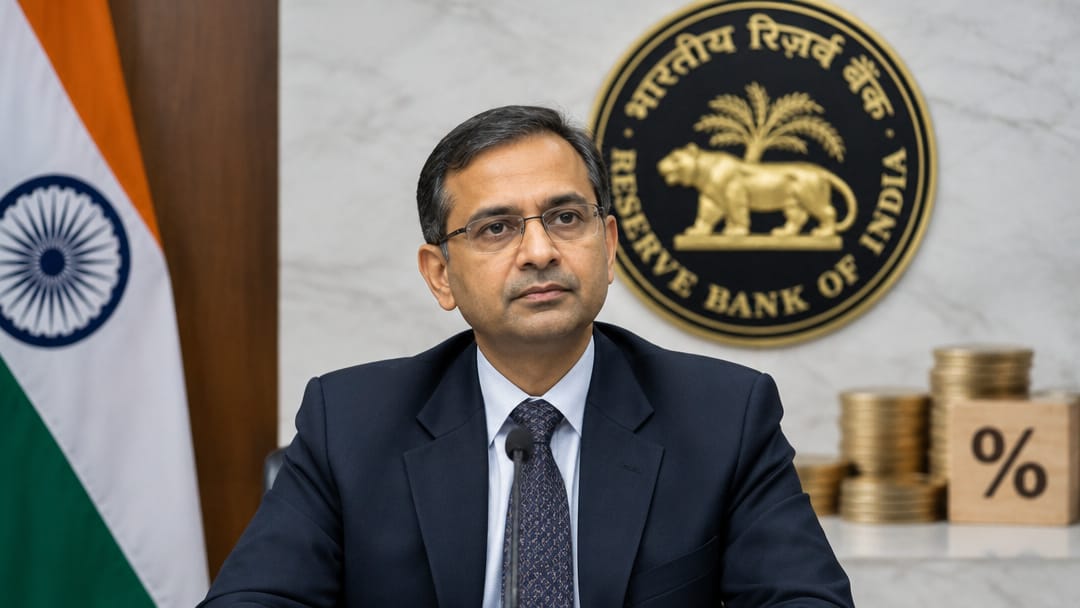
The RBI's Monetary Policy Committee kept the policy repo rate unchanged at 5.25 per cent and retained its neutral stance. The Standing Deposit Facility rate remains at 5 per cent, and the Marginal Standing Facility and bank rate stay at 5.5 per cent. Governor Sanjay Malhotra cited US tariff measures, crude oil volatility, and West Asia tensions as key risks. Inflation remains within the tolerance band, and domestic growth is supported by favourable monsoon and capital inflows.
Why it matters
This MPC decision is a textbook illustration of the RBI's inflation-targeting framework in action. Under the flexible inflation targeting (FIT) framework adopted in 2016, the MPC is mandated to keep CPI inflation at 4 per cent, with a tolerance band of ±2 per cent (i.e., 2–6 per cent). When inflation is within this band but showing upward movement, and growth remains resilient, the MPC has no compelling trigger to either cut or hike — hence a hold with a neutral stance.
The LAF corridor is central to understanding how these rates interact. The repo rate (5.25%) is the rate at which banks borrow overnight from RBI against collateral. The SDF rate (5 per cent) forms the floor — banks park surplus liquidity with RBI at this rate. The MSF rate (5.5%) forms the ceiling — banks borrow emergency overnight funds at this rate. Together, these create a 50-basis-point corridor that guides short-term money market rates.
The neutral stance signals that the MPC is not pre-committed to either cutting or hiking. It retains flexibility depending on how inflation and growth evolve. This contrasts with an 'accommodative' stance (biased toward cuts) or a 'withdrawal of accommodation' stance (biased toward hikes).
For transmission: when the repo rate holds steady, bank lending rates and deposit rates are unlikely to move significantly. Credit growth remains dependent on demand conditions rather than rate incentives. For agricultural credit — relevant to NABARD aspirants — NABARD's refinancing rates are linked to prevailing policy rates, so a hold means rural lending costs remain stable.
RBI holds repo rate at 5.25% for fourth straight meeting, lifts GDP forecast to 6.7%
What happened
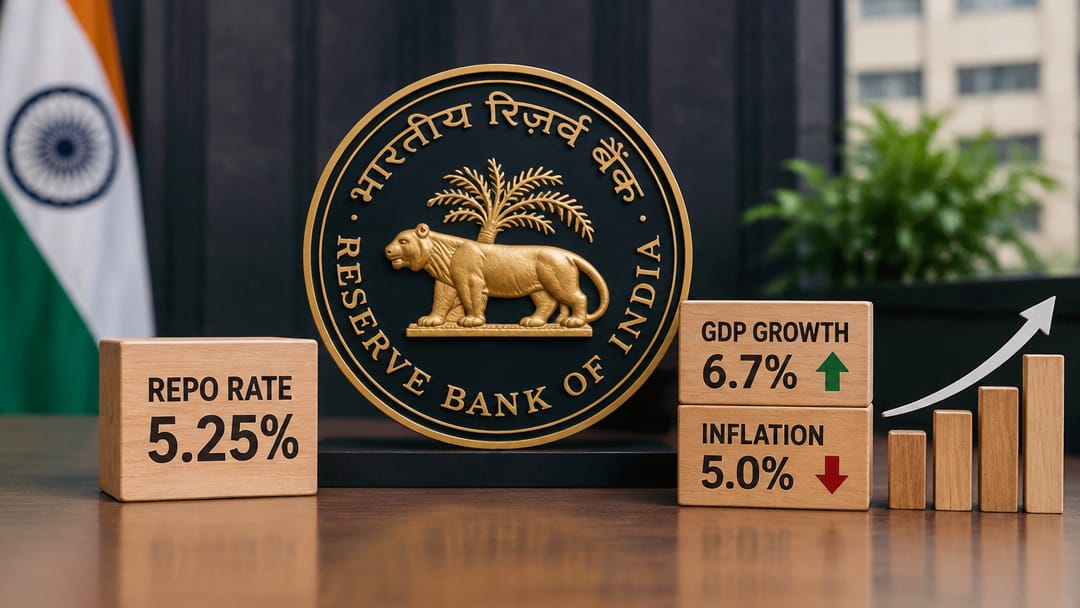
The RBI's MPC, in its August 3–5, 2026 meeting, held the repo rate unchanged at 5.25% for the fourth consecutive review, citing global geopolitical uncertainty and elevated energy prices. FY27 GDP growth forecast was raised to 6.7% from 6.6%, with Q1 revised up to 7%. Headline CPI inflation projection was trimmed to 5.0% from 5.1%, while core inflation forecast was cut sharply by 40 basis points to 4.3%. The neutral policy stance was retained.
Why it matters
The MPC operates within India's flexible inflation-targeting framework, where the RBI targets CPI inflation at 4% (±2%). The repo rate — the rate at which the RBI lends overnight to commercial banks — is the primary instrument. When the MPC holds the rate, it signals neither stimulus nor tightening; a neutral stance means the next move could go either way depending on incoming data.
The transmission mechanism matters for exams: a repo rate cut reduces borrowing costs for banks, which should lower lending rates, stimulate credit growth, boost investment and consumption, and support GDP — but with a lag. When the MPC holds despite softening inflation, it signals that risks (here, geopolitical tension, energy prices, monsoon uncertainty) prevent a premature pivot.
The distinction between headline CPI and core inflation is exam-critical. Headline CPI includes food and fuel, which are volatile and supply-driven. Core inflation strips these out, reflecting demand-side price pressure that monetary policy can actually influence. A 40 bps cut in core inflation forecast (4.7% → 4.3%) tells the MPC that underlying demand pressure is easing — a signal that could support future rate cuts if sustained.
For NABARD aspirants: the repo rate directly affects NABARD's borrowing cost from RBI, which in turn influences refinancing rates for rural and agricultural credit. A hold means no immediate relief on agricultural lending costs.
The LAF corridor: the repo rate (5.25%) is the policy rate; the SDF (Standing Deposit Facility) forms the floor and the MSF (Marginal Standing Facility) forms the ceiling, together defining the liquidity adjustment corridor within which interbank rates operate.
Liechtenstein's Hereditary Prince visits India as EFTA TEPA marks its first year
What happened
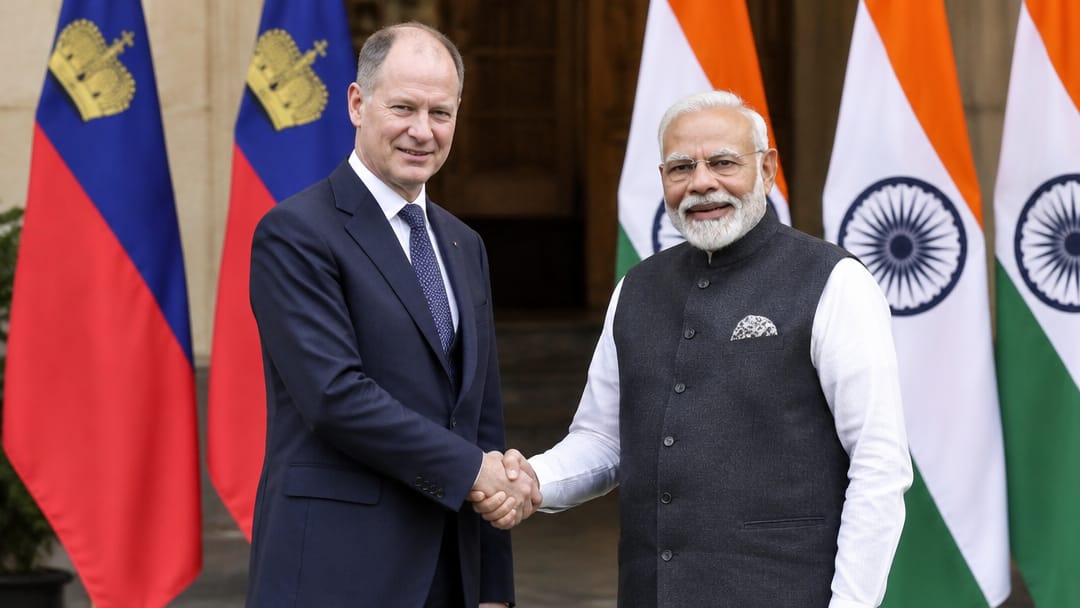
Hereditary Prince Alois of Liechtenstein visited India shortly after the first anniversary of the India-EFTA Trade and Economic Partnership Agreement (TEPA). The visit focused on expanding bilateral trade, technology cooperation, and investment. Liechtenstein is one of four EFTA members alongside Switzerland, Norway, and Iceland. The TEPA, operationalised in 2024, includes a landmark $100 billion investment commitment to India over 15 years, with Liechtenstein's precision engineering and financial services sectors among the key areas of engagement.
Why it matters
The India-EFTA TEPA is a landmark trade agreement between India and the four-member European Free Trade Association — Switzerland, Norway, Iceland, and Liechtenstein. Unlike a conventional Free Trade Agreement (FTA), TEPA includes a binding investment pledge: EFTA nations collectively committed to facilitate $100 billion in investments into India over 15 years, covering sectors like manufacturing, technology, and financial services. This is historically significant because India had not concluded a major trade deal with any developed-country bloc for over a decade before TEPA.
Liechtenstein, though tiny (population ~39,000), is economically potent — it is one of the wealthiest nations per capita and hosts major precision manufacturing and financial holding companies. Its membership in EFTA (not the EU) makes it a distinct bilateral partner for India.
The Hereditary Prince's visit signals Liechtenstein's intent to deepen the bilateral relationship beyond what TEPA mandates at the bloc level. For India, engagement with individual EFTA members matters because investment commitments under TEPA are disaggregated by country.
For exam purposes, the TEPA is testable across multiple angles: its signing date (March 2024), the $100 billion investment figure, the distinction between EFTA and EU membership, and the fact that TEPA is not a conventional goods-only FTA but includes services and intellectual property chapters. UPSC has consistently tested India's bilateral and multilateral trade frameworks, while RBI Grade B tests institutional membership and investment mechanisms.