RBI holds repo rate at 5.25%, cites global trade uncertainty and inflation risk
What happened
The RBI's Monetary Policy Committee kept the policy repo rate unchanged at 5.25 per cent and retained its neutral stance. The Standing Deposit Facility rate remains at 5 per cent, and the Marginal Standing Facility and bank rate stay at 5.5 per cent. Governor Sanjay Malhotra cited US tariff measures, crude oil volatility, and West Asia tensions as key risks. Inflation remains within the tolerance band, and domestic growth is supported by favourable monsoon and capital inflows.
Why it matters
This MPC decision is a textbook illustration of the RBI's inflation-targeting framework in action. Under the flexible inflation targeting (FIT) framework adopted in 2016, the MPC is mandated to keep CPI inflation at 4 per cent, with a tolerance band of ±2 per cent (i.e., 2–6 per cent). When inflation is within this band but showing upward movement, and growth remains resilient, the MPC has no compelling trigger to either cut or hike — hence a hold with a neutral stance.
The LAF corridor is central to understanding how these rates interact. The repo rate (5.25%) is the rate at which banks borrow overnight from RBI against collateral. The SDF rate (5 per cent) forms the floor — banks park surplus liquidity with RBI at this rate. The MSF rate (5.5%) forms the ceiling — banks borrow emergency overnight funds at this rate. Together, these create a 50-basis-point corridor that guides short-term money market rates.
The neutral stance signals that the MPC is not pre-committed to either cutting or hiking. It retains flexibility depending on how inflation and growth evolve. This contrasts with an 'accommodative' stance (biased toward cuts) or a 'withdrawal of accommodation' stance (biased toward hikes).
For transmission: when the repo rate holds steady, bank lending rates and deposit rates are unlikely to move significantly. Credit growth remains dependent on demand conditions rather than rate incentives. For agricultural credit — relevant to NABARD aspirants — NABARD's refinancing rates are linked to prevailing policy rates, so a hold means rural lending costs remain stable.
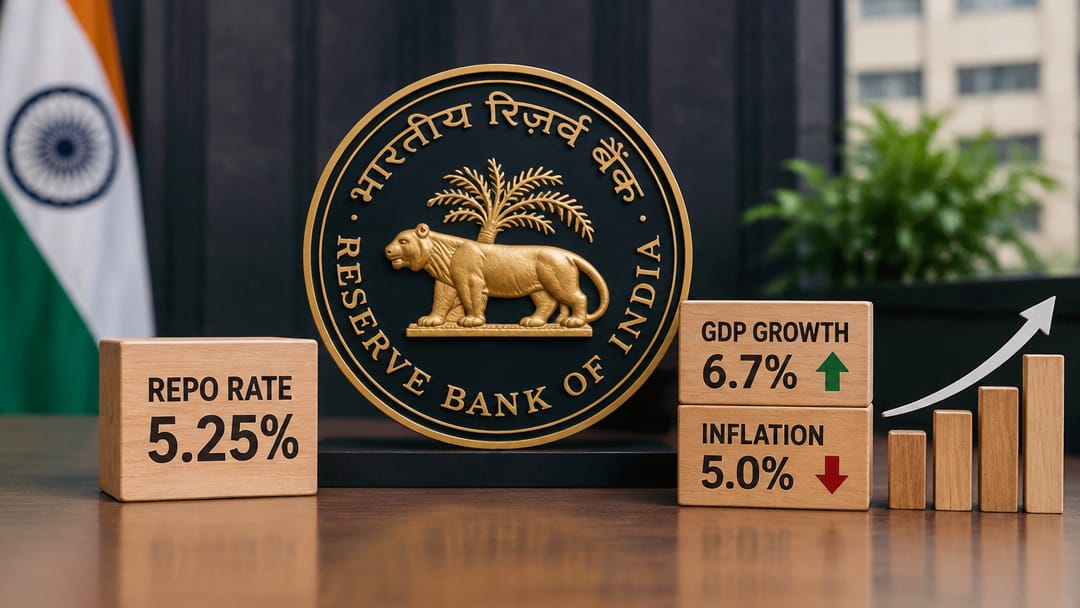
RBI holds repo rate at 5.25% for fourth straight meeting, lifts GDP forecast to 6.7%
What happened
The RBI's MPC, in its August 3–5, 2026 meeting, held the repo rate unchanged at 5.25% for the fourth consecutive review, citing global geopolitical uncertainty and elevated energy prices. FY27 GDP growth forecast was raised to 6.7% from 6.6%, with Q1 revised up to 7%. Headline CPI inflation projection was trimmed to 5.0% from 5.1%, while core inflation forecast was cut sharply by 40 basis points to 4.3%. The neutral policy stance was retained.
Why it matters
The MPC operates within India's flexible inflation-targeting framework, where the RBI targets CPI inflation at 4% (±2%). The repo rate — the rate at which the RBI lends overnight to commercial banks — is the primary instrument. When the MPC holds the rate, it signals neither stimulus nor tightening; a neutral stance means the next move could go either way depending on incoming data.
The transmission mechanism matters for exams: a repo rate cut reduces borrowing costs for banks, which should lower lending rates, stimulate credit growth, boost investment and consumption, and support GDP — but with a lag. When the MPC holds despite softening inflation, it signals that risks (here, geopolitical tension, energy prices, monsoon uncertainty) prevent a premature pivot.
The distinction between headline CPI and core inflation is exam-critical. Headline CPI includes food and fuel, which are volatile and supply-driven. Core inflation strips these out, reflecting demand-side price pressure that monetary policy can actually influence. A 40 bps cut in core inflation forecast (4.7% → 4.3%) tells the MPC that underlying demand pressure is easing — a signal that could support future rate cuts if sustained.
For NABARD aspirants: the repo rate directly affects NABARD's borrowing cost from RBI, which in turn influences refinancing rates for rural and agricultural credit. A hold means no immediate relief on agricultural lending costs.
The LAF corridor: the repo rate (5.25%) is the policy rate; the SDF (Standing Deposit Facility) forms the floor and the MSF (Marginal Standing Facility) forms the ceiling, together defining the liquidity adjustment corridor within which interbank rates operate.
Gujarat launches habitat project in Little Rann of Kutch, home of the wild ass
What happened
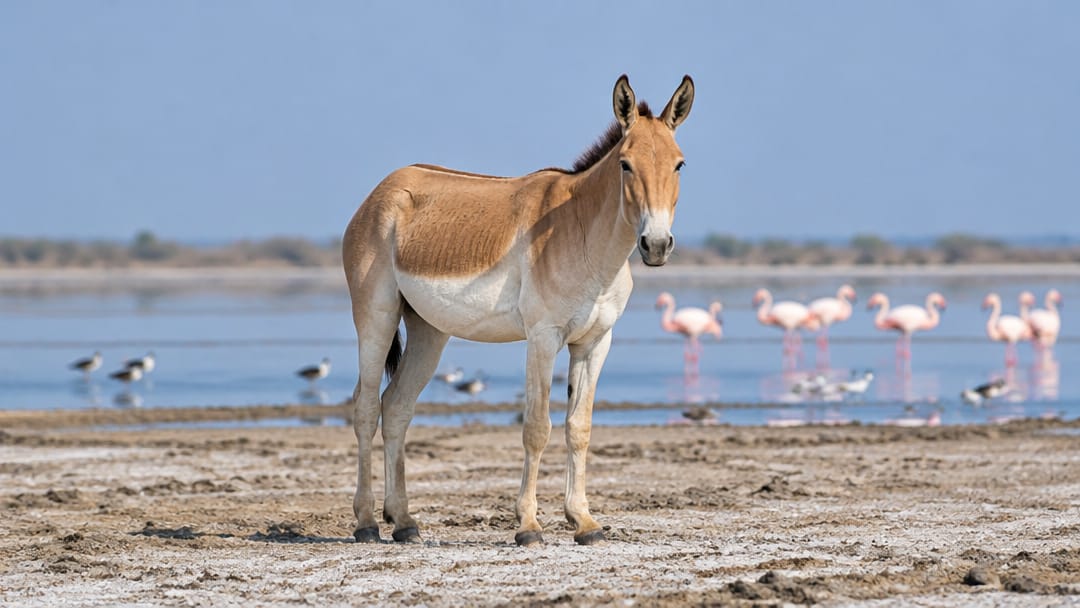
The Gujarat government has launched a conservation project in the Little Rann of Kutch targeting water retention, soil erosion control, and wildlife habitat improvement. The Little Rann is the sole habitat of the Indian Wild Ass, a Schedule I species protected under the Wildlife Protection Act. The initiative aims to restore the ecological balance of this salt marsh ecosystem, which also supports flamingos and other migratory birds critical to the region's biodiversity.
Why it matters
The Little Rann of Kutch (LRK) is a seasonal salt marsh in Gujarat's Surendra nagar and Kutch districts. It is notified as the Indian Wild Ass Sanctuary — the only place in the world where the Indian Wild Ass (Equus hemionus khur), locally called 'Ghudkhur,' survives in the wild. The species is classified as Near Threatened on the IUCN Red List and listed under Schedule I of the Wildlife Protection Act, 1972, giving it the highest legal protection in India.
The LRK ecosystem is fragile: it floods seasonally during monsoon (providing freshwater) and desiccates to a salt flat in summer. Soil erosion and water scarcity outside the monsoon period reduce carrying capacity for herbivores. The Gujarat government's project addresses this through water conservation structures and soil stabilisation — essentially applying watershed management principles to a protected area.
For exam purposes, the key static facts are: (1) LRK is not a Ramsar site, distinguishing it from nearby wetlands; (2) the Indian Wild Ass Sanctuary was established in 1973; (3) the species faces threats from disease (surra), agricultural encroachment, and road accidents. UPSC has repeatedly tested species-habitat linkages and Schedule I classifications. NABARD-relevant angles include how watershed interventions in protected areas can simultaneously support pastoral livelihoods of Agaria salt farmers who depend on LRK.
India calls for science-based guardrails on synthetic biology at CBD COP17
What happened
At the Convention on Biological Diversity's COP17, India urged that any use of synthetic biology in conservation must be governed by rigorous, science-based safeguards to prevent unintended ecological harm. India also highlighted its flagship programmes on big cats, mangroves, wetlands, and soil health, framing biodiversity protection as inseparable from ecosystem services. The position reflects India's broader stance: embrace biotechnological innovation cautiously, with precautionary principles anchoring any regulatory framework under the CBD.
Why it matters
Synthetic biology involves redesigning or engineering living organisms — sometimes creating entirely novel genetic sequences — for purposes ranging from medicine to conservation. At the CBD, its application in biodiversity contexts (e.g., gene drives to eliminate invasive species, engineered organisms to restore ecosystems) is deeply controversial. The core tension is between biotechnological potential and biosafety risk: a gene drive released into a wild population, for instance, cannot be recalled.
India's position at COP17 aligns with the CBD's precautionary approach enshrined in the Cartagena Protocol on Biosafety (2000), which governs the transboundary movement of living modified organisms. India is a party to both the CBD and the Cartagena Protocol, with the Ministry of Environment, Forest and Climate Change (MoEFCC) as the nodal ministry.
COP17 of the CBD is significant because it follows the landmark Kunming-Montreal Global Biodiversity Framework (GBF), adopted at COP15 in December 2022, which set 23 targets including the '30x30' goal — protecting 30% of land and oceans by 2030. Synthetic biology's role in meeting these targets remains unresolved.
For UPSC, the examiner will test: which convention governs synthetic biology in biodiversity contexts, what the Cartagena Protocol covers, India's nodal ministry, and how the GBF's targets interface with emerging biotechnologies. India's conservation showcases — Project Tiger, Mangrove Initiative for Shoreline Habitats and Tangible Incomes (MISHTI), and the National Wetland Conservation Programme — are all exam-relevant static facts linked to this news.
India's tiger count at 3,682 and 89 Ramsar sites: key numbers for IFS officers
What happened
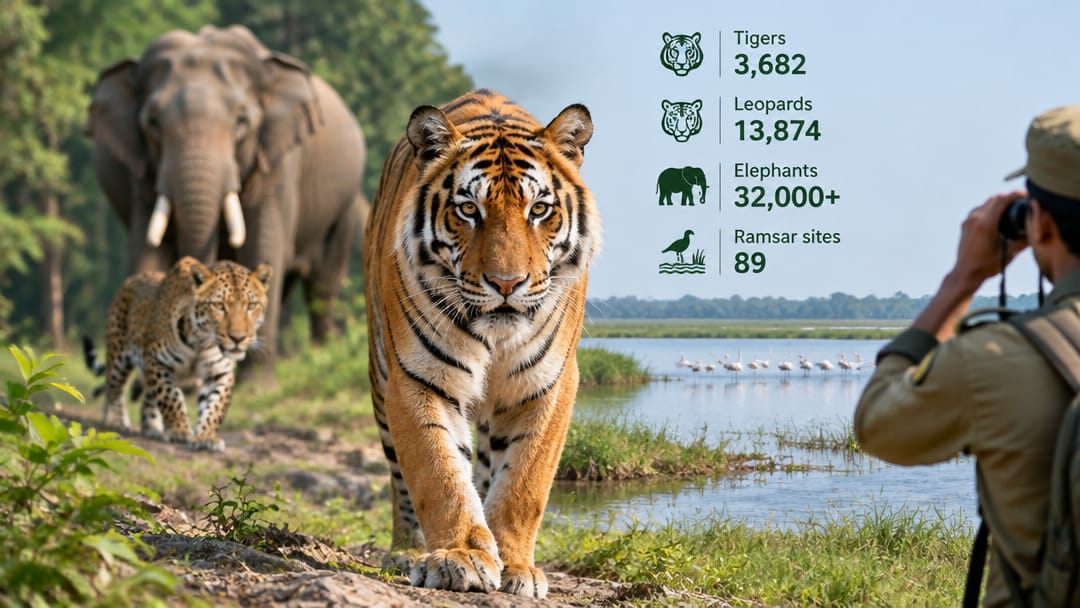
Union Environment Minister Bhupender Yadav met Indian Forest Service probationers and highlighted India's conservation milestones: tiger population at 3,682, leopard count at 13,874, elephant population at 32,000-plus, and Ramsar wetland sites reaching 89. He credited Project Tiger and Project Elephant for the recoveries and urged IFS officers to address emerging challenges including human-wildlife conflict, climate adaptation, and community-based forest governance as frontline ecological administrators.
Why it matters
This interaction is a policy signalling moment, but the exam tests the static numbers and frameworks behind it. Here is what you must anchor:
**Tiger conservation:** Project Tiger was launched in 1973 under the Wildlife Protection Act, 1972. The National Tiger Conservation Authority (NTCA) under the MoEFCC is the nodal body. India's latest tiger census (2022) placed the count at 3,682 — up from 2,967 in 2018. India holds approximately 75% of the world's wild tiger population.
**Elephant conservation:** Project Elephant was launched in 1992. India has the world's largest Asian elephant population. The elephant count of 32,000-plus covers 32 Elephant Reserves across 14 states.
**Ramsar Sites:** The Ramsar Convention on Wetlands (1971, Iran) designates wetlands of international importance. India's 89 Ramsar sites are the most in Asia. The key threshold numbers to remember: India had 26 sites until 2014, crossed 75 in 2022, and reached 89 by 2024.
**Leopard count:** The 2022 leopard census estimated 13,874 individuals — the first scientifically rigorous national estimate.
**IFS officers** are recruited through UPSC Civil Services and trained at the Indira Gandhi National Forest Academy (IGNFA), Dehradun. The exam will test the statutory framework (Wildlife Protection Act, Forest Conservation Act) and the nodal bodies, not the ministerial speech itself.
CBIC drops Udyam proof requirement and caps GST registration approval at seven days
What happened
The Central Board of Indirect Taxes and Customs (CBIC) has simplified GST registration by removing the mandatory Udyam registration certificate as a required document for small businesses. CBIC has also set a strict seven-day timeline for tax authorities to approve or reject registration applications. These changes aim to reduce compliance burdens on MSMEs and small enterprises, speeding up their formal entry into the GST system and improving ease of doing business across India.
Why it matters
GST registration is the gateway through which businesses enter India's formal indirect tax network. Previously, small businesses seeking GST registration were required to submit an Udyam registration certificate — a document issued under the Ministry of MSME that classifies enterprises as micro, small, or medium. This created a two-step compliance burden: businesses had to first register under Udyam before obtaining GST registration, delaying their formalization.
CBIC's clarification removes this dependency. Businesses can now apply for GST registration without possessing an Udyam certificate, reducing documentation friction for new and informal enterprises entering the formal economy.
The seven-day approval cap is equally significant. Previously, registration delays were common, with applications pending for weeks. A defined timeline creates accountability for tax officers and gives businesses certainty about when they can begin operations under GST.
For NABARD aspirants, the connection is direct: rural MSMEs, artisans, farmer-producer organizations (FPOs), and agri-processing units often struggle with layered compliance requirements. Easier GST registration means more rural enterprises can access formal credit, since banks and NABARD-refinanced cooperative institutions typically require GST registration as part of KYC or loan eligibility. Improved GST collections from wider registration also strengthens government revenue, which in turn funds rural development schemes that NABARD co-implements. Understanding how GST policy changes affect rural credit access and NABARD's refinancing environment is a tested angle in NABARD Grade A.