SC: rejecting anticipatory bail doesn't let HC pre-set regular bail terms
What happened
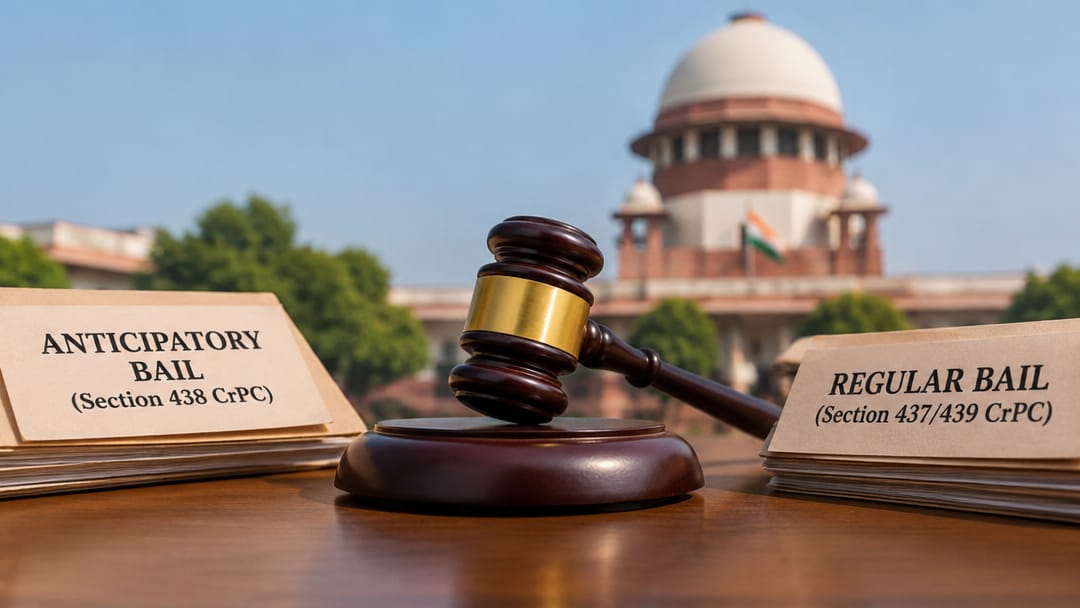
The Supreme Court set aside an Orissa High Court order that denied anticipatory bail in a murder case but simultaneously directed the trial court to grant regular bail on predetermined conditions. The Supreme Court held that this practice is legally impermissible — a court rejecting anticipatory bail under Section 438 CrPC cannot usurp the trial court's independent jurisdiction by pre-fixing conditions for regular bail under Section 437 or 439 CrPC. Each bail application must be decided on its own merits.
Why it matters
This ruling clarifies a critical boundary between two distinct bail jurisdictions under the CrPC (now mirrored in BNSS 2023).
Anticipatory bail under Section 438 CrPC (Section 482 BNSS) is pre-arrest protection granted by a Sessions Court or High Court when a person apprehends arrest. Regular bail under Section 437 (Magistrate) or Section 439 CrPC (Sessions Court/High Court) operates post-arrest, after the accused is taken into custody.
The Orissa High Court's order attempted a hybrid: it refused anticipatory bail but simultaneously told the trial court to grant regular bail if the accused was arrested, subject to conditions the HC itself specified. The Supreme Court found this legally untenable for two reasons.
First, it conflates two separate jurisdictions. The power to grant regular bail belongs to the court before which the accused appears after arrest. That court must independently assess flight risk, evidence tampering potential, severity of offence, and other factors at that stage — it cannot be pre-empted by a higher court deciding a different application.
Second, such a direction amounts to the High Court exercising Section 439 jurisdiction preemptively and in the abstract, without the accused actually being in custody — which is the precondition for Section 439 to operate.
For CLAT PG, the key principle is jurisdictional separateness: anticipatory bail and regular bail are not a continuum but distinct remedies with different preconditions, different courts of primary jurisdiction, and independent discretion at each stage.
SEBI bars EKI Energy and its MD for two months over financial misrepresentation
What happened
SEBI has barred EKI Energy Services Ltd and its Managing Director Manish Kumar Dabkara from the securities market for two months and 12 months respectively, citing financial misrepresentation. The regulator also imposed a monetary penalty on both entities. EKI Energy, a carbon credit services company, was found to have misrepresented its financial statements, misleading investors. The action invokes SEBI's powers under the SEBI Act and LODR Regulations to protect market integrity and investor interests.
Why it matters
This order tests two intersecting pillars of securities law: SEBI's enforcement powers and the liability of key managerial personnel for disclosure violations.
SEBI's power to bar entities from the securities market flows from Section 11 and Section 11B of the SEBI Act, 1992, which empower the Board to issue directions in the interest of investors and the securities market. A 'debarment' or 'restraint order' is distinct from a mere penalty — it prevents the entity from buying, selling, or dealing in securities during the ban period.
The LODR (Listing Obligations and Disclosure Requirements) Regulations, 2015 mandate that listed companies accurately disclose financial statements. Misrepresentation of financials violates Regulation 4(2)(f) (fair disclosure) and Regulation 33 (financial results). SEBI can act against both the company and its officers in default — here, the MD was held personally liable, which is a critical principle the examiner tests.
The differential penalty — 2 months for the company, 12 months for the MD — reflects SEBI's practice of imposing stricter personal accountability on key managerial personnel who sign off on disclosures. This mirrors the 'officer in default' concept under the Companies Act.
For SEBI Grade A aspirants, the operative legal hooks are Section 11B (directions), Section 15HA (penalty for fraudulent/unfair trade practices), and the LODR framework. The principle that a regulator can impose differentiated sanctions on an entity and its officer simultaneously is a favourite examiner angle.
SC judge calls Collegium male-dominated, urges it to include women in deliberations
What happened
Justice Ujjal Bhuyan of the Supreme Court publicly called the Supreme Court Collegium 'male-dominated' and urged that it invite woman judges to participate in its deliberations. The Collegium, a five-judge body responsible for appointing and transferring judges to higher courts, has historically had little to no female representation. Justice Bhuyan's remarks highlight a structural gap in judicial appointments that affects gender diversity at the highest levels of India's judiciary.
Why it matters
The Supreme Court Collegium is a body comprising the Chief Justice of India and the four most senior judges of the Supreme Court. It holds the exclusive power to recommend appointments, elevations, and transfers of judges to High Courts and the Supreme Court — a power settled through the Second and Third Judges Cases (1993 and 1998). The Collegium system is not codified in statute; it evolved through constitutional interpretation of Articles 124 and 217.
Justice Bhuyan's observation targets a structural gender deficit: since the Collegium's composition is determined purely by seniority, and women have historically been underrepresented in the judiciary at all levels, very few women have ever reached the senior-most positions that would place them in the Collegium. As of 2025, no woman has ever served as a permanent member of the Supreme Court Collegium.
His suggestion — that the Collegium should invite a woman judge to participate even without formal membership — raises a broader principle: gender-inclusive deliberation as a constitutional value, not merely a statistical aspiration. This connects to the Supreme Court's own jurisprudence on gender stereotyping (e.g., the 2023 handbook against gender stereotypes in judicial language) and to the idea that institutional design shapes substantive equality. For CLAT PG aspirants, the key legal angle is whether the Collegium's informal, convention-based process can be reformed from within by judicial initiative, without legislative intervention.
SC rules 550 acres of jagir land in Miyapur vests in Telangana govt, not heirs
What happened
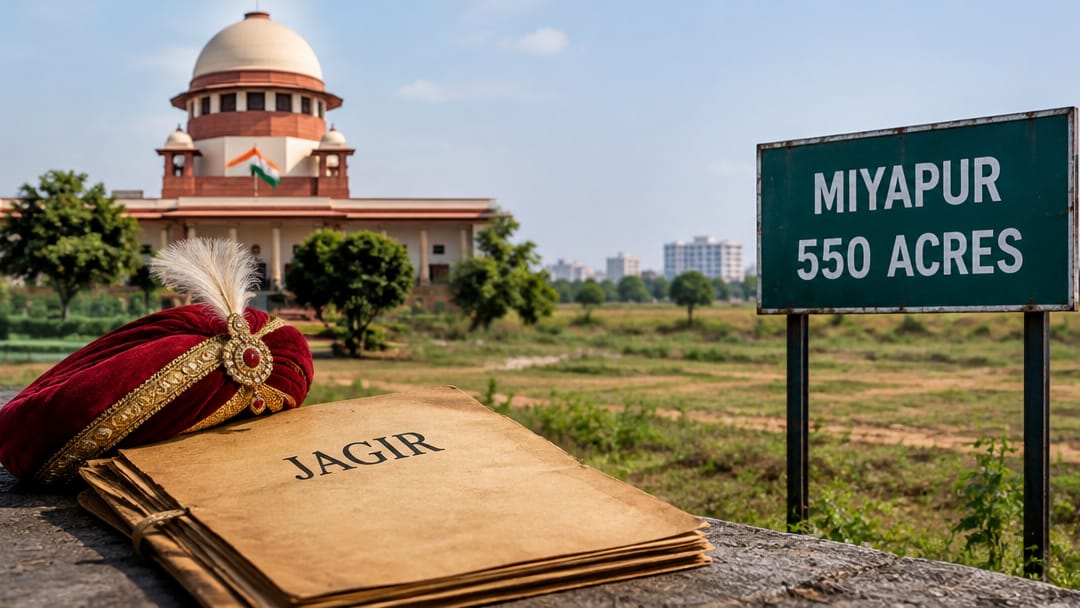
The Supreme Court on 29 October 2024 dismissed appeals by claimants seeking title over approximately 550 acres of land in Miyapur, Telangana. The Court held that jagirdars never held full proprietary title to the land; their rights were abolished under Hyderabad-era land reform legislation. Upon abolition, the land vested absolutely in the government. No succession, sale, or gift by the jagirdar could transfer what was never privately owned.
Why it matters
This ruling turns on the doctrine of 'vesting by operation of law' — a constitutional and statutory mechanism central to land reform jurisprudence in India.
Background: After Independence, the Hyderabad State enacted the Hyderabad (Abolition of Jagirs) Regulation, 1358 Fasli (1949), which abolished the jagir system. A jagir was not private ownership; it was a revenue assignment by the sovereign. The jagirdar collected land revenue but held no absolute proprietary title. The Regulation extinguished even that limited right, and the land vested in the State.
Constitutional Interface: The Ninth Schedule of the Constitution protects land reform laws from challenge under Articles 14, 19, and 31 (now Article 300A). The 1st Constitutional Amendment (1951) inserted Articles 31A and 31B specifically to shield agrarian reform legislation from property-rights challenges. This means jagirs abolished before or after the Constitution cannot be challenged on the ground that private property was taken without compensation under Article 300A once the Ninth Schedule protection applies.
Test Applied: The Court applied a two-part inquiry — (1) Did the jagirdar ever hold a proprietary title cognisable in law? (2) If not, can heirs claim succession to a title that never existed? The answer to both was no. The doctrine of 'nemo dat quod non habet' (one cannot give what one does not have) completes the reasoning: the jagirdar could not pass on title by succession or alienation.
Broader Principle: Escheat and bona vacantia are separate but related doctrines (Article 296). Here the mechanism was statutory vesting, not escheat — an important distinction the examiner may probe.
Ambit Of Constructive Trust, And What Does Section 92 CPC Bring Into Play?
What happened
The Supreme Court upheld a ruling permitting a suit against a registered society to proceed under Section 92 of the Code of Civil Procedure, which governs suits involving public charitable trusts. The Court's reasoning, however, was carefully limited: it did not hold that every registered society automatically qualifies as a trust for Section 92 purposes. Instead, it examined whether the society in question held property for a charitable or religious purpose akin to a constructive trust, making the doctrinal boundary between societies and trusts the central question.
Why it matters
Section 92 CPC is a special provision that allows two or more persons to file a suit against the trustees of an express or constructive trust created for public charitable or religious purposes. The key doctrinal question this judgment engages is whether a registered society — which is not a trust in the formal sense — can be subjected to Section 92 proceedings.
A constructive trust is not created by an express deed; it arises by operation of law when a person holds property in circumstances where equity demands that the property be treated as held for another's benefit. Courts impose it to prevent unjust enrichment or breach of fiduciary duty.
The Supreme Court's nuanced holding matters because a broad ruling that 'every society is a trust' would have dramatically expanded Section 92's reach. Instead, the Court appears to have anchored its decision on whether the specific society held property dedicated to a public charitable purpose — bringing it within the functional definition of a constructive trust — rather than on the organisational label.
For CLAT PG aspirants, this intersection of equity doctrine (constructive trust), procedural law (Section 92 CPC), and organisational law (registered societies) is a classic multi-doctrine question. The examiner frequently tests whether aspirants can distinguish express trusts from constructive trusts, identify the conditions for Section 92 maintainability, and apply the correct principle when facts blur the boundary between a society and a trust.
Jharkhand HC gives police 3 months to finish stalled bridge collapse probes
What happened
The Jharkhand High Court has directed police to complete investigations into long-pending bridge collapse cases in Dhanbad, Palamau, and Gumla within three months. The cases had remained unresolved for an extended period despite involving public safety failures. The High Court's intervention reflects judicial oversight over executive inaction in criminal investigations. The order underscores the court's power to supervise police investigations through suo motu or petition-based proceedings to ensure accountability in infrastructure-related criminal cases.
Why it matters
This order illustrates a foundational principle in criminal procedure: High Courts possess supervisory jurisdiction over police investigations and can issue directions to ensure timely completion of probes. Under Section 482 CrPC (now Section 528 BNSS), High Courts retain inherent powers to prevent abuse of process and secure ends of justice, which includes compelling investigating agencies to act when probes stagnate.
The bridge collapse cases sit at the intersection of criminal negligence, public safety, and state accountability. When infrastructure collapses due to potential negligence or corruption, IPC sections relating to culpable homicide not amounting to murder (Section 304), causing death by negligence (Section 304A), and criminal breach of trust (Section 409) typically apply. Under BNSS equivalents, these are Sections 106, 125, and 316 respectively.
Judicial intervention in stalled investigations can take multiple forms: directions to submit status reports, transfer of investigation to CBI or SIT, and in extreme cases, orders for registration of FIR under Section 156(3) CrPC (Section 175(3) BNSS). The three-month deadline here is a supervisory direction, not a transfer order.
For CLAT PG, the key doctrinal point is that the right to a fair and expeditious investigation is traceable to Article 21 — the Supreme Court in Lalita Kumari v. State of UP (2014) held that registration of FIR is mandatory when a cognizable offence is disclosed, limiting police discretion. Courts use this doctrine to push stalled probes forward.