UCC enacted in Uttarakhand, 21 NDA states targeted by 2029
What happened
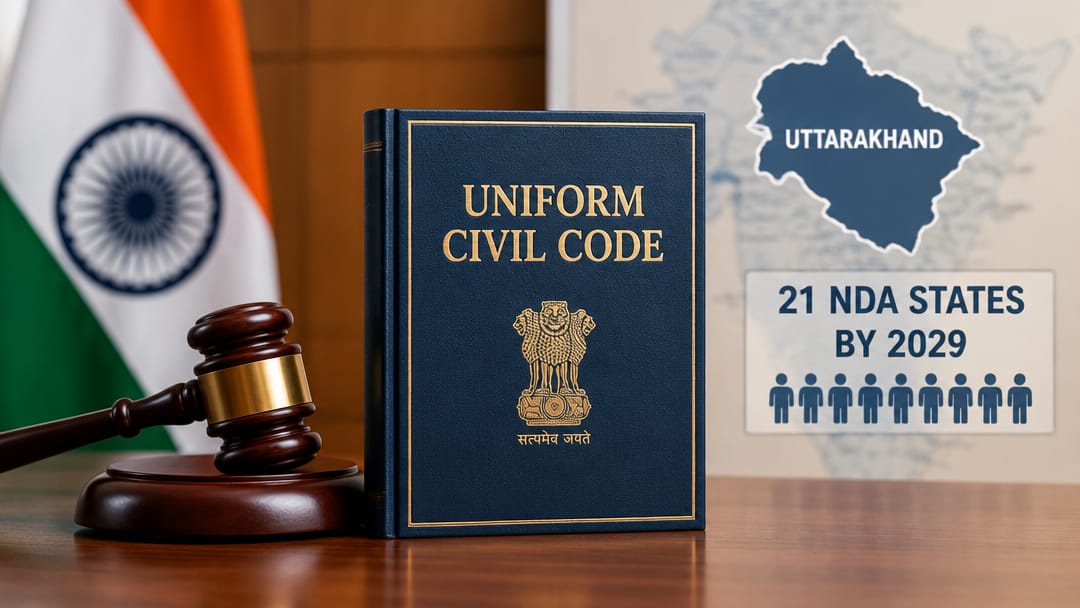
Uttarakhand became the first state to enact a Uniform Civil Code in 2024, replacing personal laws governing marriage, divorce, inheritance, and adoption for all residents except Scheduled Tribes. The BJP-led NDA government has set a target of implementing UCC across 21 states by 2029. The UCC is directed by Article 44 of the Constitution as a Directive Principle of State Policy, making it aspirational but not judicially enforceable as a fundamental right.
Why it matters
The Uniform Civil Code refers to a single set of civil laws governing personal matters — marriage, divorce, maintenance, inheritance, and adoption — applicable to all citizens regardless of religion. Currently, India operates under religion-specific personal laws: the Hindu Marriage Act, Muslim Personal Law, Indian Christian Marriage Act, and Parsi Marriage and Divorce Act, among others.
Article 44 of the Constitution places UCC in Part IV as a Directive Principle of State Policy (DPSP). DPSPs are non-justiciable — a citizen cannot go to court demanding UCC enforcement — but courts have repeatedly nudged Parliament toward it. The Supreme Court first called for UCC in Shah Bano (1985) and again in Sarla Mudgal (1995), observing that personal law conflicts produce unjust outcomes, especially for women.
The constitutional tension is critical for CLAT PG: UCC intersects with Article 25 (freedom of religion), Article 26 (right to manage religious affairs), and Article 14 (equality). Minority communities argue personal law is part of religious identity protected under Articles 25–26. Proponents argue inequality within personal laws — especially in Muslim divorce, Hindu inheritance, and Christian adoption — violates Article 14.
Uttarakhand's 2024 UCC Act is significant because it is the first sub-national implementation. It exempts Scheduled Tribes — a deliberate carve-out that itself raises Article 14 questions about differential treatment. For CLAT PG, the examiner will test whether you understand why a DPSP cannot be directly enforced, how personal law interacts with fundamental rights, and what the courts have said about the state's obligation.
Anticipatory bail moves from Section 438 CrPC to Section 482 BNSS after July 2024
What happened
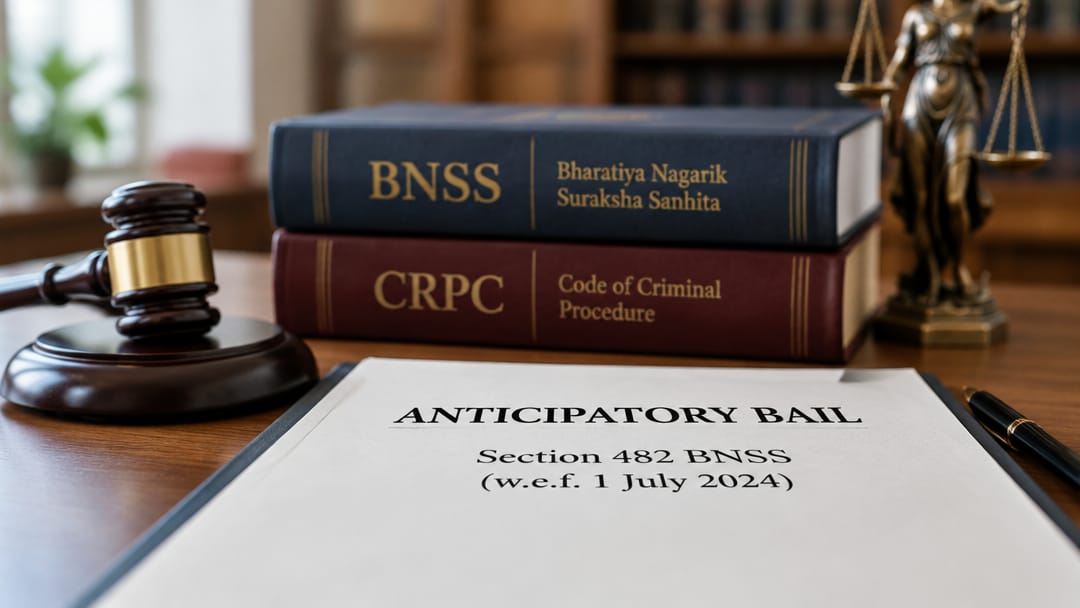
From 1 July 2024, anticipatory bail applications are filed under Section 482 of the Bharatiya Nagarik Suraksha Sanhita, replacing Section 438 CrPC. The petition is addressed to the Sessions Court or High Court, seeking a direction that, if arrested for a specified non-bailable offence, the applicant shall be released on bail. The core relief — pre-arrest bail — remains unchanged, but practitioners must now cite BNSS for all proceedings initiated after the BNSS commencement date.
Why it matters
Anticipatory bail is a pre-arrest remedy: it does not prevent arrest but directs that if an arrest occurs for a named offence, bail shall be granted immediately. The constitutional anchor is Article 21 — protection of personal liberty — and the statutory anchor shifted on 1 July 2024 from Section 438 CrPC to Section 482 BNSS.
Key structural features: • Jurisdiction: Sessions Court (primary) or High Court (concurrent). The High Court may entertain directly, but conventions favour the Sessions Court first. • Conditions: The court may impose conditions such as making oneself available for interrogation, not leaving the country without permission, surrendering the passport, and not tampering with evidence. For offences punishable with death, life imprisonment, or imprisonment of ten years or more (and for gang-rape under Section 70 BNSS), the court must hear the public prosecutor before granting bail. • Duration: Unlike Section 438 CrPC (which was silent), BNSS discussions in Parliament flagged that interim anticipatory bail may be time-bound; the final order's duration is court-determined. • Key distinction from regular bail: Anticipatory bail is granted before arrest; regular bail under Section 480/483 BNSS is post-arrest. • Landmark cases: Gurbaksh Singh Sibbia v. State of Punjab (1980) — SC held anticipatory bail provisions should be interpreted liberally; Sushila Aggarwal v. State (NCT of Delhi) (2020) — SC (Constitution Bench) held anticipatory bail need not be time-limited and can continue until end of trial.
The examiner tests the section number change, the conditions attached, the category of offences requiring special treatment, and the Sibbia/Sushila Aggarwal precedents.
SC rules bail orders must show a court's own reasoning, not just summarise party arguments
What happened
The Supreme Court, in Ramprakash Rajagopal, held that bail orders must contain independent judicial reasoning and cannot merely reproduce submissions made by the parties. A court granting or refusing bail must apply its own mind to the relevant factors — flight risk, criminal antecedents, nature of the offence — and record why it is satisfied or not satisfied. Recording what lawyers argued, without analysing those arguments, does not constitute a reasoned order.
Why it matters
Bail is the rule, jail is the exception — a principle the Supreme Court has affirmed repeatedly — but that principle is only operational if the bail order itself is reasoned. In Ramprakash Rajagopal, the Court addressed a systemic problem: courts routinely pass bail orders that do little more than list the submissions of both sides and then state a conclusion. Such orders are legally deficient.
The requirement of a reasoned order is not merely procedural. It serves three functions: (i) it disciplines the judicial mind to actually weigh competing considerations; (ii) it enables a higher court to meaningfully examine whether the discretion was properly exercised on appeal or revision; and (iii) it protects personal liberty by ensuring that deprivation of freedom is not the product of an unexamined mechanical exercise.
Under the CrPC (Section 437, 439) and the BNSS (Sections 479, 483), bail is a discretionary remedy. But discretion must be structured. The classic factors — nature and gravity of the accusation, antecedents of the accused, possibility of fleeing justice, and likelihood of tampering with evidence — must actually be weighed, not merely enumerated. This ruling also connects to the broader line of cases (Arnesh Kumar, Satender Kumar Antil) where the Court has pushed back against mechanical incarceration. CLAT PG passages in this area frequently excerpt such rulings and ask applicants to identify what the court held versus what was merely argued.
SC protects bona fide flat buyers from demolition caused by builder's unauthorised work
What happened
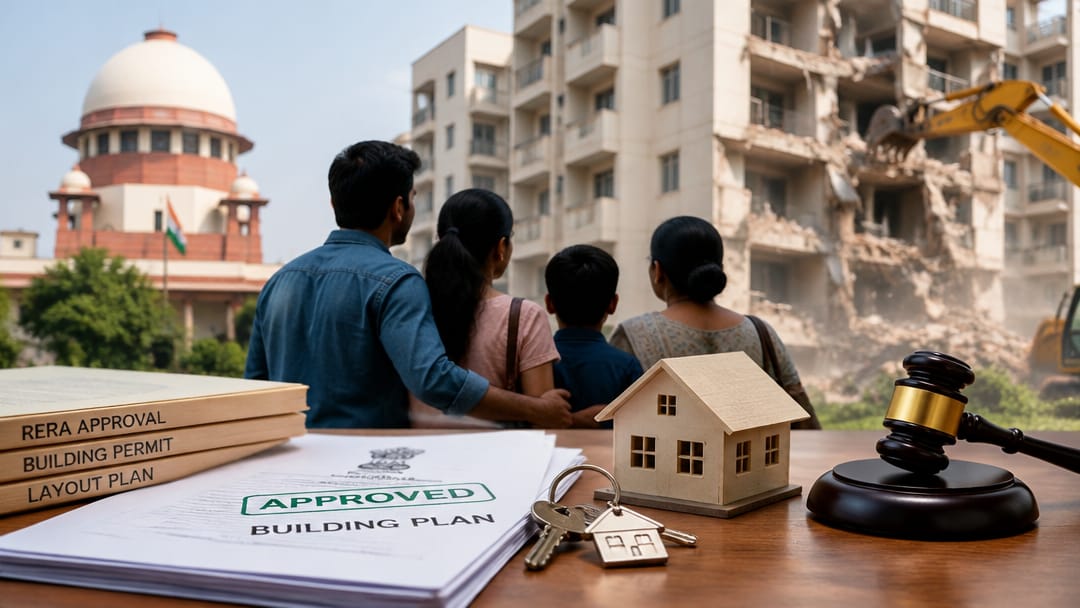
The Supreme Court ruled that flat buyers who purchased homes relying on government-issued approvals and official documents cannot be penalised for a builder's unauthorised construction. Before any demolition proceeds, the state must provide an alternative site or accommodation to affected residents. The Court held that innocent purchasers acting in good faith deserve protection under Article 300A, which guarantees that no person shall be deprived of property except by authority of law and with due process.
Why it matters
This ruling sits at the intersection of Article 300A (right to property) and the doctrine of legitimate expectation rooted in Articles 14 and 21. After the 44th Constitutional Amendment (1978) removed the right to property from Part III, Article 300A became the sole constitutional shelter for property rights — but the Supreme Court has progressively expanded its content.
The Court has held, beginning with Vidya Devi v. State of H.P. (2020) and reiterated in multiple benches, that Article 300A is not a mere procedural shell. It contains substantive guarantees: (1) the deprivation must be by 'authority of law' — not mere executive action; (2) the law must be just, fair, and reasonable (importing Article 21's due-process standard); and (3) the State must pay compensation or provide an equivalent remedy.
The present ruling adds a fourth dimension — the bona fide purchaser principle. Where a buyer relies on officially granted approvals (completion certificates, occupancy certificates, registered sale deeds), the State cannot demolish without first securing alternative accommodation. This is an application of the estoppel doctrine against the State: the government cannot resile from representations made through its own regulatory approvals to the detriment of innocent third parties.
For CLAT PG, the key doctrinal chain is: Art. 31 (repealed 1978) → Art. 300A → Vidya Devi (2020) → Kolkata Municipal Corp. cases → present ruling. The examiner tests whether aspirants can distinguish the right, the limitation, and the test — and apply them to new fact patterns involving demolition, acquisition, or dispossession.
Justice Kaul reveals CJI Chandrachud urged a 'middle path' in a PMLA bench dispute
What happened
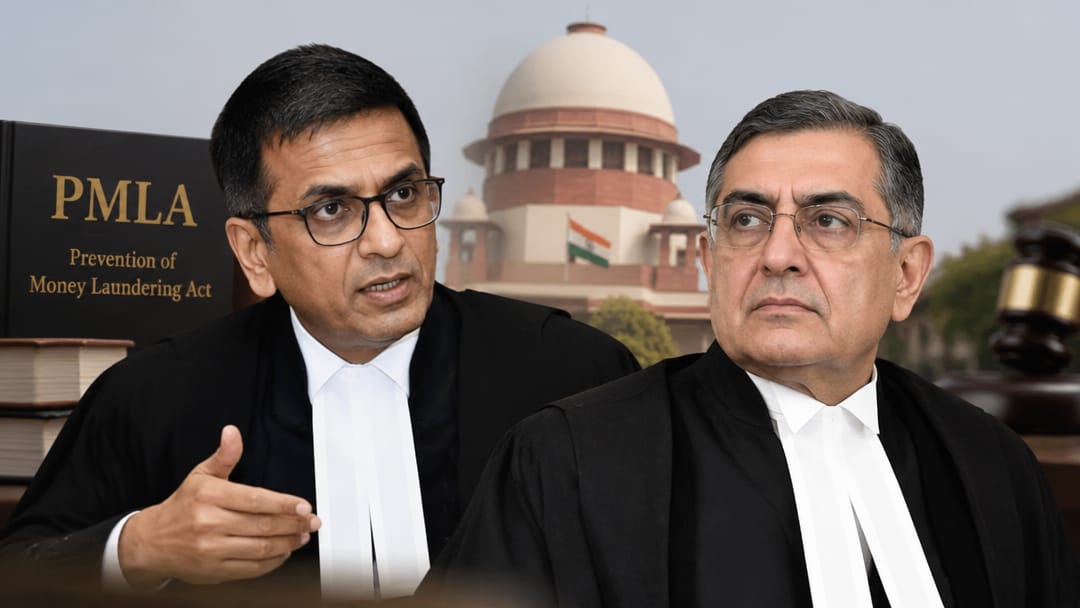
Retiring Supreme Court Justice Sanjay Kishan Kaul disclosed that then-CJI D.Y. Chandrachud asked him to adopt a 'middle path' during deliberations on a PMLA (Prevention of Money Laundering Act) case where the bench was divided. Justice Kaul declined, choosing to write a separate opinion. The disclosure highlights rare judicial candour about internal bench dynamics and underscores the continuing tension between PMLA's stringent bail and arrest provisions and constitutional liberty guarantees.
Why it matters
The PMLA, enacted in 2002 and significantly amended in 2019, grants the Enforcement Directorate sweeping powers: arrest without a warrant in certain circumstances, a reversed burden of proof for bail under Section 45, and the ability to attach property before conviction. The Supreme Court's 2022 Vijay Madanlal Choudhary judgment upheld most of these provisions, but the bench was not entirely unanimous in its reasoning.
Justice Kaul's disclosure matters for two reasons. First, it reveals that even within the majority, judges debated how far to push back against PMLA's expansive enforcement architecture. A 'middle path' in this context likely meant softening the judgment's endorsement of ED powers without striking down provisions outright — a compromise Justice Kaul apparently refused. Second, it illustrates the difference between a concurring opinion and a dissent: a concurrence agrees with the outcome but differs on reasoning, while a dissent rejects the outcome entirely.
For CLAT PG, this story is a gateway into PMLA's statutory framework: Section 3 (offence of money laundering), Section 45 (twin conditions for bail), Section 50 (ED's power to summon and record statements), and the constitutional challenge to each under Articles 14, 19, and 21. The examiner tests whether aspirants can distinguish the statute's provisions from the Court's interpretive gloss on them.