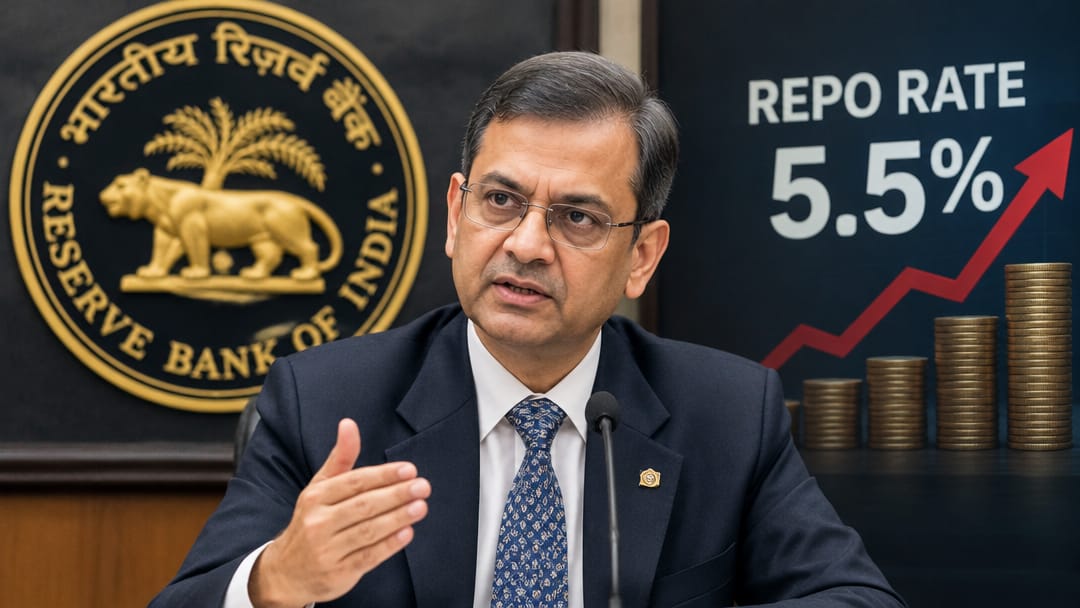
RBI raises repo rate to 5.5%, shifts stance to calibrated tightening
What happened
The RBI's MPC unanimously raised the repo rate by 25 basis points to 5.5 per cent at its October 5–7 meeting — the first hike in nearly four years. The stance shifted from neutral to calibrated tightening, ruling out near-term cuts. Governor Sanjay Malhotra flagged broadening inflation: 37 per cent of CPI basket commodities recorded inflation above 4 per cent in August, up from 20 per cent in March. Future hikes remain data-dependent.
Why it matters
This MPC decision tests several layered concepts that examiners repeatedly probe.
**The LAF Corridor and Repo Rate:** The repo rate is the rate at which RBI lends overnight funds to commercial banks under the Liquidity Adjustment Facility. A hike raises borrowing costs for banks, which transmit higher rates to consumers and firms, cooling credit demand and thereby inflation. The transmission mechanism runs: repo rate → bank lending rates → credit growth → aggregate demand → inflation.
**Stance Shift — Neutral to Calibrated Tightening:** Under the inflation targeting framework (IT framework, 2016), the MPC manages policy through both the rate and the stance. 'Neutral' means the next move could go either way. 'Calibrated tightening' explicitly rules out cuts — only a hike or a pause is possible. This is a stronger signal than a rate move alone because it shapes market expectations.
**Inflation Targeting Framework:** India adopted flexible inflation targeting in 2016. The target is 4% CPI with a tolerance band of ±2% (lower: 2%, upper: 6%). If inflation breaches the upper tolerance for three consecutive quarters, the RBI must submit a report to the government explaining the breach and remedial steps. The current data point — 37% of CPI commodities above 4% — signals broadening, not just headline, inflation.
**MPC Composition:** The six-member MPC has three RBI members (Governor as chair, Deputy Governor, one RBI officer) and three external members appointed by the Government of India. Decisions require a majority; the Governor has a casting vote in a tie. A unanimous vote, as here, is exam-notable.
**Second-Round Effects:** Supply shocks (e.g., food or fuel price spikes) can feed into wages and broader prices — these 'second-round effects' are what central banks fear most because they entrench inflation expectations.
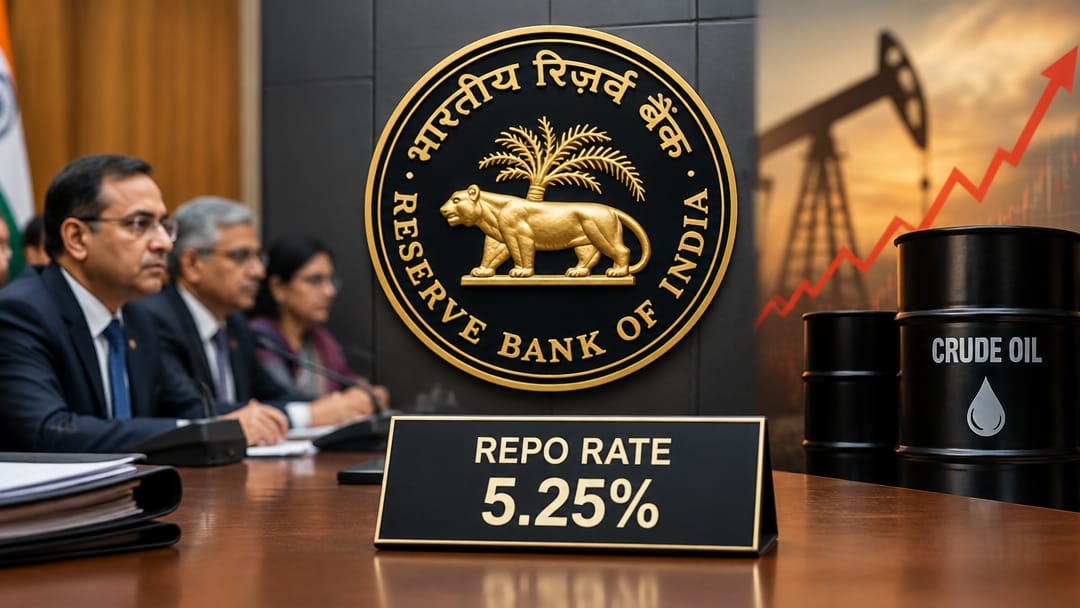
RBI MPC meets June 2026 with repo rate at 5.25% amid crude oil inflation risk
What happened
The RBI's Monetary Policy Committee began its June 2026 three-day meeting under Governor Sanjay Malhotra, with markets widely expecting the repo rate to hold at 5.25%. The key tension is rising crude oil prices, which threaten to push inflation higher and complicate the MPC's accommodative stance. Having already cut rates earlier in 2025-26, the committee faces pressure to pause and assess transmission before any further easing of monetary conditions.
Why it matters
The MPC operates India's flexible inflation targeting framework, mandated to keep CPI inflation at 4% with a ±2% band. The repo rate — the rate at which RBI lends overnight funds to commercial banks — is the primary policy instrument. When MPC cuts repo, borrowing costs fall, credit expands, and demand rises; when it holds or hikes, it signals caution about inflation.
The LAF (Liquidity Adjustment Facility) corridor frames daily liquidity: the repo rate is the ceiling for borrowing from RBI, and the Standing Deposit Facility (SDF) rate is the floor for parking funds with RBI. The policy rate sits at the midpoint, giving the corridor its shape.
Crude oil prices matter because India imports roughly 85% of its oil. A sustained rise feeds directly into transport costs, manufacturing input costs, and food supply chains — creating cost-push inflation that the MPC cannot easily offset with rate cuts without risking a price spiral. This is the classic supply-side bind: cutting rates to support growth risks stoking inflation that is already being pushed up by external commodity prices.
The June 2026 pause scenario reflects a 'wait and watch' posture: prior cuts have been made, and the MPC now waits to see whether credit growth and investment respond before deciding the next move. This transmission lag — typically 2–3 quarters — is central to understanding why the MPC does not adjust rates every meeting.
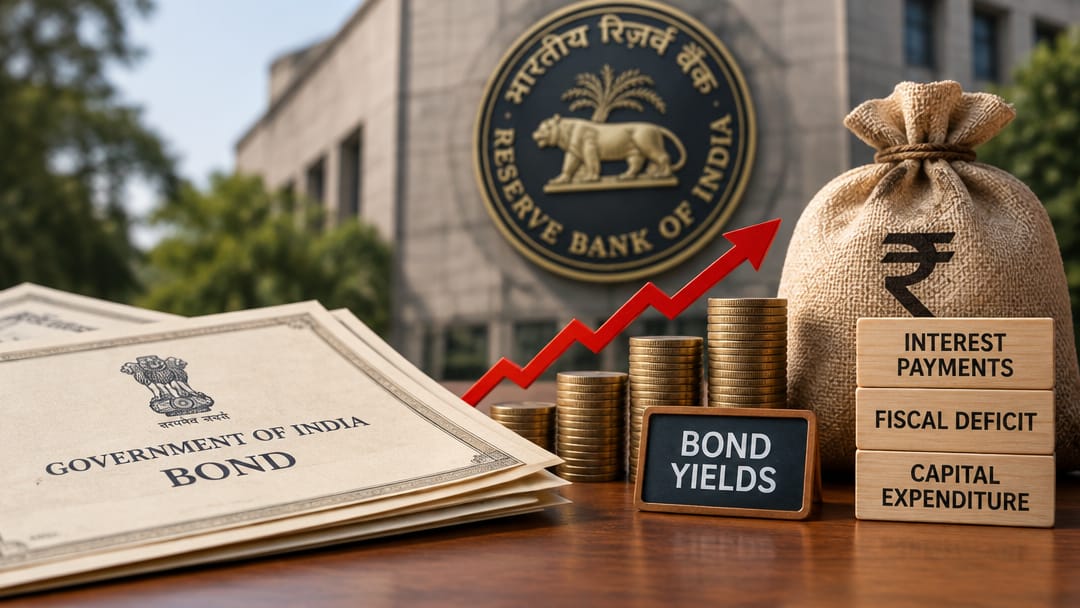
Rising bond yields after RBI's October policy could raise India's interest bill
What happened
After the RBI's October 2024 monetary policy review, government bond yields have risen sharply, threatening to increase the central government's interest payment burden for the rest of the fiscal year. When yields rise on newly issued or rolled-over debt, the cost of borrowing goes up, squeezing the fiscal deficit target. Higher interest payments crowd out capital expenditure, tightening the government's room to spend on infrastructure and social programmes without breaching the deficit ceiling.
Why it matters
Government bond yields and fiscal arithmetic are tightly linked through a mechanism most aspirants underestimate. When the RBI holds or raises policy rates — or signals a hawkish stance — bond market participants demand higher yields on government securities (G-Secs) to compensate for the expectation that money will remain expensive. The yield on the benchmark 10-year G-Sec is the reference rate for sovereign borrowing cost.
India's central government borrows heavily through dated securities and Treasury Bills throughout the year under a market borrowing programme announced in the Union Budget. When yields rise mid-year — after that programme is already underway — the government must either pay higher coupon rates on fresh issuances or accept higher cut-off yields at weekly auctions. Both outcomes increase the interest outgo beyond what was budgeted.
Interest payments are the single largest item in India's revenue expenditure, consuming over 40 paise of every rupee the government earns in revenue receipts. A sustained yield spike therefore compresses the fiscal space available for discretionary spending. The government faces a trilemma: cut capital expenditure (crowding-out), accept a wider fiscal deficit (breaching the FRBM glide path), or reduce market borrowing (tightening liquidity further).
This connects to the LAF corridor: if the RBI wants to bring yields down it can conduct Open Market Operations (OMO) — purchasing G-Secs from the secondary market — injecting liquidity and pushing prices up (yields down). The absence of such OMOs signals the RBI's tolerance for tighter financial conditions, which is itself a transmission tool for inflation control.
India–EU Free Trade Agreement targeted for December 2026 during Modi's Brussels visit
What happened
India and the European Union are targeting December 2026 to sign a Free Trade Agreement, potentially during Prime Minister Modi's visit to Brussels. Negotiations, which originally began in 2007 and stalled in 2013, were relaunched in 2022. The deal would cover goods, services, investment, and geographical indications. The EU is India's largest trading partner bloc, with bilateral trade exceeding €120 billion annually, making this one of India's most consequential trade negotiations.
Why it matters
The India–EU FTA, also called the Broad-based Trade and Investment Agreement (BTIA), has been among the most protracted trade negotiations in modern history. Talks began in 2007 under the EU–India Strategic Partnership framework but collapsed in 2013 over disagreements on tariff reductions for automobiles and wines, data security recognition, and market access for generic pharmaceuticals and professional services.
Negotiations were formally relaunched in June 2022 at the India–EU Leaders' Meeting in New Delhi. The revived talks run on three parallel tracks: a Free Trade Agreement (goods and services), an Investment Protection Agreement, and a Geographical Indications Agreement.
For India, the strategic calculus has shifted. The EU represents roughly 15% of India's total exports. Post-Brexit, the UK trade deal has been separately negotiated, removing a major variable. The EU's Carbon Border Adjustment Mechanism (CBAM), which taxes carbon-intensive imports from 2026, gives Indian exporters in steel, aluminium, and chemicals a strong incentive to conclude an FTA that includes climate-compatible provisions.
For the EU, India is a hedge against China-dependency in supply chains, especially after the post-pandemic realignment. The EU has also pushed for labour standards, intellectual property enforcement, and public procurement access — all contentious for India.
A December 2026 signing during a Modi–Brussels summit would be politically symbolic and economically transformative, potentially the largest FTA either party has signed by trade value.
MPC minutes flag rising inflation; economists now expect a repo rate hike in December
What happened
The RBI's Monetary Policy Committee meeting minutes, released after the June 2025 meeting, highlighted rising inflation concerns, with Governor Sanjay Malhotra signalling that rate decisions remain data-dependent. Economists now anticipate a back-to-back repo rate hike in December 2025, reversing the earlier accommodative tilt. The minutes underscore the MPC's vigilance on inflation persistence even as growth concerns linger, marking a potential pivot in India's monetary policy stance.
Why it matters
The MPC operates under India's flexible inflation targeting framework, mandated to keep CPI inflation at 4% (with a ±2% band) under the RBI Act, 1934 (as amended in 2016). The repo rate — the rate at which RBI lends overnight funds to commercial banks against collateral — is the primary policy instrument. When inflation rises persistently above the 4% target, the MPC typically raises the repo rate to make borrowing costlier, which dampens demand and credit growth, eventually cooling prices.
The transmission mechanism works thus: a repo rate hike raises banks' cost of funds → lending rates (MCLR and external benchmark-linked rates) rise → EMIs increase → consumer spending and investment fall → aggregate demand contracts → inflation moderates. However, transmission is not instantaneous; it typically takes 3–4 quarters to fully transmit.
The Liquidity Adjustment Facility (LAF) corridor defines the policy rate band: the Standing Deposit Facility (SDF) rate forms the floor, the repo rate is the policy rate (middle), and the Marginal Standing Facility (MSF) rate is the ceiling. A rate hike shifts this entire corridor upward.
For NABARD aspirants: higher repo rates increase RBI's refinancing cost to NABARD, which can push up agricultural credit costs, affecting rural borrowers directly. This connection between MPC decisions and ground-level credit access is central to NABARD's mandate.