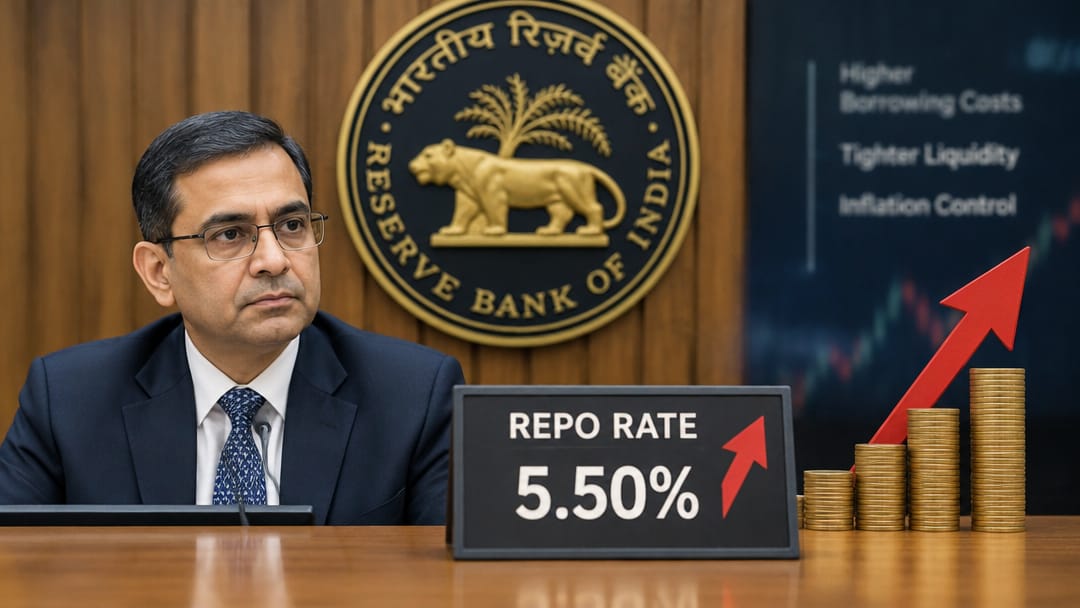
MPC raises repo rate 25 bps to 5.50%, signalling inflation over growth
What happened
The Reserve Bank of India's Monetary Policy Committee, chaired by Governor Sanjay Malhotra, raised the repo rate by 25 basis points to 5.50% on October 7, 2025. The decision reflects the MPC's continued prioritisation of inflation control amid a challenging global environment marked by tight financial conditions. The rate hike transmits upward pressure on bank lending rates, raising borrowing costs for households and firms, and tightening liquidity across the economy.
Why it matters
The repo rate is the rate at which the RBI lends overnight funds to commercial banks under the Liquidity Adjustment Facility (LAF). When the MPC raises it, banks face higher costs for short-term borrowing from the RBI, which they pass on to customers through higher lending rates — mortgages, auto loans, working capital credit all become costlier.
The transmission mechanism works in steps: repo rate rise → bank cost of funds rises → marginal cost of funds-based lending rate (MCLR) rises → retail and corporate loan rates rise → consumption and investment slow → aggregate demand falls → inflationary pressure eases over 3–6 quarters.
India's inflation targeting framework, in force since 2016, mandates the MPC to keep CPI inflation at 4% with a ±2% band (i.e., 2–6%). When inflation threatens to breach the upper tolerance band or stays persistently above target, the MPC is legally obligated to explain its failure and tighten policy.
The LAF corridor defines the policy rate band: the Standing Deposit Facility (SDF) rate forms the floor, the repo rate is the policy anchor in the middle, and the Marginal Standing Facility (MSF) rate forms the ceiling. A repo rate hike shifts the entire corridor upward, tightening systemic liquidity. For NABARD, higher repo rates feed into NABARD's own refinancing rates to rural cooperative banks and RRBs, raising agricultural credit costs at the farm level.
Agriculture budget up 5x in 13 years: ₹27,663 crore to ₹1,40,529 crore
What happened
India's budget for the Department of Agriculture and Farmers Welfare has risen from ₹27,663 crore in 2013-14 to ₹1,40,528.78 crore in 2026-27, a five-fold increase over thirteen years. This growth reflects a sustained policy shift toward rural welfare, food security, and farm income support. Key schemes driving this expansion include PM-KISAN, PM Fasal Bima Yojana, and the National Food Security Mission, alongside structural reforms in credit delivery and allied sectors like fisheries and animal husbandry.
Why it matters
The five-fold rise in agriculture budget allocation is not merely a fiscal headline — it reflects a deliberate policy architecture designed to address India's agrarian distress through multiple instruments simultaneously.
At the core is income support: PM-KISAN provides ₹6,000 per year directly to landholding farmer families, operationalising Direct Benefit Transfer (DBT) at massive scale. This reduces leakage compared to earlier input subsidies and is a standard RBI-angle question on financial inclusion and DBT efficiency.
Risk coverage comes through PM Fasal Bima Yojana (PMFBY), which restructured the crop insurance framework by capping farmer premium contributions and shifting actuarial risk to the government — exam questions often test premium caps (2% for Kharif, 1.5% for Rabi, 5% for horticulture).
Credit delivery has been reformed via the Kisan Credit Card (KCC) scheme, expanded to animal husbandry and fisheries, with the short-term credit limit revised upward. NABARD's refinance role in rural credit is directly linked to this budget expansion.
For UPSC, the governance angle matters: the shift from subsidy-based to rights-based agriculture support, convergence of schemes, and PM-KISAN's role in doubling farmer income. For NABARD, priority sector lending targets, agricultural credit flow, and the RIDF (Rural Infrastructure Development Fund) corpus connect directly. For RBI, the DBT pipeline and Jan Dhan-Aadhaar-Mobile (JAM) trinity link agriculture welfare to financial inclusion architecture.
The allied sectors — fisheries under PM Matsya Sampada Yojana and animal husbandry under PM Rashtriya Pashudhan Vikas Yojana — are increasingly tested as separate scheme questions.
RBI surveys household inflation expectations to feed its bi-monthly policy decisions
What happened
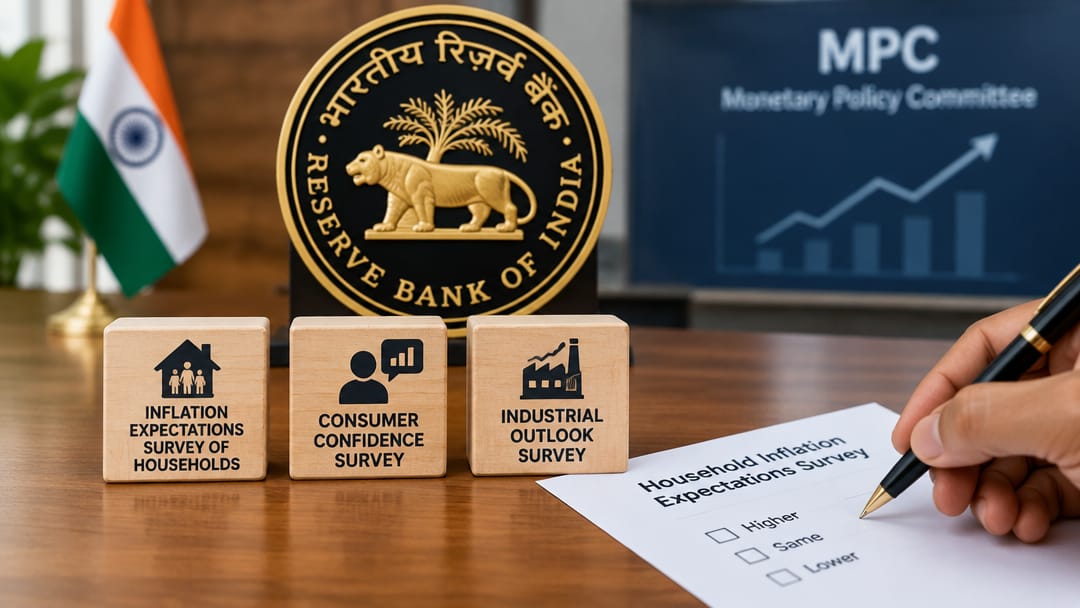
The Reserve Bank of India has launched three surveys — the Inflation Expectations Survey of Households, the Consumer Confidence Survey, and the Industrial Outlook Survey — to gather forward-looking data ahead of its bi-monthly Monetary Policy Committee meeting. These surveys capture household perceptions of current and future inflation, consumer sentiment on economic conditions, and business expectations on output and employment, feeding directly into the MPC's inflation-targeting framework under the flexible inflation targeting mandate.
Why it matters
India's monetary policy operates under a flexible inflation targeting framework, legally established through an amendment to the RBI Act in 2016. The MPC is mandated to maintain CPI inflation at 4%, with a tolerance band of ±2% (i.e., 2%–6%). Rate decisions cannot rely solely on current CPI prints — the MPC must anticipate where inflation is heading. This is where surveys become analytically indispensable.
The Inflation Expectations Survey of Households (IESH) is conducted across 19 cities, covering 6,000 households. It captures whether people expect prices to rise, stabilise, or fall over the next three months and one year. If household expectations become unanchored — meaning people consistently expect high inflation — it becomes self-fulfilling: workers demand higher wages, firms raise prices pre-emptively, and the inflation spiral widens. Central banks therefore watch expectation data as closely as actual CPI.
The Consumer Confidence Survey (CCS) measures sentiment on current economic conditions and one-year-ahead outlook on income, spending, employment, and the general economy. A deteriorating confidence index signals demand compression ahead, which in turn affects the inflation-growth trade-off the MPC must navigate.
The Industrial Outlook Survey captures business expectations on production, order books, employment, and costs — a leading indicator for core inflation pressures.
Together, these three surveys operationalise the 'forward-looking' character of inflation targeting. The examiner tests not just whether you know these surveys exist, but what they measure, why central banks use expectation data, and how they interact with the Taylor Rule logic underlying repo rate decisions.
Jaishankar at G20: protect civilian ships, let developing nations industrialise
What happened
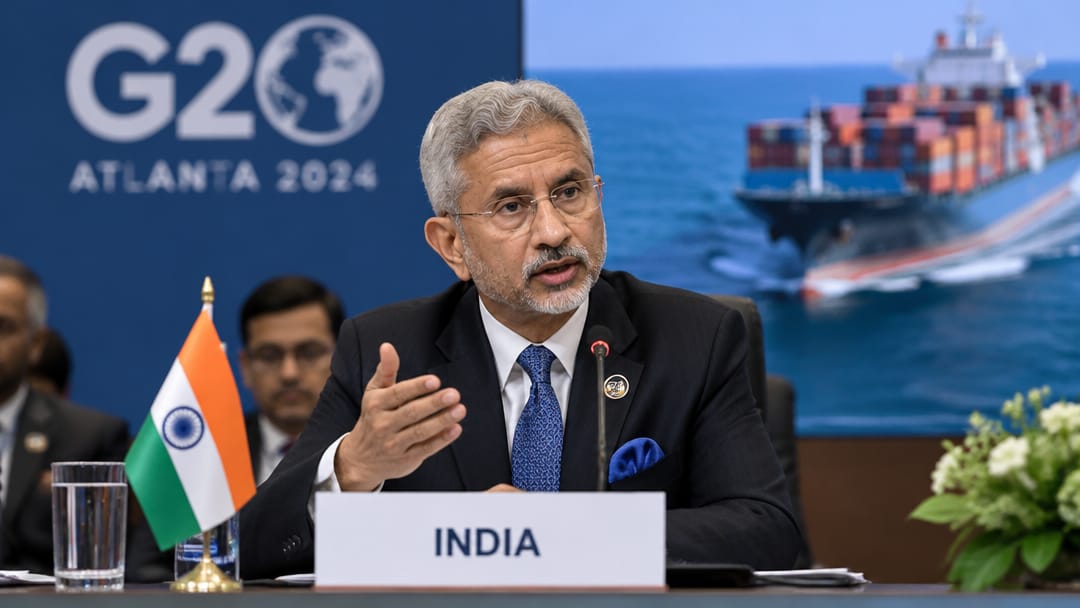
At the G20 meeting in Atlanta, External Affairs Minister S. Jaishankar called for stronger protection of civilian ships and seafarers facing rising conflict risks at sea. In the final session, he defended developing nations' right to industrialise and warned against predatory economic practices. India's position linked maritime security directly to global trade continuity, underscoring that disruptions to shipping lanes disproportionately harm emerging economies dependent on seaborne commerce.
Why it matters
India's statement at the G20 Atlanta meeting sits at the intersection of two distinct but related concerns: maritime security under international law and the economic sovereignty of developing nations.
On maritime security, the backdrop is the surge in attacks on commercial vessels in the Red Sea and Gulf of Aden since late 2023, primarily by Houthi forces targeting shipping linked to Israel. India, as one of the world's largest seafarer-supplying nations (over 240,000 Indian seafarers serve globally, roughly 12% of the world's total), has an acute interest in the safety of civilian vessels. The United Nations Convention on the Law of the Sea (UNCLOS, 1982) guarantees freedom of navigation and requires states to cooperate in suppressing piracy. India's stance aligns with these obligations while calling on the international community to extend them to conflict zones.
On industrialisation rights, Jaishankar's warning against 'predatory practices' references a longstanding Global South argument: that developed nations use trade rules, climate conditionalities, and technology restrictions to prevent developing countries from climbing the industrial value chain. This connects to India's consistent position in multilateral forums — from WTO negotiations to G20 — that equity in global economic governance is non-negotiable.
The G20 itself is the premier forum for international economic cooperation, comprising 19 countries plus the EU and the African Union (added under India's 2023 presidency). The Atlanta meeting, held under the US G20 presidency in 2025, signals continued engagement on trade and maritime issues.
GST to pilot retail e-invoicing from April 2027, extending digital trail to consumers
What happened
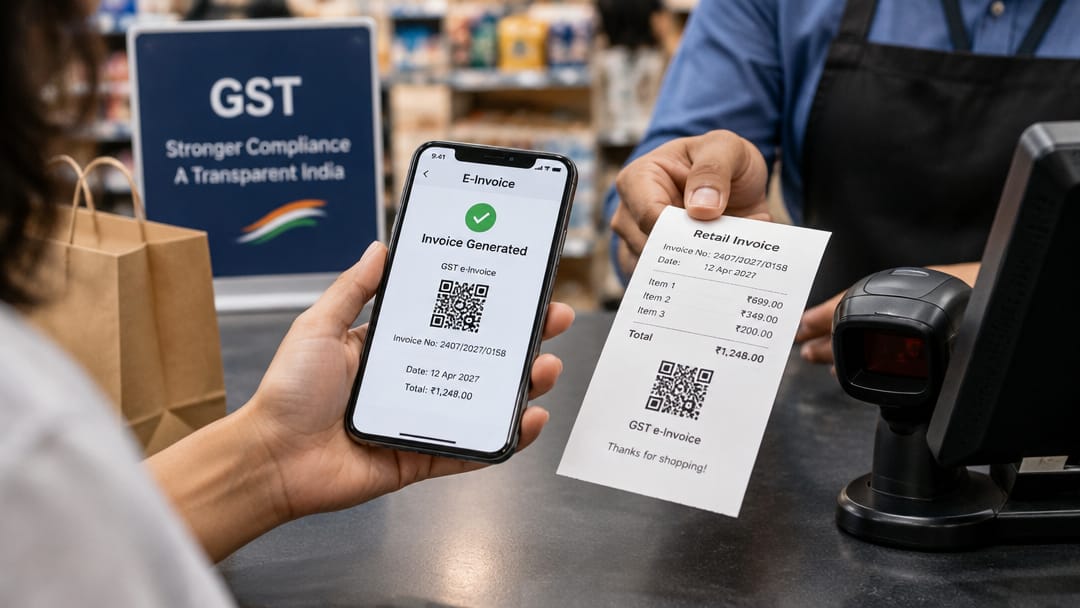
GST authorities are planning a pilot for retail e-invoicing from April 2027, which would electronically record invoices issued by shops and businesses directly to end consumers. Currently, e-invoicing under GST applies only to business-to-business transactions above a certain turnover threshold. Extending it to business-to-consumer retail transactions would significantly widen the GST compliance net, reduce tax evasion at the last mile, and create a verifiable digital audit trail for retail sales across India.
Why it matters
E-invoicing under GST was introduced in October 2020 for large businesses and has been progressively extended to smaller ones. It works by requiring businesses to generate invoices through the Invoice Registration Portal (IRP), which issues a unique Invoice Reference Number (IRN) and QR code. This creates a real-time, tamper-proof record that the GST Network (GSTN) can cross-verify against returns filed by both buyers and sellers.
The critical policy gap has always been the business-to-consumer (B2C) segment. When a retail shop sells to an individual, there is no GST-registered buyer to cross-check the transaction, making suppression of sales easy. Retail e-invoicing would close this gap by electronically capturing B2C transactions at the point of sale itself.
For competitive exams, understand the two-layer significance: (1) Revenue: GST collections have grown from roughly ₹8 lakh crore annually in early years to consistently above ₹20 lakh crore, yet the retail leakage remains large. Retail e-invoicing targets the final, hardest segment. (2) Financial inclusion and formalization: Formalizing retail transactions creates income and expenditure records for small businesses, improving their creditworthiness — a direct NABARD and RBI angle — and enabling better priority sector lending assessments.
The April 2027 pilot date signals a phased, careful rollout rather than an abrupt mandate, consistent with how B2B e-invoicing was itself rolled out in stages from 2020 onward.
CBDT approves tax benefits for 11 research institutions, valid 2026-27 to 2030-31
What happened
The Central Board of Direct Taxes has released a consolidated list approving 11 research institution cases for tax benefits under the Income Tax Act. The approvals cover scientific research associations and institutions, granting them exemptions applicable for five assessment years from 2026-27 to 2030-31. Such approvals allow donors contributing to these bodies to claim weighted deductions, and the institutions themselves to receive tax-exempt status, incentivising private funding of scientific research in India.
Why it matters
Under the Income Tax Act, 1961, Sections 35 and 80GGA provide the legal scaffolding for tax incentives linked to scientific research. Section 35 allows companies and businesses to claim deductions — sometimes weighted at 150% or 200% — for sums paid to approved scientific research associations, universities, or institutions. Section 80GGA allows non-business individuals to claim similar deductions for donations to approved research bodies.
The CBDT, functioning under the Ministry of Finance, is the apex body that administers direct tax laws and must approve institutions before donors can claim these benefits. Approval is time-bound — in this case, five years from AY 2026-27 to AY 2030-31 — meaning institutions must reapply periodically.
This mechanism serves a dual policy purpose: it reduces the tax cost of research funding for corporates and individuals, and it channels private capital toward scientific and social research without direct government expenditure. The government effectively subsidises research through foregone tax revenue.
For exam purposes, the examiner often tests the distinction between Section 35 (business expenditure route) and Section 80GGA (non-business route), the role of CBDT in granting approvals, and the concept of weighted deductions. The five-year approval window is a specific testable datum. UPSC may frame this within fiscal policy and science funding; RBI Grade B may test it as a budget or direct-tax provision with a withheld number.
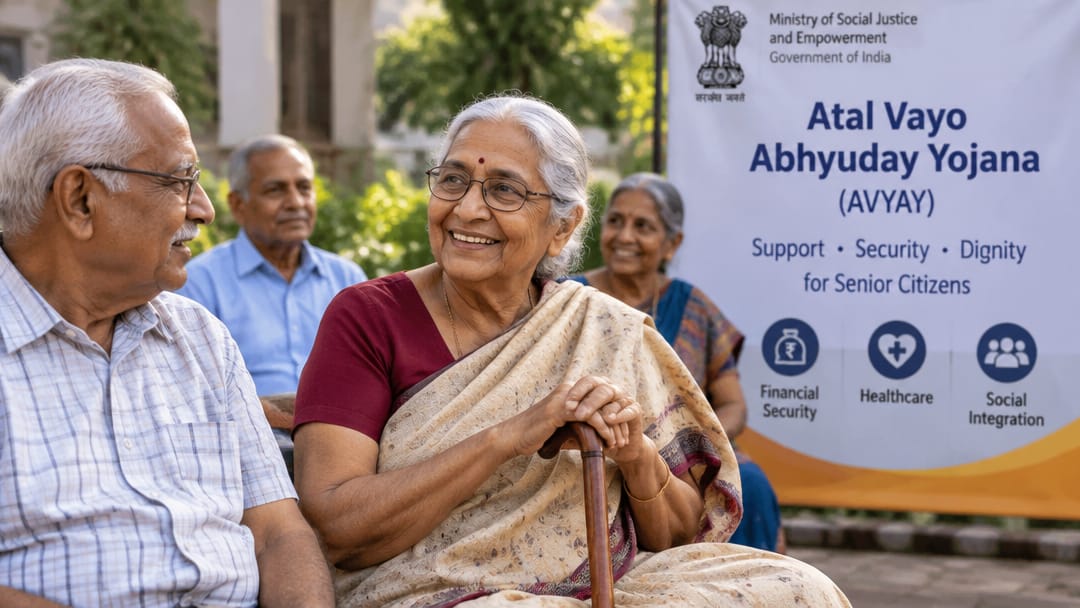
Centre releases ₹77.98 crore to 755 projects under Atal Vayo Abhyuday Yojana
What happened
The Central Government has released ₹77.98 crore as grant-in-aid to 755 projects under the Atal Vayo Abhyuday Yojana (AVYAY), its flagship scheme for elderly welfare. AVYAY, implemented by the Ministry of Social Justice and Empowerment, consolidates multiple sub-schemes targeting senior citizens' financial security, healthcare, and social integration. The release signals active fiscal commitment to India's rapidly ageing population, which is projected to exceed 300 million by 2050.
Why it matters
Atal Vayo Abhyuday Yojana (AVYAY) is an umbrella scheme under the Ministry of Social Justice and Empowerment that replaced the earlier National Action Plan for Senior Citizens. It consolidates several sub-schemes into one administrative framework:
1. Integrated Programme for Senior Citizens (IPSrC): Funds NGOs and organisations to run old-age homes, day care centres, and mobile Medicare units for destitute elderly. 2. Rashtriya Vayoshri Yojana (RVY): Provides assisted-living devices (hearing aids, wheelchairs, spectacles, etc.) free of cost to BPL senior citizens suffering from age-related disabilities. Implemented through ALIMCO (Artificial Limbs Manufacturing Corporation of India). 3. Senior Able Citizens for Re-Employment in Dignity (SACRED): An online platform connecting retired/senior citizens with employment opportunities. 4. Elder Line (14567): India's first pan-India helpline for senior citizens covering legal aid, financial fraud, emotional support, and healthcare guidance.
The grant-in-aid mechanism here is key for NABARD and RBI aspirants: funds flow from the Centre to NGOs and State-registered entities through a project-based competitive grant model, not through direct benefit transfer. This distinguishes AVYAY's delivery architecture from schemes like PM-KISAN or PMJDY.
For UPSC aspirants, AVYAY sits at the intersection of demographic dividend reversal (ageing population), SDG Goal 3 (Good Health and Well-Being), and Article 41 of the Constitution (right to public assistance in old age). India's elderly population (60+) currently stands at approximately 149 million (2024), making elder-care policy a governance priority.