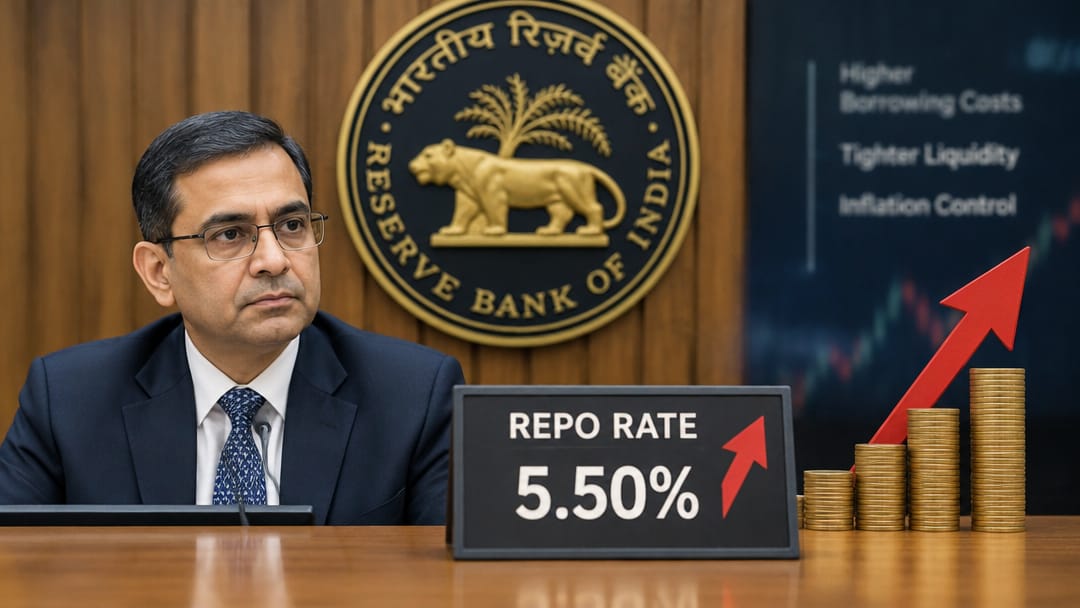
MPC raises repo rate 25 bps to 5.50%, signalling inflation over growth
What happened
The Reserve Bank of India's Monetary Policy Committee, chaired by Governor Sanjay Malhotra, raised the repo rate by 25 basis points to 5.50% on October 7, 2025. The decision reflects the MPC's continued prioritisation of inflation control amid a challenging global environment marked by tight financial conditions. The rate hike transmits upward pressure on bank lending rates, raising borrowing costs for households and firms, and tightening liquidity across the economy.
Why it matters
The repo rate is the rate at which the RBI lends overnight funds to commercial banks under the Liquidity Adjustment Facility (LAF). When the MPC raises it, banks face higher costs for short-term borrowing from the RBI, which they pass on to customers through higher lending rates — mortgages, auto loans, working capital credit all become costlier.
The transmission mechanism works in steps: repo rate rise → bank cost of funds rises → marginal cost of funds-based lending rate (MCLR) rises → retail and corporate loan rates rise → consumption and investment slow → aggregate demand falls → inflationary pressure eases over 3–6 quarters.
India's inflation targeting framework, in force since 2016, mandates the MPC to keep CPI inflation at 4% with a ±2% band (i.e., 2–6%). When inflation threatens to breach the upper tolerance band or stays persistently above target, the MPC is legally obligated to explain its failure and tighten policy.
The LAF corridor defines the policy rate band: the Standing Deposit Facility (SDF) rate forms the floor, the repo rate is the policy anchor in the middle, and the Marginal Standing Facility (MSF) rate forms the ceiling. A repo rate hike shifts the entire corridor upward, tightening systemic liquidity. For NABARD, higher repo rates feed into NABARD's own refinancing rates to rural cooperative banks and RRBs, raising agricultural credit costs at the farm level.
Agriculture budget up 5x in 13 years: ₹27,663 crore to ₹1,40,529 crore
What happened
India's budget for the Department of Agriculture and Farmers Welfare has risen from ₹27,663 crore in 2013-14 to ₹1,40,528.78 crore in 2026-27, a five-fold increase over thirteen years. This growth reflects a sustained policy shift toward rural welfare, food security, and farm income support. Key schemes driving this expansion include PM-KISAN, PM Fasal Bima Yojana, and the National Food Security Mission, alongside structural reforms in credit delivery and allied sectors like fisheries and animal husbandry.
Why it matters
The five-fold rise in agriculture budget allocation is not merely a fiscal headline — it reflects a deliberate policy architecture designed to address India's agrarian distress through multiple instruments simultaneously.
At the core is income support: PM-KISAN provides ₹6,000 per year directly to landholding farmer families, operationalising Direct Benefit Transfer (DBT) at massive scale. This reduces leakage compared to earlier input subsidies and is a standard RBI-angle question on financial inclusion and DBT efficiency.
Risk coverage comes through PM Fasal Bima Yojana (PMFBY), which restructured the crop insurance framework by capping farmer premium contributions and shifting actuarial risk to the government — exam questions often test premium caps (2% for Kharif, 1.5% for Rabi, 5% for horticulture).
Credit delivery has been reformed via the Kisan Credit Card (KCC) scheme, expanded to animal husbandry and fisheries, with the short-term credit limit revised upward. NABARD's refinance role in rural credit is directly linked to this budget expansion.
For UPSC, the governance angle matters: the shift from subsidy-based to rights-based agriculture support, convergence of schemes, and PM-KISAN's role in doubling farmer income. For NABARD, priority sector lending targets, agricultural credit flow, and the RIDF (Rural Infrastructure Development Fund) corpus connect directly. For RBI, the DBT pipeline and Jan Dhan-Aadhaar-Mobile (JAM) trinity link agriculture welfare to financial inclusion architecture.
The allied sectors — fisheries under PM Matsya Sampada Yojana and animal husbandry under PM Rashtriya Pashudhan Vikas Yojana — are increasingly tested as separate scheme questions.
India's 18 biosphere reserves: 13 carry UNESCO recognition, 5 do not
What happened
India observed Biosphere Reserves Day highlighting its network of 18 notified biosphere reserves, of which 13 have been recognised under UNESCO's Man and the Biosphere Programme. These sites serve a triple mandate — conserving biodiversity, supporting scientific research, and sustaining local livelihoods through buffer and transition zones. The Ministry of Environment, Forest and Climate Change is the nodal authority. The gap between total notified reserves and UNESCO-recognised ones is a key number examiners test.
Why it matters
A biosphere reserve is not a standard protected area. Unlike national parks or wildlife sanctuaries — which are purely exclusionary — biosphere reserves operate on a zoned model defined by UNESCO's Man and the Biosphere (MAB) Programme launched in 1971. Each reserve has three concentric zones: a core zone (strictly protected, no human activity), a buffer zone (limited research and education), and a transition or cooperation zone (sustainable human use, local communities, tourism). This design is what makes them distinct from Tiger Reserves or Ramsar sites in examination contexts.
India's 18 biosphere reserves are notified by the central government under the Environment (Protection) Act, but UNESCO recognition is a separate, higher-prestige designation awarded by the MAB Programme's International Coordinating Council. India currently has 13 UNESCO-recognised sites, making it one of the larger national networks globally.
For exam purposes, the critical distinctions are: (1) biosphere reserves vs. wildlife sanctuaries vs. national parks — the legal authority and purpose differ; (2) UNESCO MAB recognition is not automatic — India has 5 reserves that are nationally notified but not yet internationally recognised; (3) the nodal ministry is MoEFCC; (4) biosphere reserves support sustainable livelihoods, which connects them directly to rural development themes tested in NABARD exams. The overlap of biosphere reserves with Ramsar sites, Tiger Reserves, and biodiversity hotspots is a classic multi-layered UPSC question trap.
RBI surveys household inflation expectations to feed its bi-monthly policy decisions
What happened
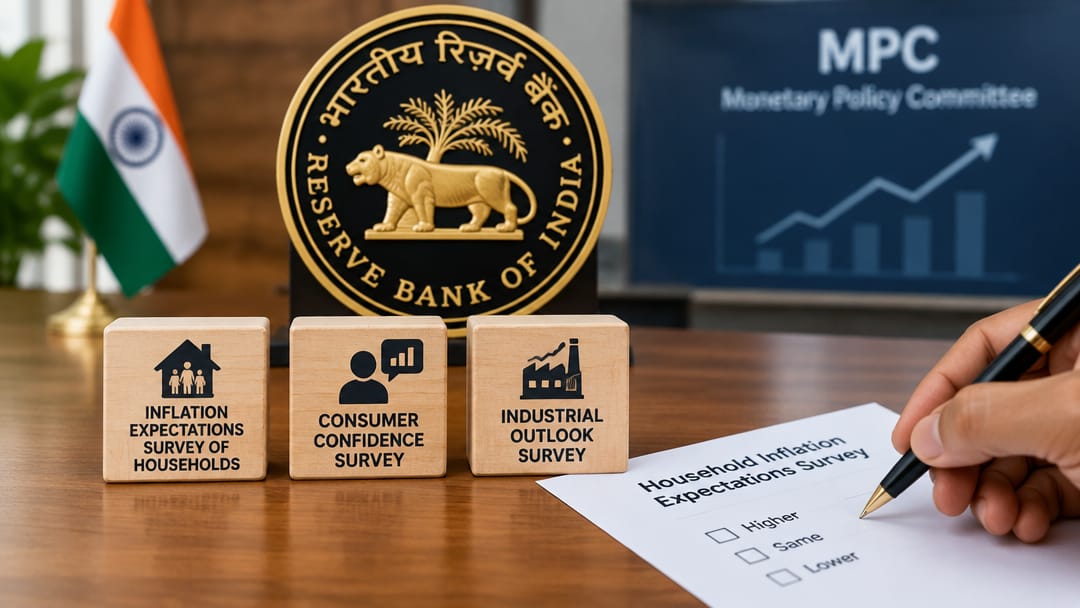
The Reserve Bank of India has launched three surveys — the Inflation Expectations Survey of Households, the Consumer Confidence Survey, and the Industrial Outlook Survey — to gather forward-looking data ahead of its bi-monthly Monetary Policy Committee meeting. These surveys capture household perceptions of current and future inflation, consumer sentiment on economic conditions, and business expectations on output and employment, feeding directly into the MPC's inflation-targeting framework under the flexible inflation targeting mandate.
Why it matters
India's monetary policy operates under a flexible inflation targeting framework, legally established through an amendment to the RBI Act in 2016. The MPC is mandated to maintain CPI inflation at 4%, with a tolerance band of ±2% (i.e., 2%–6%). Rate decisions cannot rely solely on current CPI prints — the MPC must anticipate where inflation is heading. This is where surveys become analytically indispensable.
The Inflation Expectations Survey of Households (IESH) is conducted across 19 cities, covering 6,000 households. It captures whether people expect prices to rise, stabilise, or fall over the next three months and one year. If household expectations become unanchored — meaning people consistently expect high inflation — it becomes self-fulfilling: workers demand higher wages, firms raise prices pre-emptively, and the inflation spiral widens. Central banks therefore watch expectation data as closely as actual CPI.
The Consumer Confidence Survey (CCS) measures sentiment on current economic conditions and one-year-ahead outlook on income, spending, employment, and the general economy. A deteriorating confidence index signals demand compression ahead, which in turn affects the inflation-growth trade-off the MPC must navigate.
The Industrial Outlook Survey captures business expectations on production, order books, employment, and costs — a leading indicator for core inflation pressures.
Together, these three surveys operationalise the 'forward-looking' character of inflation targeting. The examiner tests not just whether you know these surveys exist, but what they measure, why central banks use expectation data, and how they interact with the Taylor Rule logic underlying repo rate decisions.
Nagaland minister calls for stricter enforcement of Wildlife Protection Act, 1972
What happened
Nagaland's Environment, Forests and Climate Change Minister CL John has called for effective implementation of the Wildlife Protection Act, 1972, highlighting enforcement gaps in the state. The appeal comes amid ongoing concerns about poaching and habitat destruction in Northeast India, a biodiversity hotspot. The Wildlife Protection Act governs protection of wild animals, birds, and plants, and establishes the framework for protected areas including wildlife sanctuaries and national parks across India.
Why it matters
The Wildlife Protection Act, 1972 (WPA) is the foundational statute for wildlife conservation in India. Enacted before India's constitutional 42nd Amendment (1976) placed 'forests' and 'protection of wild animals and birds' in the Concurrent List, the WPA was originally a central law under Entry 97 of the Union List. Post-1976, it operates under the Concurrent List (Entry 17A and 17B), meaning both Parliament and state legislatures can legislate, but central law prevails on repugnancy.
The Act creates six categories of protected areas: National Parks, Wildlife Sanctuaries, Conservation Reserves, Community Reserves, Tiger Reserves (under Project Tiger), and closed areas. Schedule I and Part II of Schedule II animals receive the highest protection — hunting them is an absolute offence with no exceptions. Schedules I through VI classify species by protection level, with Schedule VI protecting specified plants.
The 2022 Amendment to the WPA was significant: it reduced the Schedules from six to four, implemented CITES obligations domestically, and introduced provisions for invasive alien species. The National Board for Wildlife (NBWL), chaired by the Prime Minister, is the apex advisory body. The Chief Wildlife Warden in each state is the primary enforcement authority.
Northeast India, including Nagaland, sits within the Indo-Burma biodiversity hotspot — one of only 36 globally recognised biodiversity hotspots. Nagaland's Intanki National Park and Fakim Wildlife Sanctuary fall under WPA protections. The call by Minister CL John directly engages the state's obligation under the Concurrent List framework to enforce central wildlife law.
GST to pilot retail e-invoicing from April 2027, extending digital trail to consumers
What happened
GST authorities are planning a pilot for retail e-invoicing from April 2027, which would electronically record invoices issued by shops and businesses directly to end consumers. Currently, e-invoicing under GST applies only to business-to-business transactions above a certain turnover threshold. Extending it to business-to-consumer retail transactions would significantly widen the GST compliance net, reduce tax evasion at the last mile, and create a verifiable digital audit trail for retail sales across India.
Why it matters
E-invoicing under GST was introduced in October 2020 for large businesses and has been progressively extended to smaller ones. It works by requiring businesses to generate invoices through the Invoice Registration Portal (IRP), which issues a unique Invoice Reference Number (IRN) and QR code. This creates a real-time, tamper-proof record that the GST Network (GSTN) can cross-verify against returns filed by both buyers and sellers.
The critical policy gap has always been the business-to-consumer (B2C) segment. When a retail shop sells to an individual, there is no GST-registered buyer to cross-check the transaction, making suppression of sales easy. Retail e-invoicing would close this gap by electronically capturing B2C transactions at the point of sale itself.
For competitive exams, understand the two-layer significance: (1) Revenue: GST collections have grown from roughly ₹8 lakh crore annually in early years to consistently above ₹20 lakh crore, yet the retail leakage remains large. Retail e-invoicing targets the final, hardest segment. (2) Financial inclusion and formalization: Formalizing retail transactions creates income and expenditure records for small businesses, improving their creditworthiness — a direct NABARD and RBI angle — and enabling better priority sector lending assessments.
The April 2027 pilot date signals a phased, careful rollout rather than an abrupt mandate, consistent with how B2B e-invoicing was itself rolled out in stages from 2020 onward.
GST registration amendments from Nov 2026 add online verification for business premises
What happened
From November 1, 2026, India's GST registration rules will require online verification of a taxpayer's Principal Place of Business during amendment applications. The updated procedure mandates digital approval workflows, replacing or supplementing earlier physical verification steps. Businesses seeking to amend registration details — particularly their primary business address — must comply with the new online process. The changes aim to reduce fraudulent registrations and fake input tax credit claims that have undermined GST revenue collections in recent years.
Why it matters
GST registration is the gateway through which businesses enter the formal tax system. The Principal Place of Business (PPOB) is the primary address a taxpayer declares when registering — it determines jurisdictional authority, state-level revenue allocation, and eligibility for input tax credit (ITC). Fraudulent registrations, often using fake or non-existent addresses, have been a persistent problem enabling bogus ITC claims that drain government revenues.
The 2026 amendment introduces mandatory online verification at the amendment stage — not just at initial registration. This closes a loophole where genuine initial registrations were later amended to point to non-existent premises, allowing shell entities to claim ITC fraudulently.
For NABARD aspirants, the GST-agriculture nexus matters: GST collections fund central transfers including those to NABARD-linked rural schemes. Higher compliance means better GST revenue, which supports the fiscal space for rural credit programmes, PM-KISAN transfers, and cooperative bank refinancing through NABARD. Additionally, agricultural input dealers — selling fertilisers, pesticides, seeds — are registered GST entities; tighter registration rules affect their compliance burden and credit access from cooperative banks.
The move also reflects India's broader digitisation of tax administration, connecting to themes the NABARD exam tests around financial inclusion, digital banking, and rural formalisation.
Centre releases ₹77.98 crore to 755 projects under Atal Vayo Abhyuday Yojana
What happened
The Central Government has released ₹77.98 crore as grant-in-aid to 755 projects under the Atal Vayo Abhyuday Yojana (AVYAY), its flagship scheme for elderly welfare. AVYAY, implemented by the Ministry of Social Justice and Empowerment, consolidates multiple sub-schemes targeting senior citizens' financial security, healthcare, and social integration. The release signals active fiscal commitment to India's rapidly ageing population, which is projected to exceed 300 million by 2050.
Why it matters
Atal Vayo Abhyuday Yojana (AVYAY) is an umbrella scheme under the Ministry of Social Justice and Empowerment that replaced the earlier National Action Plan for Senior Citizens. It consolidates several sub-schemes into one administrative framework:
1. Integrated Programme for Senior Citizens (IPSrC): Funds NGOs and organisations to run old-age homes, day care centres, and mobile Medicare units for destitute elderly. 2. Rashtriya Vayoshri Yojana (RVY): Provides assisted-living devices (hearing aids, wheelchairs, spectacles, etc.) free of cost to BPL senior citizens suffering from age-related disabilities. Implemented through ALIMCO (Artificial Limbs Manufacturing Corporation of India). 3. Senior Able Citizens for Re-Employment in Dignity (SACRED): An online platform connecting retired/senior citizens with employment opportunities. 4. Elder Line (14567): India's first pan-India helpline for senior citizens covering legal aid, financial fraud, emotional support, and healthcare guidance.
The grant-in-aid mechanism here is key for NABARD and RBI aspirants: funds flow from the Centre to NGOs and State-registered entities through a project-based competitive grant model, not through direct benefit transfer. This distinguishes AVYAY's delivery architecture from schemes like PM-KISAN or PMJDY.
For UPSC aspirants, AVYAY sits at the intersection of demographic dividend reversal (ageing population), SDG Goal 3 (Good Health and Well-Being), and Article 41 of the Constitution (right to public assistance in old age). India's elderly population (60+) currently stands at approximately 149 million (2024), making elder-care policy a governance priority.